Professional Agri-Forestry Industry Insights | Global Intelligence Leader

The Evolution of High-Density Rearing: Structural Mechanics in Modern Battery Cages





The global commercial egg production sector is currently navigating an unprecedented era of transformation. Driven by exploding international protein demand, diminishing arable land availability, and strictly enforced biosecurity regulations, poultry farm operators can no longer rely on traditional, extensive free-range or rudimentary barn rearing methods. To meet the voracious demands of the global supply chain, modern egg production has evolved into a highly precise, technologically advanced industrial operation.
At the epicenter of this agricultural revolution is the modernization of avian containment infrastructure. Transitioning a commercial farm into a multi-tier, high-density production facility requires massive capital expenditure and a profound understanding of structural mechanics, thermodynamics, and animal welfare engineering. This comprehensive technical report dissects the advanced engineering principles driving modern avian housing, focusing on the metallurgical integrity, spatial design, and automated manure management systems required to safely maximize yield in commercial layer operations.
The Paradigm Shift to Vertical Density
To understand the necessity of advanced structural engineering in poultry farming, one must first examine the economic pressures driving the industry. Land acquisition costs and the energy required to heat and cool massive commercial barns are the two primary financial burdens for any egg-producing enterprise.
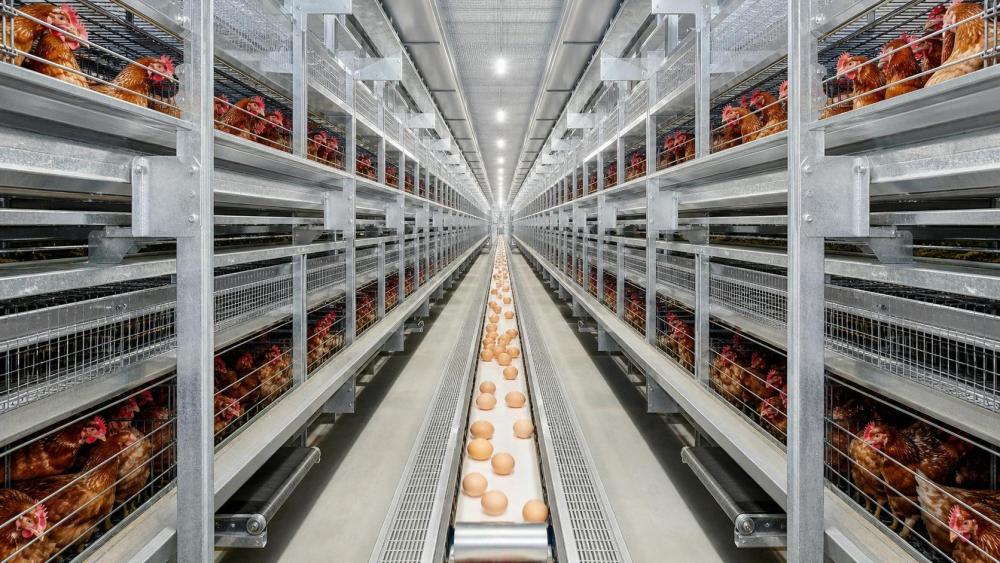
By transitioning from a single-level floor operation to a vertical, multi-tier containment system, a facility can exponentially multiply its bird capacity within the exact same building footprint. A barn that historically housed 10,000 birds can easily accommodate 50,000 to 100,000 layers utilizing a four-tier or six-tier vertical infrastructure. However, this massive aggregation of living, breathing biological mass creates immense structural and thermodynamic challenges. The physical weight of tens of thousands of birds, combined with the extreme torque of automated feeding chains and massive manure belts, places unprecedented stress on the metal framework holding the system together.
Structural Metallurgy and Anti-Corrosion Technologies
A commercial poultry barn is a hyper-corrosive environment. The continuous exhalation of the birds, combined with the rapid accumulation of ammonia-rich manure, creates a highly acidic, humid microclimate. If the containment infrastructure is manufactured from inferior materials, catastrophic structural failure is inevitable.
To combat this aggressive chemical degradation, top-tier engineering standards mandate the use of hot-dip galvanized steel for all structural components and mesh wiring. The galvanization process bonds a thick, self-healing layer of zinc to the underlying steel matrix, creating a robust shield against ammonia-induced pitting corrosion.
When facility directors execute procurement strategies for a new
Thermodynamic Airflow and Microclimate Synchronization
One of the most complex engineering hurdles in high-density vertical rearing is maintaining thermodynamic equilibrium across all tiers. Because heat and ammonia gas naturally rise, the birds housed in the uppermost tiers are at extreme risk of heat stress, hyperventilation, and respiratory distress, while the birds in the bottom tiers may suffer from stagnant air and localized chilling.
Modern multi-tier systems are explicitly designed to integrate with highly synchronized, automated ventilation arrays. The mesh wire partitions between adjacent containment units are mathematically calibrated to provide maximum tensile strength while creating minimal drag resistance against the barn’s longitudinal airflow.
Furthermore, advanced setups incorporate negative-pressure tunnel ventilation. Massive exhaust fans pull fresh air from evaporative cooling pads at one end of the barn, drawing a high-velocity curtain of chilled air directly through the wire mesh of the tiers. This precise thermodynamic design continuously evacuates the kinetic heat generated by the birds’ metabolism, ensuring that a layer resting on the first tier experiences the exact same microclimate as a layer on the sixth tier.
Automated Manure Evacuation and Biosecurity
In the context of intensive livestock farming, aggressive manure management is the fundamental cornerstone of biosecurity and disease prevention. The traditional accumulation of feces on the barn floor provides an optimal breeding ground for highly pathogenic avian influenza (HPAI), coccidiosis, and extreme ammonia volatilization.
Modern vertical systems completely eradicate this hazard through the implementation of continuous polypropylene (PP) manure belts. Located beneath the wire floor of every single tier, these motorized belts physically capture the manure immediately after it is excreted.
The structural mechanics driving these belts are astonishingly complex. A single belt stretching 100 meters down the length of the barn must handle the cumulative weight of thousands of kilograms of wet manure without snapping, sagging, or derailing. High-torque variable frequency drive (VFD) motors power massive cast-iron drive rollers, systematically evacuating the waste from the barn on a daily or bi-weekly basis. This rapid, automated removal process drastically lowers the ambient ammonia concentration, radically improves the respiratory health of the flock, and prevents the rampant spread of biological pathogens across the facility.
Egg Collection Kinetics and Defect Mitigation
The ultimate metric of success in a commercial layer operation is not merely the volume of eggs produced, but the percentage of viable, intact, Grade-A eggs that successfully reach the packing room. In a facility housing 50,000 birds, manually collecting eggs is logistically impossible.
Vertical containment units rely on precise geometric slopes integrated into the bottom mesh flooring. When an egg is laid, it gently rolls out of the immediate containment area, passing under a protective baffle to rest safely on a centralized, automated egg collection belt.
The angle of this floor slope is a masterpiece of ergonomic engineering. If the angle is too steep, the egg gains too much kinetic velocity and shatters upon impacting the collection belt; if the angle is too shallow, the egg remains in the containment area, risking pecking damage or contamination from the birds. Furthermore, the longitudinal collection belts must operate with absolute zero-vibration synchronization, seamlessly transferring thousands of fragile eggs to cross-conveyors and central elevators without inflicting micro-cracks on the calcium carbonate shells.
Conclusion
The shift towards highly mechanized, vertically integrated avian rearing represents a permanent evolution in global agriculture. A commercial containment system is no longer just a passive wire structure; it is an incredibly complex fusion of metallurgical endurance, thermodynamic precision, and automated logistics.
For agribusiness executives and farm operators seeking to scale their production to meet international demand, understanding the intense engineering mechanics behind these systems is non-negotiable. By prioritizing hot-dip galvanized anti-corrosion technology, intelligent ventilation synchronization, and robust automated waste evacuation, poultry enterprises can successfully transition from outdated farming models into highly profitable, biosecure, and efficient modern industrial powerhouses.
Related News
- 00
0000-00
How to Evaluate Livestock Automation Systems for Labor Savings and Animal Welfare - 00
0000-00
What Determines the Startup Budget for 1,000 Broilers in Nigeria? - 00
0000-00
How Poultry Cage Material and Design Affect Long-Term Farming Costs in Nigeria - 00
0000-00
Matching Automatic Chicken Cage Capacity to Layer Farm Scale - 00
0000-00
Poultry Cage in Nigeria: Matching A-Type Systems to Layer Farm Scale
Livestock Industry Editorial Team
Weekly Insights
Stay ahead with our curated technology reports delivered every Monday.