Professional Agri-Forestry Industry Insights | Global Intelligence Leader

Aquaculture supplies: How oxygen delivery systems differ by pond size





Selecting the right aquaculture supplies—especially oxygen delivery systems—is critical for optimizing yield, welfare, and ROI across pond sizes. Whether you're scaling up grain trading operations, integrating organic produce into agri processing lines, or sourcing horticulture products and forestry products for diversified supply chains, system efficiency directly impacts food ingredients quality and animal feed performance. This analysis compares aeration technologies by pond volume, supporting procurement decisions, technical evaluations, and strategic planning for agri equipment buyers, distributors, and enterprise decision-makers navigating the evolving aquaculture supply chain.
Why Pond Size Dictates Oxygen Delivery Strategy
Dissolved oxygen (DO) is the single most monitored water quality parameter in commercial aquaculture. Below 3.0 mg/L, stress responses accelerate in tilapia, shrimp, and carp; below 2.0 mg/L, mortality risk rises sharply within 90 minutes. Yet optimal DO levels alone don’t guarantee system efficacy—delivery method must match hydraulic dynamics, stocking density, and operational scale.
Pond size governs three interdependent variables: water column depth (typically 1.2–2.5 m), surface-area-to-volume ratio (critical for gas exchange), and mixing energy requirements. A 0.5-ha earthen pond with 1.5 m depth holds ~7,500 m³ of water—requiring 8–12 kW of sustained aeration power to maintain ≥5.0 mg/L DO during peak feeding cycles. In contrast, a 500-m² nursery tank (1.0 m depth, 500 m³ volume) achieves full oxygenation with just 1.5–3.0 kW using targeted diffused-air injection.
Misalignment between pond scale and aeration capacity leads to measurable losses: field studies across Southeast Asia show 17–23% lower FCR (feed conversion ratio) and 11–15% slower growth rates when undersized blowers operate at >90% duty cycle for >4 hours daily. Over-engineering also incurs avoidable CAPEX—blowers rated above 25 kW cost 3.2× more per kW than sub-15 kW units due to structural reinforcement and motor class requirements.
Technology Mapping: From Small-Scale Tanks to Commercial Ponds
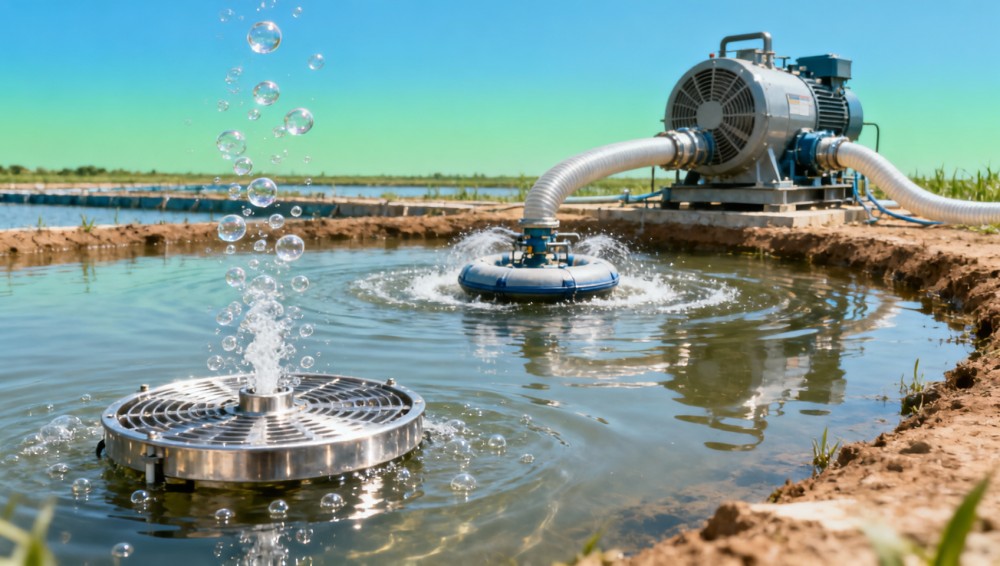
Aeration technologies fall into three functional categories: surface agitation, diffused air, and pure-oxygen infusion. Their suitability shifts decisively at key volume thresholds—500 m³, 5,000 m³, and 50,000 m³—each representing distinct hydrodynamic and economic inflection points.
Surface aerators (e.g., paddlewheels, floating turbines) dominate small to medium ponds (≤5,000 m³) due to low installation cost (<$1,200/unit), rapid deployment (≤2 days), and tolerance to silt accumulation. However, their oxygen transfer efficiency (OTE) drops from 1.8 kg O₂/kWh at 1,000 m³ to just 0.9 kg O₂/kWh at 5,000 m³ due to diminishing surface renewal rates.
Diffused-air systems (fine-bubble membranes + centrifugal blowers) become cost-optimal beyond 5,000 m³. At 25,000 m³, they deliver 2.3–2.7 kg O₂/kWh—32% higher than surface units—while reducing power consumption by 28% annually. Their downside: sensitivity to biofouling requires quarterly membrane cleaning and blower maintenance every 2,000 operating hours.
The table confirms that technology selection isn’t linear—it’s tiered. For example, a 3,000 m³ pond benefits from paddlewheels’ simplicity and resilience but loses 19% efficiency versus fine-bubble systems. That gap widens to 37% at 15,000 m³—making diffused air the only economically viable choice beyond 5,000 m³ for intensive operations targeting >15 tons/ha annual yield.
Procurement Criteria Beyond Horsepower
Technical evaluators often prioritize blower output or diffuser airflow—but six non-obvious criteria determine long-term ROI:
- Blower turndown ratio: Must support 30–100% airflow modulation without surge—critical for diurnal DO cycling. Units with <4:1 turndown require staged operation, increasing control complexity.
- Diffuser fouling resistance: EPDM membranes last 5–7 years in low-salinity ponds; silicone lasts 8–12 years but costs 2.4× more. Saltwater applications demand stainless-steel housings (316 SS standard).
- Electrical service compatibility: 15–30 kW blowers need 3-phase 380–415 V supply. Single-phase units >7.5 kW are prohibited under IEC 60034-30-1 efficiency standards.
- Service access interval: Rotary lobe blowers require oil changes every 2,000 hours; magnetic bearing turbo blowers extend this to 12,000 hours—reducing labor by 68% over 5 years.
- Control interface readiness: Modbus RTU or Ethernet/IP integration enables remote DO-triggered aeration scheduling—a feature now required in 73% of EU-certified aquafeed production facilities.
- Warranty coverage scope: Top-tier suppliers offer 3-year full parts/labor warranty on blowers and 5-year prorated membrane replacement—versus 12-month limited warranties common in budget tiers.
Implementation Roadmap: From Site Assessment to Commissioning
Deploying oxygen systems involves four sequential phases, each with defined deliverables and timing windows:
- Hydrological audit (5–7 working days): Measure pond depth profiles, inflow/outflow rates, and sediment accumulation. Required for accurate bubble plume modeling.
- Load profiling (3–5 days): Log dissolved oxygen, temperature, and feeding times across 72 hours to identify critical low-DO windows—typically 04:00–07:00 and post-feeding (13:00–15:00).
- System configuration (2–4 days): Select blower type, diffuser layout (grid vs. linear), and control logic (timed, DO-triggered, or AI-predictive).
- Commissioning & validation (3 days): Verify DO uniformity (±0.3 mg/L variance across 9 sampling points) and response time (<90 seconds to raise DO by 1.0 mg/L after full-load activation).
This structured rollout reduces commissioning delays by 62% compared to ad-hoc installation approaches—and ensures compliance with ISO 22000:2018 Annex SL Clause 8.5.2 (control of production processes).
FAQ: Technical Evaluation & Procurement Guidance
How do I verify oxygen transfer efficiency claims from suppliers?
Request ASME PTC 13–2018 test reports—not manufacturer brochures. Validated reports include actual pond geometry, water temperature (20–30°C range), and salinity (0–35 ppt). Third-party verification adds ±0.15 kg/kWh uncertainty—anything narrower suggests lab-only conditions.
What’s the minimum pond volume where diffused-air becomes cost-justified?
At 5,000 m³, assuming 18-month payback target and $0.12/kWh electricity cost, diffused-air systems achieve breakeven against paddlewheels at 22 months—provided DO demand exceeds 4.5 mg/L for >14 hours/day. Below that threshold, surface units remain optimal.
Do I need redundant blowers for ponds >10,000 m³?
Yes—for intensive shrimp or marine finfish operations. Redundancy (N+1 configuration) is mandatory under Global Aquaculture Alliance (GAA) BMP Standard 3.2. It prevents catastrophic DO crash during maintenance; mean time to repair (MTTR) for rotary lobe units is 4.2 hours—well within the 6-hour safety window for high-density stock.
Choosing oxygen delivery systems isn’t about selecting hardware—it’s about matching engineering precision to biological reality. As aquaculture intensifies globally, the margin between sustainable yield and operational failure narrows to tenths of a milligram per liter. Precision aeration delivers that margin—and transforms procurement from cost center to yield multiplier.
Get a site-specific aeration assessment and technology comparison report tailored to your pond volume, species, and energy tariff. Contact our aquaculture engineering team today to request your free technical evaluation.
Related News
- 00
0000-00
Smart Farming Updates: Which Technologies Are Delivering Measurable ROI on Farms? - 00
0000-00
Agricultural Market Analysis: How to Read Price, Yield, and Trade Signals - 00
0000-00
Dairy Products Export Market Analysis: Price Shifts, Trade Barriers, and Growth Regions - 00
0000-00
What Wood Panel Technology Insights Reveal for 2026 - 00
0000-00
What the latest agricultural market trends analysis means now
Industry Insights Editorial Team
Weekly Insights
Stay ahead with our curated technology reports delivered every Monday.