Professional Agri-Forestry Industry Insights | Global Intelligence Leader

What Determines the Startup Budget for 1,000 Broilers in Nigeria?





A 1,000-broiler project is often described as a “small” poultry operation, but it is large enough for weak budgeting assumptions to become expensive. For a financial approver, the central question is not simply the purchase price of chicks, feed, or equipment. It is whether the proposed budget covers the full path from site preparation to the point at which birds can be sold, including delays, mortality, price movements, and working-capital pressure.
There is no single reliable figure for a 1,000-bird startup budget in Nigeria. Costs differ by location, housing condition, production system, feed source, equipment specification, financing method, and the level of contingency included. A plan that appears inexpensive may only be excluding essential items: water storage, drainage, wiring, litter, transport, staff costs, or a reserve for a delayed market sale.
The more useful approach is to separate one-time establishment costs from cycle-based operating costs, then assess whether the business can complete at least one production cycle without relying on unplanned borrowing.
Start with the budget boundary, not a headline number
Before approving any estimate, management should define what “startup” includes. Some proposals count only day-old chicks, feed, medication, and basic housing. Others include land acquisition, a borehole, a generator, a perimeter fence, staff accommodation, office costs, and delivery vehicles. Both can be called a startup budget, yet they describe very different investments.
For a 1,000-broiler operation, it is helpful to use three separate budget views:
- Minimum operational budget: the cash needed to place birds and complete one cycle where an existing, functional poultry house is already available.
- Farm establishment budget: the cost of making a site ready, including housing repairs or construction, water, electricity, drainage, storage, and essential equipment.
- Resilient startup budget: establishment costs plus operating cash, contingency, and enough liquidity to absorb a realistic disruption without stopping the cycle.
Confusion between these categories is a common approval risk. A low-cost proposal may be acceptable only when the business already owns suitable infrastructure and can use it without major repairs. If a new house must be built, the same operating plan should not be presented as if it were a simple chick-and-feed purchase.
Recurring costs usually determine whether the project remains financeable
Broiler farming converts feed, housing conditions, labour, water, heat management, and animal-health control into saleable live birds or dressed chickens. Most of the cash exposure sits in recurring inputs rather than in the initial purchase of drinkers or feeders. Feed is usually the largest cost line, which makes feed procurement assumptions more consequential than small differences in the price of hand tools.
A financial model should calculate feed requirement from the intended sales weight, expected growth period, feed programme, and a conservative allowance for wastage. It should not simply multiply a quoted bag price by an arbitrary number of bags. The buyer should ask which feed phases are included, whether delivery is included, how feed will be stored, and whether the quotation remains valid long enough for the procurement schedule.
Day-old chick pricing needs similar scrutiny. The quoted unit price may not include transport to the farm, crates, unloading losses, or timing risk. Chicks arriving after prolonged transport, or arriving before the brooding area is ready, can increase early losses and weaken uniformity. A lower chick price is not automatically a lower biological or financial risk.
Other recurring lines should be visible rather than absorbed into a vague “miscellaneous” item:
The project should also retain working capital after the birds are placed. A budget that reaches zero immediately after chick placement gives management little room to respond to a feed-price change, generator repair, water disruption, or delayed customer payment.
Housing and utilities change the risk profile more than many budgets show
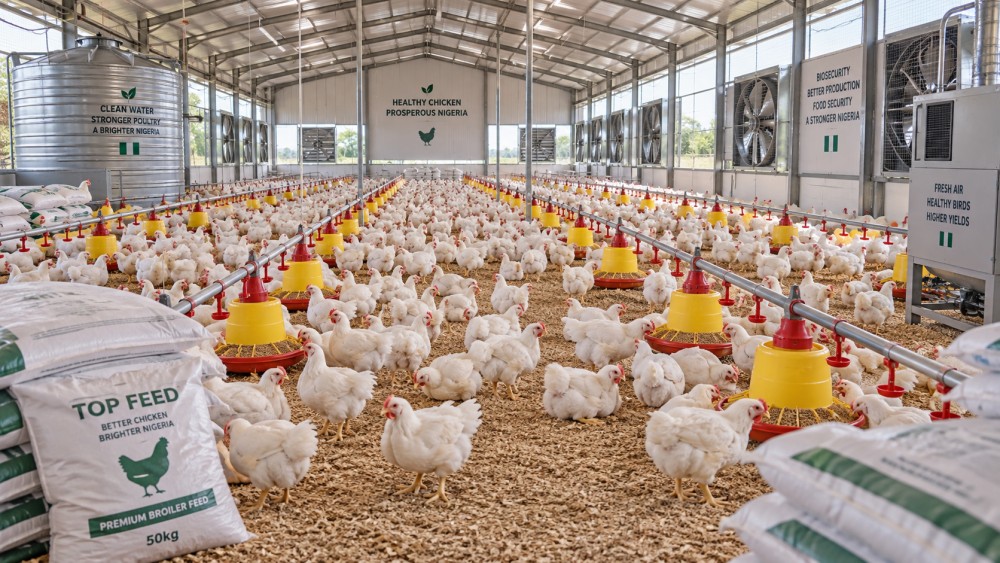
For broilers, the house is not merely a shelter. It controls ventilation, litter condition, heat retention during brooding, bird density, cleaning access, and the ability to maintain separation from visitors and other livestock. The cost of a structure depends on whether the plan uses an existing building, renovates an old poultry house, constructs a naturally ventilated open-sided house, or installs more controlled environmental equipment.
A low-cost building can become costly if it is difficult to clean, has poor drainage, permits rainwater intrusion, or cannot support adequate airflow. Conversely, an expensive construction package may be difficult to justify for a 1,000-bird pilot if its capacity and operating requirements far exceed the planned scale. The investment case should link each construction item to a practical requirement: bird welfare, cleaning, security, water control, worker access, or a measurable reduction in operating risk.
Water deserves its own line item. The farm needs a dependable source, storage capacity, plumbing, drinker connections, and a cleaning routine. Approvers should distinguish between a water source that exists and one that can reliably supply the house during dry periods, power interruptions, or high-demand brooding periods. A borehole, tank, pump, filtration arrangement, or public supply connection may each produce a different capital and maintenance profile.
Electricity planning should be equally specific. The budget should identify which loads are essential: lighting, pumping, ventilation equipment, heating controls, cold storage if used, and security. If a generator is proposed, the financial model needs fuel, servicing, spare parts, and realistic run-time assumptions. Where electrical work is required, it should be included as a scoped installation item rather than treated as a minor contingency.
Equipment should be specified around flock management, not bought as a generic package
Feeders, drinkers, brooders, water tanks, pipes, curtains, weighing tools, litter equipment, and cleaning tools may appear straightforward, but they affect labour, feed wastage, water hygiene, and the ability to monitor flock performance. The question is not whether equipment is “automatic” or “manual”; it is whether it suits the house layout, available utilities, labour capability, and maintenance capacity.
Manual or semi-automatic systems can be workable at this scale where trained staff are available and daily inspection is disciplined. Their lower upfront cost may be appropriate for a first cycle. Yet the business should still assess the hidden labour requirement and the possibility of uneven access to feed or water. More mechanised equipment may reduce repetitive handling, but its value depends on reliable power, correct installation, available parts, and the operator’s ability to maintain it.
When reviewing equipment quotations, finance teams can request a simple acceptance schedule covering quantity, material description, dimensions where relevant, delivery scope, installation responsibility, missing components, and warranty terms if offered. For drinker lines and water-related components, compatibility with the planned water pressure and pipe layout should be checked before delivery. A cheap item that requires modifications after arrival is not a cheap procurement outcome.
A practical reference on how much to start a poultry farm in nigeria can help buyers organise cost categories, but the final approval should still be based on local quotations, site conditions, and the operating model proposed for the specific farm.
Biological risk must be translated into financial assumptions
Budgets fail when they assume every chick survives, every bird reaches the desired sale condition on schedule, and every customer pays promptly. A finance case does not need to predict exact flock performance, but it should show what happens if performance is weaker than planned.
Useful sensitivity tests include:
- a higher feed purchase cost before the final feed delivery;
- fewer birds available for sale than the placement quantity;
- lower average sale weight than planned;
- a later selling date that adds feed, labour, and utility costs;
- a lower market price at the intended sale window;
- a customer paying after delivery rather than on collection.
The purpose is not to make the project look unattractive. It is to determine the liquidity reserve required and to identify the assumptions that need contractual or operational controls. For example, a planned sale to wholesalers may need a deposit policy, clear weight basis, collection date, and buyer confirmation before birds approach market size. Selling only after birds are ready can leave the farm exposed to extended feeding costs.
Biosecurity expenditure should be viewed in the same way: as a risk-control cost, not an optional add-on. The World Organisation for Animal Health identifies biosecurity as a core component of disease prevention and control in animal production systems. At farm level, this commonly includes controlled entry, cleaning and disinfection routines, separation of age groups where applicable, pest management, dead-bird disposal procedures, and records that allow abnormal mortality or feed intake to be identified early. The exact veterinary programme should be set with appropriately qualified local animal-health support and aligned with applicable requirements. Source: World Organisation for Animal Health (WOAH), Terrestrial Animal Health Code, chapter on biosecurity procedures in poultry production.
Land, approvals, and waste handling should not be left outside the model
Land purchase can distort a 1,000-broiler feasibility assessment because it is a long-term asset rather than a direct cost of one flock cycle. For comparison purposes, many investors model land separately and use lease cost, site preparation, or an internal rental charge in the operating case. This makes it easier to compare a leased-site project with one using land already owned by the promoters.
That separation should not imply that location is unimportant. Access roads affect feed deliveries and live-bird collection. Drainage affects litter management and cleaning. Proximity to neighbouring homes, other poultry farms, markets, and water sources can influence practical operating conditions and local permissions.
Applicable approvals can vary by state and local authority, as can expectations for building work, environmental management, water use, waste disposal, and commercial registration. The budget owner should obtain written confirmation of the approvals relevant to the chosen location before funds are committed to construction. If slaughtering, processing, cold storage, or packaged poultry sales are included, those activities should be budgeted and reviewed as separate scopes rather than assumed to be covered by a live-bird farm plan.
Waste management also needs a physical and financial plan. Used litter, mortalities, wash water, and packaging waste cannot be treated as an afterthought. The chosen method should suit the site, local requirements, and disease-control plan. The Food and Agriculture Organization of the United Nations provides guidance on good hygiene and biosecurity practices in poultry production, including attention to cleaning, waste, and disease prevention. Source: FAO, Good Practices in Biosecurity for the Poultry Sector.
A better approval pack for a 1,000-broiler startup
The strongest proposal is usually not the one with the lowest total. It is the one that makes its assumptions inspectable. A financial approver should expect a bill of quantities for housing and equipment, supplier quotations with validity dates, a placement-to-sale cash-flow calendar, feed and chick procurement assumptions, utility estimates, a staffing plan, a veterinary and biosecurity budget, and a documented contingency rule.
It should also distinguish committed expenditure from optional upgrades. Items that are essential for safe placement, water supply, ventilation, cleaning, and bird monitoring belong in the base case. Expansion features, non-essential automation, and assets intended for future scale can be considered separately. This avoids approving a project that is underfunded for basic operation while overfunded for features that will not be used in the first cycle.
A 1,000-broiler startup becomes financially clearer when it is treated as a controlled production cycle rather than a single purchase event. The right budget is the one that can fund suitable housing, healthy placement, dependable daily management, and a realistic route to sale while still leaving room for normal operating uncertainty.
Got questions about this industry topic or seeking best practices for your business? Drop us a line below, and let the expert team at AgriTrade help you out.
We respect your privacy. Your information is strictly confidential.
Related News
- 00
0000-00
US Cattle Herd Falls to 75-Year Low as Beef Prices Rise - 00
0000-00
Chicken House Size in Meters: Planning for 1,000 Caged Layers - 00
0000-00
Livestock Breeding Technology: How AI and Genomic Selection Work - 00
0000-00
What Is a Husbandry System? Housing, Feeding, and Grazing Explained - 00
0000-00
Feed Storage Loss Reduction: Controlling Moisture, Mold, and Pests
0000-00
Livestock Industry Editorial Team
Weekly Insights
Stay ahead with our curated technology reports delivered every Monday.