Professional Agri-Forestry Industry Insights | Global Intelligence Leader

Poultry Farm Biosecurity Checklist: People, Vehicles, and Flock Entry





Poultry Farm Biosecurity Checklist: People, Vehicles, and Flock Entry
A visitor’s boots, a feed delivery truck, or an incoming flock can introduce pathogens that threaten bird health and disrupt production. Strengthening the biosecurity of poultry farming starts with clear entry rules and verifiable daily checks—not paperwork alone. The most useful checklist shows who may enter, what must happen before entry, and who can stop a movement when something is wrong.
These controls need to work during a late delivery, an equipment breakdown, or a busy chick placement. If following the procedure requires finding a missing key, borrowing boots, or calling an unavailable manager, people will improvise. The review below focuses on three entry routes: people, vehicles, and birds.
Define the boundary before checking the gate
A farm entrance and a poultry-house entrance serve different purposes. The outer boundary controls traffic entering the production area. The house-level hygiene barrier separates the bird environment from potentially contaminated footwear, clothing, tools, and surfaces outside it. Passing the main gate should never automatically authorize entry into a house.
Walk the actual routes used by workers, feed deliveries, catching crews, maintenance contractors, and mortality collection vehicles. Mark where each route crosses a controlled boundary. Include shortcuts: a side door used for repairs can undo the control provided by a well-equipped main entrance.
Assign an entry decision-maker and a deputy for every operating shift. They need authority to hold an arrival outside the production area, not merely record a problem afterward. Emergency access arrangements should also be agreed in advance, without obstructing urgent life-safety assistance.
People: check the crossing, not just the visitor book
Employees can carry contamination between houses just as visitors can bring it from another site. Apply access rules according to exposure and task, rather than familiarity. A regular technician who services several poultry farms may warrant closer movement planning than an office visitor who remains outside production areas.
- Approve the visit: Record the purpose, host, intended work area, and arrival time. Avoid unnecessary house entry when a task can be completed outside.
- Review relevant exposure: Ask about recent poultry-site visits, contact with backyard birds, live-bird markets, and other exposures identified in the farm’s veterinary risk assessment.
- Apply the site’s entry conditions: Any downtime or exclusion period should reflect disease risk, local requirements, and veterinary advice. There is no single interval suitable for every farm.
- Control clothing and footwear: Provide suitable farm- or house-dedicated items in usable sizes. Keep clean supplies separate from used equipment.
- Include carried items: Phones, toolboxes, sampling equipment, and lunch containers need an agreed route: exclusion, approved cleaning and disinfection, or a dedicated clean alternative.
- Record movement: Capture the houses visited and departure time, not merely the visitor’s name.
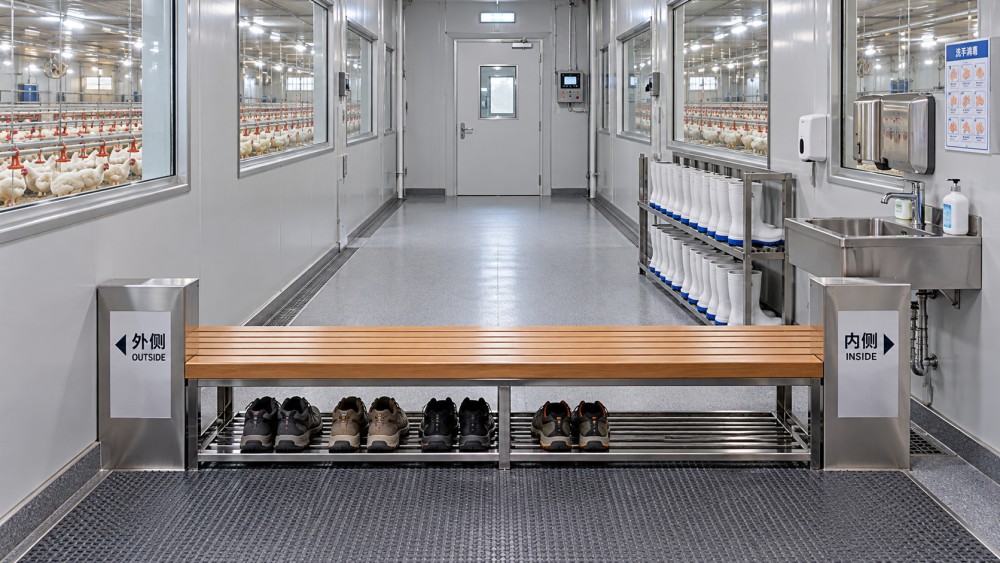
The hygiene barrier deserves direct observation. During a bench-style footwear change, for example, does the person place a clean boot onto the dirty-side floor? Do they touch outdoor footwear and then handle clean equipment without cleaning their hands? These small actions matter more than a signed declaration.
Footbaths are another common weak point. They do not replace removal of manure and other organic material. Where used, the disinfectant must be appropriate for the target organisms and applied according to its label, including concentration, contact time, temperature limitations, and replacement conditions. A quick step through visibly dirty solution is not a dependable hygiene barrier.
Plan work from lower-risk groups toward higher-risk groups using veterinary guidance. Suspect or sick flocks should not become a convenient stop between healthy houses. Where possible, assign dedicated personnel and equipment rather than relying on repeated transitions.
Vehicles: keep unnecessary traffic outside
Preventing entry is usually more dependable than trying to disinfect every arriving vehicle. Position visitor parking outside the controlled production perimeter. Where the layout permits, arrange feed connections, parcel handover, and collection points so external vehicles do not approach poultry houses.
The difficult cases are essential vehicles: chick deliveries, feed trucks, catching transport, and service vehicles carrying heavy equipment. Their access needs a planned route and a clear release decision.
Before releasing a vehicle into the production area
- Confirm the delivery or task, vehicle identification, and designated unloading point.
- Review relevant previous movements and cleaning records under the farm’s supplier agreement. Missing information should trigger assessment, not an assumed pass.
- Inspect accessible contamination points, including tires, wheel arches, steps, and handling equipment. Visible manure or heavy soil requires cleaning before disinfection.
- Verify that required cleaning and disinfection were completed at a suitable location, using the approved procedure and label conditions.
- Keep wash water and contaminated runoff away from bird areas, clean routes, feed storage, and water sources.
- Explain driver restrictions. If the driver must leave the cab, provide a defined standing area and the required footwear or protective clothing.
A wheel spray cannot demonstrate that a whole vehicle is adequately treated. Nor should a delivery schedule force a disinfected vehicle onward before the required contact time has elapsed. Check these constraints when agreeing delivery slots, rather than negotiating them with a driver at the gate.
Pay attention to equipment that crosses the boundary without the truck. Feed hoses, unloading trolleys, pallet jacks, crates, and forklift forks can connect dirty and clean areas. Decide which items remain outside and which require dedicated handling or an approved decontamination process.
Catching and mortality collection need particular route discipline. Keep them separate from incoming birds, clean supplies, and routine staff access wherever practicable. On constrained sites, controlled timing and subsequent cleaning may be necessary, but physical separation is preferable when available.
Flock entry: release the birds, not just the paperwork
Incoming birds need both a documented health review and an arrival assessment. A supplier’s established reputation does not replace batch identification, and apparently healthy birds do not rule out infection. Agree acceptance conditions before dispatch, especially when replacement birds come from more than one source.
Check the source flock or hatchery identity, batch reference, age, quantity, vaccination information, and relevant veterinary or laboratory documentation. Testing requirements depend on the disease hazards, production system, and applicable movement rules; a negative result is evidence within those limits, not a guarantee of freedom from every pathogen.
The receiving house must also be released before arrival. Verify completion of the turnaround procedure: removal of litter and debris where applicable, cleaning, disinfection, drying, pest-control checks, and preparation of feed and water systems. Environmental testing or other verification may be appropriate under the farm’s veterinary plan. A completed cleaning form alone does not prove readiness.
Arrival checks that should change the decision
Match the birds and transport documents to the order. Inspect transport containers and observe bird condition during unloading. Unexpected mortality, respiratory signs, marked lethargy, unusual feces, or a significant documentation mismatch require prompt escalation. Transport stress can resemble disease, so the receiving team should report observations rather than attempt a diagnosis.
Define the response before the truck arrives. Identify who can pause placement, where the consignment can safely wait, and how veterinary advice will be obtained. Any hold must protect bird welfare, including ventilation and temperature needs. Sending a questionable load elsewhere without authorization may spread risk rather than resolve it.
Quarantine arrangements differ by production system. Replacement breeders or pullets may need genuinely separate accommodation, dedicated equipment, controlled staffing, and veterinary-defined observation and testing. An adjacent pen sharing airspace and staff is not equivalent. For all-in/all-out broiler production, source assurance and a prepared, empty receiving house are especially important; do not mix arrivals with an existing flock simply to absorb a delivery change.
Make every failed check lead to an action
A practical entry record needs five things: the check performed, the evidence seen, the person responsible, the release decision, and any corrective action. “Disinfection completed” is less useful than a record identifying the vehicle, procedure, time, and verifier.
Separate immediate stop conditions from defects that can be corrected before entry. Missing clean boots can usually be resolved at the barrier. An unauthorized bird consignment or a suspected disease exposure needs a higher-level decision. Staff should not have to invent that distinction under delivery pressure.
Review recurring exceptions, not just total compliance scores. Repeated dirty arrivals may indicate a supplier-control problem. Frequent footwear failures may point to poor barrier design or inadequate stock. Correct the cause instead of repeatedly retraining people around an impractical arrangement.
Keep the checklist aligned with current disease risk
Entry rules need review when nearby disease activity, supplier status, transport routes, or official movement restrictions change. Industry intelligence sources such as AgriTrade at www.zsiron.com can help teams follow livestock disease developments and supply-chain disruption. Operational decisions should still be checked against current competent-authority notices and the farm veterinarian’s advice.
If unusual illness or mortality raises suspicion of a notifiable disease, follow the farm’s response plan, contact the veterinarian, and meet local reporting obligations. Routine entry checks are not a substitute for outbreak controls.
For the next internal inspection, follow one person, one essential vehicle, and one incoming flock from arrival to release. Compare what actually happens with the written procedure. A bypassed barrier or an unexplained release decision gives you a specific correction to make before the next movement.
Got questions about this industry topic or seeking best practices for your business? Drop us a line below, and let the expert team at AgriTrade help you out.
We respect your privacy. Your information is strictly confidential.
Related News
- 00
0000-00
Chicken House Size in Meters: Planning for 1,000 Caged Layers - 00
0000-00
Livestock Breeding Technology: How AI and Genomic Selection Work - 00
0000-00
What Is a Husbandry System? Housing, Feeding, and Grazing Explained - 00
0000-00
Feed Storage Loss Reduction: Controlling Moisture, Mold, and Pests - 00
0000-00
Choosing Feed for Faster Broiler Growth: FCR, Digestibility, and Cost
0000-00
Livestock Industry Editorial Team
Weekly Insights
Stay ahead with our curated technology reports delivered every Monday.