Professional Agri-Forestry Industry Insights | Global Intelligence Leader

Layers vs. Broilers: Comparing Poultry Farm Startup Costs in Nigeria





Broilers can offer a shorter route to sales, while layers generally require funding for a longer period before egg income begins. That does not automatically make broilers the cheaper investment. Housing condition, bird age at purchase, equipment choice, feed purchasing arrangements and customer payment terms can change which project requires more cash before it becomes self-supporting.
For a Nigerian business comparing the two, the useful question is not simply “What does a poultry farm cost?” It is “How much capital must remain available until this particular production system can fund its next operating cycle?” A low equipment quotation can conceal an underfunded farm; a more expensive installation may still be unsuitable if its maintenance requirements exceed local support capacity.
Compare the same project scope before comparing prices
A layer proposal and a broiler proposal should use the same assumptions about land ownership, site readiness, water availability, power supply and management responsibility. Comparing a fully equipped layer house with a broiler budget that excludes building work, feed storage and backup power produces a misleading result.
Equal bird numbers are also an incomplete basis for comparison. Layers and broilers produce different saleable outputs and have different production schedules. Assess each option against available housing, peak cash requirement, expected customer demand and the owner’s ability to absorb delayed sales.
These production differences are described in the FAO’s Poultry Development Review (2013). They explain why equipment cost alone is a weak investment comparison: the timing of expenditure and receipts matters just as much.
Build the budget in three separate layers
A practical estimate of the cost of starting a poultry farm in nigeria should distinguish fixed investment, pre-revenue operating expenditure and cash reserves. Keeping these categories separate makes equipment quotations easier to assess and prevents working capital from disappearing into construction.
Fixed investment includes site preparation, buildings or refurbishment, drainage, water storage, electrical installation, feed storage and production equipment. Land purchase should appear separately so decision-makers can distinguish the property investment from the poultry operation.
Pre-revenue expenditure covers birds, feed, litter where applicable, veterinary inputs, labour, utilities and transport before sufficient customer receipts arrive. For layers, this period depends heavily on whether the farm purchases day-old chicks, growing pullets or birds approaching lay. For broilers, it depends on the production programme and actual sale date.
Liquidity reserves cover disruption and timing mismatches: a delayed feed delivery, equipment repair, slower customer payment or postponed bird collection. A reserve is not a substitute for budgeting known expenses. Installation, routine vaccination and normal transport belong in the base estimate.
Use dated local quotations rather than presenting a single naira figure as a national benchmark. Record delivery location, quotation validity, tax treatment, currency exposure and exclusions. Without those details, even a recent price may not represent the cost payable at the farm gate.
Where layers commit more capital before dependable income
The layer decision begins with bird age. Day-old chicks require a rearing programme before egg production; purchasing older pullets transfers part of that work to the supplier but increases the upfront bird-purchase commitment. Compare the complete cost to a common production stage, rather than comparing chick and pullet prices alone.
For purchased pullets, request hatch dates, vaccination records, body-weight records, the feeding programme and flock uniformity information. Treat “point of lay” as a description requiring verification, not a guaranteed date for commercially meaningful egg output. Breed guidance and flock condition should inform the forecast.
Layer management guides explain the relationship between rearing, body weight, lighting and subsequent production. Relevant references include the Hy-Line Brown Commercial Layers Management Guide and the guide for the actual strain being purchased; targets should not be transferred between strains without checking applicability.
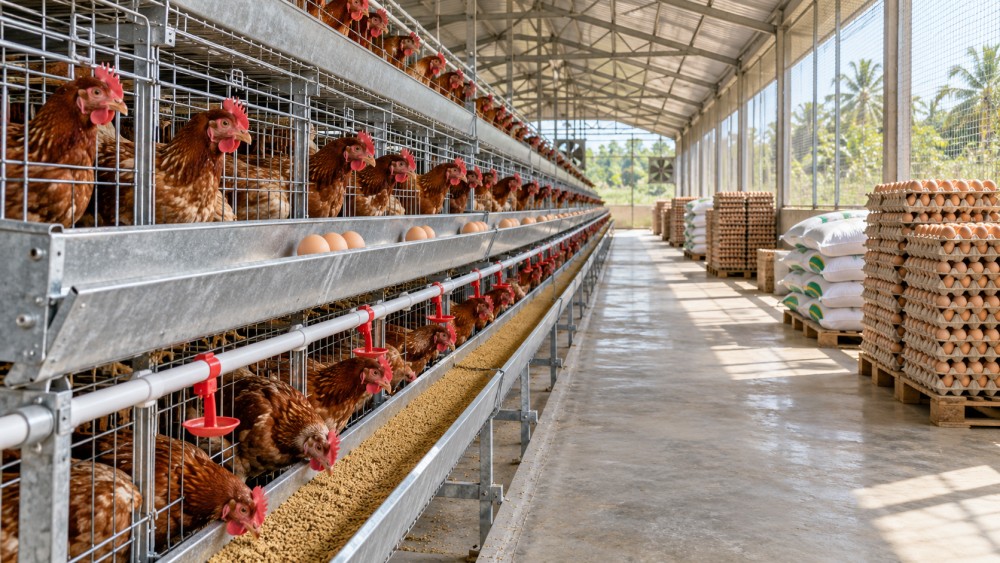
Housing choice then changes the capital profile. A cage quotation should specify the complete installed system: cages, supports, feeding and drinking arrangements, egg collection provisions, manure handling and any required electrical equipment. A floor-based alternative needs its own complete scope, including nests, litter management and egg collection arrangements. Neither quotation is meaningful without the building and operating assumptions behind it.
Daily egg receipts can help cash circulation, but invoiced sales are not necessarily cash received. Model saleable eggs after losses and breakage, include trays and delivery expenses, and apply the customer’s actual payment terms. Keep spent-hen and manure income separate rather than using uncertain future receipts to fund essential early expenditure.
Where broilers can appear cheaper than they really are
A broiler project may avoid layer-specific egg collection equipment, but it still needs a suitable house, brooding arrangements, feeders, drinkers, water storage and a workable cleaning programme. An existing shed should be assessed for drainage, ventilation, access and cleanability before its conversion is treated as a saving.
The Ross Broiler Management Handbook (Aviagen, 2018) describes the importance of brooding conditions, environmental management, feed and water provision. These are production requirements, not optional extras that can safely be removed to reduce the startup quotation.
The sales route creates another major difference. Selling live birds is not the same business scope as supplying processed chicken. Processing may introduce slaughter arrangements, chilling, packaging, cold storage, transport and additional approval requirements. Unless those activities are explicitly funded and checked, a live-bird farm budget should not assume processed-product revenue.
Broiler budgets should also allow for the possibility that buyers collect later than planned. Birds continue consuming resources while they remain on the farm. The financial exposure depends on feed use, sale weight, mortality and whether customers accept the resulting bird size.
Batch income can create false confidence. A large receipt after sales is not all available profit: some must finance cleaning, repairs and the next placement. Ring-fencing replacement working capital helps prevent the farm from completing one batch successfully but being unable to start another.
Feed and cash timing belong in the investment model
For both systems, calculate feed expenditure by production stage rather than multiplying one feed price by an undifferentiated annual quantity. Layer rearing and egg production have different requirements; broiler feeding programmes also change as birds grow. Use the relevant breeder guide and a qualified nutrition adviser when establishing assumptions. The FAO’s Poultry Development Review (2013), particularly its poultry nutrition material, provides the underlying context.
Obtain quotations that identify feed type, bag weight, delivery charges, payment terms and validity. If considering on-farm mixing, include ingredient purchasing, formulation support, storage, weighing, mixing, labour and quality control. Machinery ownership alone does not establish that a complete ration will cost less.
The core funding calculation is:
Required startup funding = fixed investment + peak cumulative operating cash deficit + contingency reserve.
The cumulative cash deficit is expenditure minus receipts over time, not simply the first month’s running cost. Build a weekly cash schedule through the first production cycle and extend it far enough to include replacement funding. For layers, continue beyond the first eggs; early receipts may not yet cover feed, labour and other expenditure.
Test adverse conditions separately: higher feed prices, lower selling prices, delayed production, weaker saleable output and slower customer payments. Show the additional cash each scenario requires. This gives management a clearer decision than applying an unexplained percentage to the equipment bill.
Buyer checks before approving equipment and construction
The lowest quotation is useful only if its scope matches the farm’s needs. Issue a common specification to competing suppliers and reconcile exclusions before comparing totals.
- Capacity basis: Confirm usable bird places, house layout, access aisles and the management assumptions behind the proposed stocking arrangement.
- Water system: Specify source availability, storage, treatment where required, pressure control and access for cleaning. Have water suitability assessed rather than assuming a borehole guarantees acceptable quality.
- Power dependency: Identify which ventilation, pumping or feeding functions stop during an outage and price a suitable backup arrangement.
- Materials and fabrication: Request material specifications, coating details, connection methods and replacement-part information rather than accepting photographs as evidence of durability.
- Installed cost: Separate equipment, freight, applicable import charges, inland transport, foundations, erection, commissioning and training. Establish who bears exchange-rate changes and shipment delays.
- Acceptance and support: Agree checks for leaks, operating movement, controls and equipment completeness. Record warranty exclusions, service responsibility and spare-parts lead times.
Operational acceptance is different from a health or safety guarantee. Biosecurity needs its own plan covering entry control, cleaning, pest management and separation between flocks. The WOAH Terrestrial Animal Health Code, Chapter 6.5, “Biosecurity Procedures in Poultry Production,” provides a reference framework; a local veterinarian should adapt procedures to the farm.
Before committing to a site or processing activity, confirm applicable planning, environmental, veterinary, waste-disposal and food-handling requirements with the responsible Nigerian authorities. Requirements should be checked for the actual location and business scope, not inferred from another farm’s arrangements.
Choose the model the business can finance and sell
Broilers may suit an operator with confirmed buyers, disciplined batch scheduling and enough liquidity to withstand delayed collection. Layers may suit a business with dependable egg distribution, daily management capability and capital that can remain committed through rearing and the buildup of production.
Existing assets can change that judgement. A suitable building with reliable water may materially reduce either project’s initial cash requirement. An unsuitable building offered at low rent may do the opposite once conversion, repairs and operating limitations are included.
Approve the investment only when the plan identifies the peak cash requirement, the evidence supporting the sales assumptions and the funding available under a downside scenario. If the business can afford the birds and equipment but cannot finance feed through delayed receipts, the proposed flock is too large—regardless of whether layers or broilers look cheaper on paper.
Got questions about this industry topic or seeking best practices for your business? Drop us a line below, and let the expert team at AgriTrade help you out.
We respect your privacy. Your information is strictly confidential.
Related News
- 00
0000-00
Chicken House Size in Meters: Planning for 1,000 Caged Layers - 00
0000-00
Livestock Breeding Technology: How AI and Genomic Selection Work - 00
0000-00
What Is a Husbandry System? Housing, Feeding, and Grazing Explained - 00
0000-00
Feed Storage Loss Reduction: Controlling Moisture, Mold, and Pests - 00
0000-00
Choosing Feed for Faster Broiler Growth: FCR, Digestibility, and Cost
0000-00
Livestock Industry Editorial Team
Weekly Insights
Stay ahead with our curated technology reports delivered every Monday.