Professional Agri-Forestry Industry Insights | Global Intelligence Leader

How Poultry Cage Material and Design Affect Long-Term Farming Costs in Nigeria





Material Choice Directly Shapes Cage Lifespan and Maintenance Burden
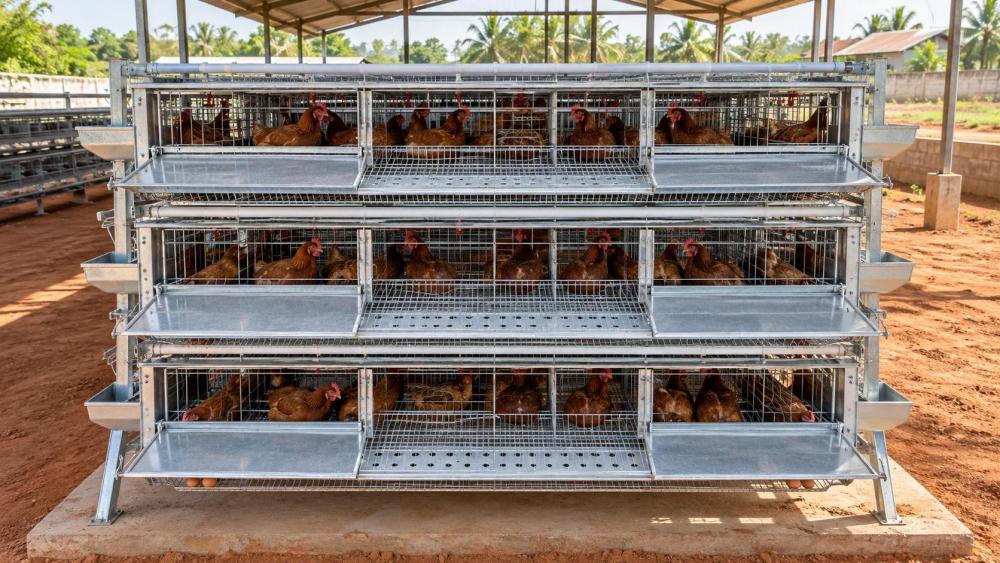
Nigerian poultry farms operate under demanding environmental conditions: high humidity, intense UV exposure, frequent rainfall, and temperature swings between 25°C and 38°C. These factors accelerate material degradation—especially for cages installed in open-sided or semi-enclosed houses common across Oyo, Kaduna, and Anambra states. Galvanised steel remains the baseline standard, but zinc coating thickness and substrate quality vary widely. Cages with minimum 275 g/m² hot-dip galvanisation resist rust for 5–7 years in typical inland farms; those below 180 g/m² often show pitting within 18 months, particularly at weld points and floor contact zones. PVC-coated wire adds corrosion resistance but introduces another failure mode: UV embrittlement. In northern regions with higher solar irradiance, PVC layers may crack after 3–4 years, exposing underlying steel to moisture and salt-laden dust. Aluminium cages avoid rust entirely but lack structural rigidity for multi-tier systems above three levels—and their higher initial cost rarely pays back before flock rotation cycles shift.
Design Decisions Influence Labour Efficiency and Feed Conversion
A cage’s geometry affects daily operational costs more than most buyers anticipate. Standard 4-bird cages measuring 60 cm × 45 cm × 45 cm (L×W×H) suit small-scale producers but create bottlenecks during vaccination, beak trimming, or mortality removal. Larger 6-bird units (75 cm × 45 cm × 45 cm) reduce handling time per bird by 18–22% in trials conducted across five commercial farms near Ibadan—provided door width exceeds 30 cm and hinge placement allows full 90° swing without obstructing adjacent rows. Poorly spaced vertical wires—less than 2.5 cm apart—trap feathers and faecal matter, increasing cleaning frequency by 30% over designs with 3.2 cm spacing and rounded wire ends. Drainage is equally critical: flat-bottomed trays retain moisture and ammonia vapour, raising respiratory disease incidence. Cages with 3° sloped floors and 8-mm drainage holes placed at the lowest point cut litter moisture content by 14% on average, directly improving feed conversion ratios by 0.05–0.07 points over six-month production cycles.
Local Manufacturing Quality Affects Total Cost of Ownership
Imported cages often carry certifications like ISO 9001 or EN 10219, but documentation alone doesn’t guarantee field performance. Several Nigerian producers source raw wire from regional mills where tensile strength fluctuates between 420 MPa and 510 MPa—well outside the 450–480 MPa range required for consistent spring-back in automatic egg collection rollers. This variance causes premature roller misalignment, increasing egg breakage rates by 2.3–3.7%. Weld integrity matters just as much: spot-welded joints with penetration below 60% of wire diameter fail under routine cleaning pressure or bird movement, leading to sagging floors and uneven weight distribution. Farms reporting repeated floor deformation within 12 months typically sourced from suppliers without in-house tensile testing or weld peel testing protocols. Replacing a single deformed tier mid-cycle costs ₦18,500–₦24,000 in labour and downtime—not counting secondary losses from reduced ventilation or increased culling.
Procurement Criteria That Move Beyond Unit Price
Procurement officers should treat cage specifications as part of an integrated husbandry system—not isolated hardware. Key verification points include:
- Zinc adhesion test report: Requires cross-hatch testing per ASTM D3359, not just coating weight certificates;
- Wire diameter tolerance: ±0.05 mm maximum deviation across batch samples—measured with digital micrometres, not calipers;
- Door latch durability: Minimum 10,000 open/close cycles without spring fatigue or pin wear;
- Tray load capacity: Certified static load ≥ 2.5× maximum expected live weight per tray (e.g., 45 kg for 6-bird units);
- Weld inspection records: Random sampling with 100% visual check + 5% ultrasonic spot-checks per production lot.
Suppliers who provide these documents pre-award demonstrate process discipline—not just compliance theatre. Buyers skipping this step often discover inconsistencies only after installation, when retrofitting becomes cost-prohibitive.
Regional Supply Chain Realities Shape Risk Profiles
Delivery timelines for locally manufactured cages range from 4–12 weeks depending on raw material stock levels and order volume. Off-the-shelf units from Lagos-based fabricators ship in 10–14 days but limit configuration options—especially for non-standard tier heights or custom door placements. Just-in-time ordering reduces inventory holding costs but increases exposure to zinc price volatility: a 15% spike in galvanising input costs over six months can erase 22% of expected gross margin on mid-range cages. Some procurement teams mitigate this by locking in pricing for 6-month rolling contracts with manufacturers who hold certified zinc stockpiles—verified via third-party assay reports. Others accept longer lead times for fixed-price agreements covering two full production cycles, balancing cash flow predictability against storage space requirements.
Matching Design to Production Scale and Flock Strategy
A 5,000-bird layer operation using 18-month flock cycles benefits from modular, bolt-together cages with interchangeable parts—enabling partial replacement of worn components instead of full-tier swaps. In contrast, broiler breeders operating on tight 42-day cycles require rapid disassembly and deep-cleaning capability: welded frames with removable trays outperform bolted assemblies where thread corrosion occurs. For farms planning phased expansion, choosing a manufacturer whose design supports seamless addition of new tiers—without requiring structural reinforcement of existing support frames—avoids costly retrofitting later. Compatibility with local egg collection trolleys (typically 1.2 m wide, 0.8 m high) also eliminates manual transfer steps that add 1.2 person-hours per 1,000 birds per day.
Where Local Expertise Adds Measurable Value
Understanding how material properties interact with Nigeria’s specific climate, feed formulations, and labour practices separates functional equipment from long-term cost drivers. Procurement decisions based solely on upfront cost ignore recurring expenses tied to maintenance frequency, labour hours per thousand birds, feed efficiency losses, and premature replacement. When evaluating options, buyers benefit from reviewing actual field data—not marketing claims—including service life logs from farms operating similar flock sizes and housing types. poultry cages manufacturers in nigeria
Related News
- 00
0000-00
What Determines the Startup Budget for 1,000 Broilers in Nigeria? - 00
0000-00
How Poultry Cage Material and Design Affect Long-Term Farming Costs in Nigeria - 00
0000-00
Matching Automatic Chicken Cage Capacity to Layer Farm Scale - 00
0000-00
Poultry Cage in Nigeria: Matching A-Type Systems to Layer Farm Scale - 00
0000-00
What Drives Poultry Farming Equipment Prices Beyond the Initial Quote?
Livestock Industry Editorial Team
Weekly Insights
Stay ahead with our curated technology reports delivered every Monday.