Professional Agri-Forestry Industry Insights | Global Intelligence Leader

Choosing Feed for Faster Broiler Growth: FCR, Digestibility, and Cost





Choose high growth rate feed by comparing the cost of reaching the required market weight under the conditions in which the flock will be raised. A stronger purchase case combines efficient feed conversion, dependable growth, suitable nutrient availability, and consistent physical quality. A lower price per tonne loses its advantage when extra feed consumption, wastage, or additional growing days absorb the saving.
Start with three linked measures: feed conversion ratio (FCR), days to target weight, and feed cost per kilogram of liveweight gain. Evaluate them against the same flock conditions and accounting rules. Then examine whether the formulation, feed form, and supporting trial evidence explain the claimed performance.
Make FCR figures comparable before ranking feeds
FCR expresses feed consumed relative to liveweight gained. A lower value indicates less feed used for each unit of gain, provided the measurements cover comparable birds, growth stages, and management conditions. The calculation appears straightforward, but differences in recordkeeping can reverse a ranking.
FCR = feed consumed ÷ liveweight gain
Confirm whether a reported figure covers a single feeding phase or the complete growing cycle. Starter performance cannot establish whole-cycle efficiency because feed intake, maintenance needs, and growth patterns change as birds develop. Similarly, a result measured at a lighter finishing weight should not be compared directly with one measured at a heavier endpoint.
Mortality accounting deserves particular attention. A mortality-adjusted FCR may include the weight of birds that died or were culled, while an unadjusted calculation treats those losses differently. Both figures can support analysis, but their definitions must accompany the results. A favorable adjusted figure does not remove the economic cost of mortality.
Feed disappearance also differs from feed ingestion. Feed delivered to a house, less remaining inventory, can include spillage, leakage, and feed discarded during cleaning. That measure is useful for commercial costing, whereas a controlled digestibility trial addresses a different question. Compare like measures and retain the original calculation method in the purchasing record.
FCR should sit beside average daily gain and days to market weight. A feed that reduces daily intake could appear economical while delaying the required endpoint. Faster growth has value when it shortens the production cycle without undermining survival, leg condition, or the required processing specification.
Translate the feed quotation into a performance threshold
For a consistent measurement period, the basic relationship is:
Feed cost per kilogram of liveweight gain = feed price per kilogram × FCR
Use delivered feed cost, including applicable transport and handling charges. Keep the currency, weight units, and moisture basis consistent. Comparing a delivered quotation with an ex-mill quotation obscures the actual purchasing difference.
The same relationship establishes how much improvement a more expensive feed must deliver. If Feed A is the current reference and Feed B carries a higher price:
Break-even FCR for Feed B = (price of Feed A × FCR of Feed A) ÷ price of Feed B
Feed B must achieve a lower FCR than that threshold to reduce feed cost per kilogram of gain. This calculation isolates feed economics; additional value from shorter growing time requires a separate assessment of housing costs, energy, labor, and whether the production schedule actually permits another flock.
Calculate whole-program cost across starter, grower, and finisher feeds. A cheaper finisher quotation does not establish a cheaper program if earlier diets increase cost or impair subsequent growth. Where phase-specific intake and gain records are reliable, use them to identify where the difference arises, then reconcile the result with whole-flock feed use.
Keep saleable output visible. Feed cost per kilogram of liveweight gain does not capture differences in carcass yield, condemnations, or weight uniformity. When payment depends on processing results, compare those outcomes separately rather than assuming that a liveweight advantage will carry through unchanged.
Read the nutrient specification beyond crude protein
Crude protein alone is a weak basis for selecting a growth feed. Broilers require an appropriate supply of digestible amino acids relative to available energy. Raising total protein without correcting a limiting amino acid adds nitrogen that cannot be efficiently retained as growth.
Request the stated energy system and the basis used for amino acid values. Apparent metabolizable energy and nitrogen-corrected apparent metabolizable energy are related measures, but their values are not interchangeable. Total amino acid declarations likewise cannot be treated as digestible amino acid guarantees.
Energy density also affects intake. When heat or another constraint limits feed consumption, nutrient concentration becomes especially relevant because birds must obtain their daily nutrient supply from less feed. Increasing energy without maintaining amino acid balance can change body composition instead of delivering the expected lean growth.
Mineral balance belongs in the same evaluation. Calcium, phosphorus, and vitamin provision support skeletal development as bodyweight increases. Strong weight gain accompanied by poor mobility creates a production problem, even when the headline growth result looks attractive.
Separate formulated digestibility from demonstrated availability
Digestibility estimates depend on ingredient identity, processing, and the reference values used in formulation. Two feeds with similar declared nutrients can deliver different results when their raw materials differ in usable nutrient content or consistency.
Soybean processing illustrates the issue. Insufficient heating leaves antinutritional activity that interferes with nutrient use; excessive heating reduces amino acid availability. A protein declaration cannot distinguish these conditions. Ingredient acceptance criteria and processing controls therefore provide useful evidence behind the finished-feed specification.
Ask whether digestibility claims come from published ingredient values, laboratory predictions, or feeding trials using the actual diet. Each supports a different level of confidence. A formulation calculated from a nutrient matrix is an estimate, while a relevant biological trial provides evidence about that tested formulation under its stated conditions.
Enzymes require similar scrutiny. Phytase and enzymes targeting non-starch polysaccharides act on particular substrates. Their contribution depends on the ingredients present, dose, processing conditions, and nutrient credits already removed from the formula. Crediting the same benefit twice, through ingredient assumptions and an enzyme matrix, overstates expected nutrient supply.
Batch consistency matters as much as an attractive average. Ingredient substitutions can preserve declared crude protein while changing fiber, fat quality, pellet behavior, or digestible amino acid supply. Formulation flexibility is compatible with consistent performance when substitutions remain within validated nutritional and manufacturing controls.
Inspect feed where the birds receive it
Pellets and crumbles influence eating behavior, feed selection, and wastage. Suitable feed form supports intake, but size and hardness must match bird age. Young chicks need accessible particles; a physically durable pellet offers little benefit if birds struggle to consume it.
Assess fines after transport and handling, with samples taken near the point of consumption. Pellets that survive dispatch testing can break during unloading, bin transfer, or feed-line movement. Excess fines change the feed presented to birds and can encourage selective consumption.
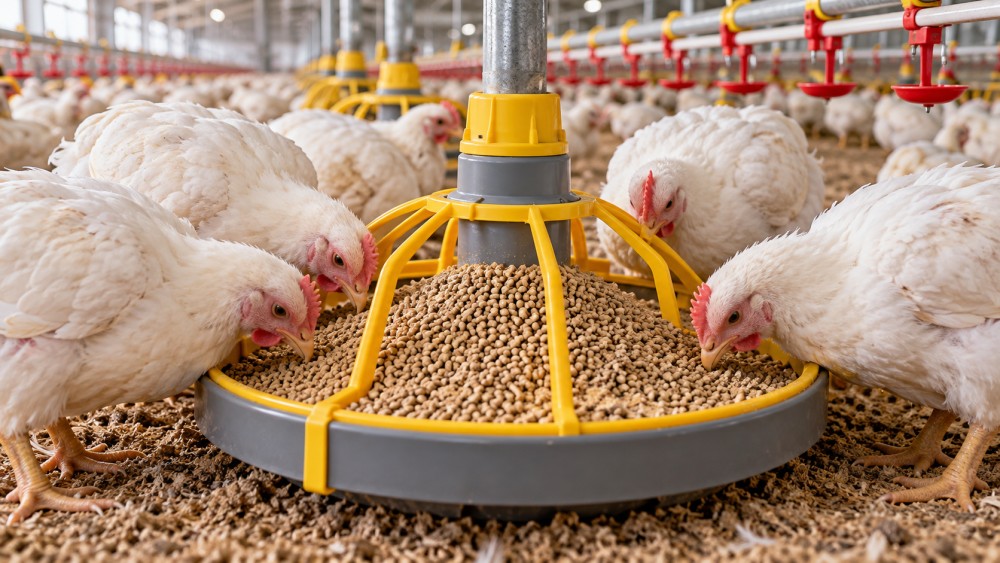
Use a defined sampling and sieving method so results remain comparable between deliveries. Record where samples were collected and whether the feeding equipment was operating normally. A single handful from the surface of a load is weak evidence because particles segregate during movement.
Durability and nutritional quality need separate evidence. Conditioning supports pellet formation, yet excessive processing can damage heat-sensitive nutrients or additives. Pellet appearance alone establishes neither digestibility nor enzyme retention.
Investigate storage condition when performance deteriorates after delivery. Moisture ingress, mold, and fat oxidation can reduce feed suitability. Retained samples, batch identification, and delivery records help distinguish a manufacturing issue from damage occurring in storage.
Use feeding trials that answer the purchase decision
A useful comparison records strain, sex, starting weight, stocking density, health status, housing conditions, feeding phases, and the final measurement point. Differences in these conditions can explain an apparent feed advantage. Results from a highly controlled facility require interpretation before applying them to a house with restricted ventilation or recurring intestinal disease.
Concurrent comparisons are stronger than comparisons between successive flocks because weather, chick quality, and disease pressure change over time. Where feasible, assign diets across comparable pens or houses with replication. Birds sharing the same feed allocation within a pen do not represent independent treatment replicates.
Choose the endpoint before the trial begins. A fixed-age comparison addresses weight achieved by a scheduled date. A fixed-weight comparison addresses time and feed required to reach a market specification. Reporting both clarifies whether a feed changes growth speed, conversion efficiency, or both.
Alongside FCR and gain, retain feed intake, mortality, culls, weight uniformity, and relevant health observations. Report variability between replicates as well as averages. A small apparent benefit that is inconsistent across replicates offers a weaker purchasing basis than a repeatable improvement.
Feed transitions must also be controlled. Abrupt changes in form or composition can temporarily alter intake. When two programs use different phase schedules, compare the complete programs and record transition dates; otherwise, a scheduling effect can be mistaken for a formulation advantage.
Turn the selected specification into an enforceable supply agreement
The agreed specification should identify nutritional guarantees, feed form, sampling methods, batch traceability, and how material deviations will be handled. Distinguish guaranteed limits from typical values. A typical analysis describes expected composition but does not automatically establish an acceptance boundary.
Set notification requirements for changes that affect the agreed performance basis, including major formulation changes, manufacturing-site changes, or substitutions outside approved limits. Link delivery quantities and storage capacity to the feeding schedule so that birds receive the intended phase diet without prolonged carryover.
After adoption, compare actual results with the assumptions used in the break-even calculation. If feed cost per kilogram of gain rises, trace the difference through delivered price, feed disappearance, growth, and mortality. That sequence identifies whether the purchasing case has changed or whether a specific production issue requires correction.
Got questions about this industry topic or seeking best practices for your business? Drop us a line below, and let the expert team at AgriTrade help you out.
We respect your privacy. Your information is strictly confidential.
Related News
- 00
0000-00
US Cattle Herd Falls to 75-Year Low as Beef Prices Rise - 00
0000-00
Chicken House Size in Meters: Planning for 1,000 Caged Layers - 00
0000-00
Livestock Breeding Technology: How AI and Genomic Selection Work - 00
0000-00
What Is a Husbandry System? Housing, Feeding, and Grazing Explained - 00
0000-00
Feed Storage Loss Reduction: Controlling Moisture, Mold, and Pests
0000-00
Livestock Industry Editorial Team
Weekly Insights
Stay ahead with our curated technology reports delivered every Monday.