Professional Agri-Forestry Industry Insights | Global Intelligence Leader

When is continuous pressing suitable for wood processing for panelboards?





Continuous pressing is a key technology in modern wood processing for panelboards, but it is not the right choice for every production scenario. Its strongest case is not simply “higher output.” It is the ability to convert stable demand, consistent furnish preparation, and disciplined process control into a long-run manufacturing advantage.
For a new panelboard project or a major line upgrade, the central question is whether the factory can keep a continuous press productively loaded while meeting thickness, density, surface, emissions, and delivery requirements. If the answer is uncertain, a lower-capacity or more flexible pressing concept may produce a better business result despite a less impressive nameplate capacity.
What continuous pressing changes in panelboard production
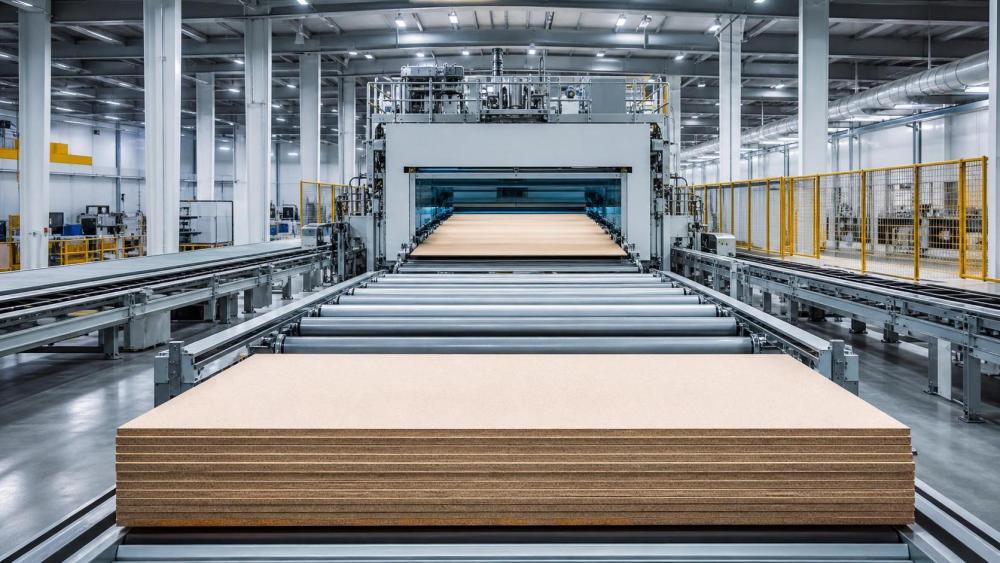
In a continuous press line, the prepared mat moves continuously through a heated press zone, typically between steel belts. Pressure and temperature are applied progressively along the press length rather than in separate pressing cycles. The process is widely associated with high-volume production of MDF, HDF, particleboard, and some specialized engineered wood panels.
Compared with multi-opening or daylight presses, continuous pressing can offer a more stable production flow, reduced handling between press cycles, and potentially better control of board properties across long production runs. It also changes the economics of the whole plant. Mat forming, resin dosing, drying, screening, sanding, trimming, cooling, storage, quality control, and maintenance planning must all operate at a level that supports the press.
A continuous press does not solve upstream instability. It makes instability more visible and more expensive. Variations in wood moisture, particle geometry, fiber quality, resin distribution, wax addition, mat weight, or heat supply can quickly become board-quality deviations or forced slowdowns.
That is why the selection decision should begin with the production system, not with the press itself.
The clearest fit: high-volume, relatively standardized board production
Continuous pressing is generally most suitable when a plant expects sustained output of a limited number of board types and thickness ranges. The line performs best when product changes are infrequent, recipes are well understood, and sales demand is sufficient to maintain high utilization over time.
This usually describes producers supplying large furniture, flooring, cabinetry, laminate, construction, or distribution markets where volumes are predictable and dimensional consistency matters. A plant producing standard MDF or particleboard in established thicknesses—rather than many small, irregular orders—can use the continuous process to improve throughput and reduce unit conversion cost.
High utilization is especially important because the investment is not limited to the press. A continuous line normally requires supporting capacity in fiber or particle preparation, drying, glue blending, forming, handling, finishing, automation, heat generation, dust extraction, and process controls. If any of these systems limits production, the expected economic benefit of the press is diluted.
A project has a strong strategic case when it can answer three questions positively:
- Can the market absorb stable, large-volume output for several years rather than only during a temporary demand peak?
- Can the mill secure enough consistent wood raw material, fiber, or particles at a cost and quality suitable for the target board?
- Can the operating organization maintain a tightly integrated production system, including planned maintenance and quality monitoring?
If one of these conditions is weak, high capacity can become a financial burden rather than a competitive advantage.
Board consistency is often a more important benefit than speed
Capacity receives most attention in early investment discussions, but many producers select continuous pressing because board consistency has direct commercial value. Stable thickness, density profile, surface quality, internal bond, and dimensional performance can reduce downgrade rates and improve reliability for downstream customers.
For MDF and HDF, the density profile through the board thickness is particularly important. It affects machining behavior, surface finishing, strength, screw holding, and the ability to meet the needs of furniture and flooring applications. A controlled continuous pressing profile can support more repeatable properties when the incoming fiber and mat are uniform.
For particleboard, benefits may include more stable thickness control and efficient production of commodity and value-added grades. Yet the result depends heavily on chip geometry, face-core layer design, resin application, moisture control, and forming accuracy. A press cannot compensate indefinitely for poorly classified particles or an inconsistent furnish stream.
Where the commercial model depends on selling panels into demanding downstream processes—lamination, direct printing, coating, CNC machining, edge banding, flooring manufacture, or structural applications—repeatability may justify the investment more convincingly than raw output alone.
When product mix makes continuous pressing less attractive
Continuous pressing is not automatically the best choice for a producer with a broad and frequently changing product portfolio. It can accommodate different formats and thicknesses, but changeovers, grade transitions, cleaning requirements, process stabilization, and downstream handling need to be evaluated realistically. The more often a mill changes board thickness, density, resin system, surface specification, or special additive package, the more production losses can erode the theoretical advantage.
This does not mean that a diverse portfolio rules out a continuous line. Large producers often run broad product families successfully. The difference is that they usually have enough volume within each product family to schedule longer campaigns and have the process discipline to manage transitions.
A more cautious approach is warranted where demand consists mainly of small lots, custom panels, intermittent export orders, or rapidly changing specifications. In these cases, the facility may value operational flexibility more than maximum linear production speed. A multi-daylight press or another lower-throughput configuration can sometimes be more forgiving and commercially sensible.
Specialty boards also require separate assessment. Fire-retardant, moisture-resistant, ultralight, high-density, low-emission, bio-based, or unusual composite panels may be technically compatible with continuous pressing, but compatibility should not be assumed from conventional MDF or particleboard experience. Additives can affect mat moisture, heat transfer, cure behavior, tool wear, emissions, surface properties, and press contamination. Pilot trials and supplier-supported validation are essential before committing to a production design.
Raw material quality determines whether the line can run at its intended value
In wood processing for panelboards, feedstock variability is often the decisive operational risk. A continuous press line needs a reasonably predictable furnish stream. This includes species mix, bark and contaminant levels, chip or fiber dimensions, moisture distribution, bulk density, storage conditions, and seasonal availability.
Plants using recycled wood face additional challenges. Recovered material can be commercially attractive and may support circular-economy objectives, but contamination control becomes more important. Metals, plastics, coatings, mineral particles, and inconsistent particle quality can damage equipment, affect board performance, and complicate emissions control. The preparation system—magnetic separation, non-ferrous metal removal, screening, cleaning, and quality inspection—must be designed as part of the press investment case.
For greenfield projects, the raw-material study should cover more than annual tonnage. It should examine the delivered quality range, competing uses for the wood resource, transport distances, weather-related disruption, storage losses, and legal traceability obligations. A press sized around optimistic fiber availability can create a long-term underutilization problem.
For brownfield upgrades, the question is whether existing preparation and drying assets can feed the new press consistently. In many cases, bottlenecks emerge not at the press but in wet chip storage, refining, dryer capacity, glue kitchen throughput, forming stations, cooling, sanding, or finished-board logistics.
Energy and emissions considerations must be assessed at line level
Continuous pressing can improve energy efficiency per unit of output when it replaces less efficient, cyclic production at high utilization. Continuous operation can reduce some heat and handling losses, while advanced control systems can help optimize press temperature, moisture profile, and production speed.
However, energy performance should not be judged from the press alone. Drying is frequently one of the largest thermal loads in MDF and particleboard manufacture. The economics depend on the moisture of incoming wood, dryer design, heat source, heat recovery, plant layout, electricity reliability, and the ability to use biomass residues safely and consistently where permitted.
Emissions also need early attention. Formaldehyde and other volatile organic compounds are a material market and compliance issue, not merely an environmental reporting issue. Requirements differ across destination markets and product categories. Buyers may request panels compliant with specific emissions classifications or voluntary schemes, while national regulations can impose separate obligations on manufacturing facilities.
Projects intended for export should map the destination-market requirements before finalizing resin systems and process conditions. The correct approach is to verify the applicable rules for the intended product and market, including any test method, declaration, certification, or chain-of-custody expectation. Designing a line around the lowest-cost resin option and addressing market access later can be costly.
Site readiness and execution risk are frequently underestimated
A continuous press project is a plant-integration project. Civil works, foundations, building clearances, belt and press access, heat supply, hydraulic systems, electrical infrastructure, controls, dust management, fire protection, conveying systems, and finished-goods storage all affect commissioning success.
The physical footprint can be substantial, but space is only one issue. The site must also support safe maintenance access and allow for replacement of major wear components without causing disproportionate disruption. A layout that minimizes initial building cost but restricts maintenance logistics may create avoidable downtime throughout the asset life.
Commissioning schedules should include time for material qualification, recipe development, operator training, mechanical tuning, automation integration, and downstream quality stabilization. A nameplate output figure is not the same as saleable output in the first months of operation. The business plan should distinguish among mechanical completion, first board, stable production, guaranteed performance, and sustained commercial utilization.
Critical spare parts, local technical support, remote diagnostics, and the availability of specialist service personnel should also be evaluated before contract award. In export-oriented regions, delayed access to a proprietary component or press-belt service can have a much larger commercial impact than the initial price difference between suppliers.
How to compare a continuous press with alternative concepts
The comparison should be made using the expected cost and risk of producing saleable boards, not simply capital expenditure or nominal annual capacity. A practical evaluation normally considers the following factors:
- Utilization: expected operating hours, product campaign length, planned shutdowns, and realistic market demand.
- Product range: thicknesses, densities, board formats, special grades, and frequency of specification changes.
- Yield: trim loss, sanding loss, rejects, downgraded boards, and startup scrap.
- Raw-material resilience: ability to manage variation in wood species, recovered wood content, moisture, and contamination.
- Utility exposure: electricity, thermal energy, water, compressed air, and backup arrangements.
- Maintenance model: planned downtime, specialist dependence, spare-parts lead times, and in-house capability.
- Market access: emissions expectations, sustainability documentation, customer specifications, and export compliance.
For an existing plant, it is useful to model at least three operating cases: the expected case, a lower-demand case, and a constrained raw-material case. The latter two often reveal whether continuous pressing remains economically robust when market or supply conditions deteriorate.
Conditions that support a confident investment decision
Continuous pressing is usually justified when a panelboard producer has a durable volume base, manageable product complexity, reliable furnish preparation, and the capital capacity to upgrade the entire process chain rather than only the press section. It is particularly compelling where consistent board properties can unlock higher-value downstream markets or reduce recurring losses from variation and downtime.
It is less suitable when utilization is likely to remain low, production depends on frequent short runs, feedstock quality is highly erratic, site infrastructure cannot support the full line, or the organization is not prepared for the maintenance and process-control demands of continuous operation.
The most reliable decision is therefore not “continuous press versus conventional press” in isolation. It is whether the proposed production system can turn continuous operation into dependable saleable output. In panelboard manufacturing, the press is the visible center of the line, but the investment succeeds or fails through the stability of everything around it.
Related News
- 00
0000-00
How to Evaluate a Heavy-Duty Forestry Equipment Manufacturer for Harsh Terrain Projects - 00
0000-00
How Do Forestry Import Rules Differ Between the EU and Southeast Asia? - 00
0000-00
When is continuous pressing suitable for wood processing for panelboards? - 00
0000-00
How to reduce sanding defects in wood panelboard processing - 00
0000-00
How resin selection affects panelboard wood processing quality
Forestry Development Editorial Team
Weekly Insights
Stay ahead with our curated technology reports delivered every Monday.