Professional Agri-Forestry Industry Insights | Global Intelligence Leader

What is driving demand in the Canada wood based panels market?





A procurement review can become unexpectedly difficult when a project team asks for wood-based panels that are available, compliant, stable in quality, and still workable within a changing budget. The request may sound routine: panels for residential construction, cabinetry, shelving, furniture components, packaging, or interior fit-outs. Yet the answer is rarely found by comparing one quoted price against another.
In Canada, a buyer may be dealing with uneven construction activity between regions, renovation schedules that cannot wait for a new production run, freight constraints over long distances, changing timber-supply conditions, and customer expectations around low-emission or responsibly sourced materials. A panel that looks economical at the quotation stage can become a costly choice if its thickness tolerance, moisture performance, surface finish, documentation, or delivery reliability does not fit the intended application.
This is why demand in the Canada wood based panels market deserves to be assessed as a chain of connected decisions rather than a single construction indicator. Housing matters, but so do repair work, furniture manufacturing, industrial uses, forest management, trade flows, product substitution, and the practical requirements of downstream users.
The demand signal is often hidden inside the project mix
A common mistake is to treat all building activity as one source of panel demand. In practice, the type of work matters more than the headline volume of activity. New housing can create demand for structural panels, subflooring, wall and roof sheathing, engineered wood components, and temporary site applications. Renovation work may place greater emphasis on interior-grade panels, cabinetry substrates, decorative boards, shelving, flooring underlayment, and moisture-resistant products for kitchens, utility rooms, and basements.
These patterns do not always move in the same direction. When large new-build projects slow, repair and modernization work can still keep certain panel categories active. Property owners may defer a full rebuild but proceed with an addition, a kitchen replacement, storage improvements, or energy-efficiency upgrades that involve interior finishing. For suppliers and purchasers, this means a weak signal in one construction segment should not automatically be read as weak demand across all panels.
The useful question is not simply, “Is construction growing?” It is, “Which applications are receiving material budgets, and which panel specifications do those applications require?” That distinction helps prevent an evaluation based on overly broad market assumptions.
Housing remains important, but renovation changes the product conversation
Canada’s housing needs support long-term interest in construction materials, particularly where residential supply, multi-unit development, repairs, and regional population shifts create continuing pressure on the built environment. Wood-based panels serve many parts of this activity because they are familiar to contractors, adaptable to different fabrication methods, and available in grades suited to structural and non-structural work.
However, renovation demand changes the buying criteria. A contractor working in an occupied home may value ready availability and ease of handling more than a purchaser on a large greenfield project. A cabinet shop may be focused on surface consistency, machining behavior, edge finishing, and formaldehyde-emission requirements. A building-material distributor may need a broad mix of standard dimensions rather than a single high-volume panel specification.
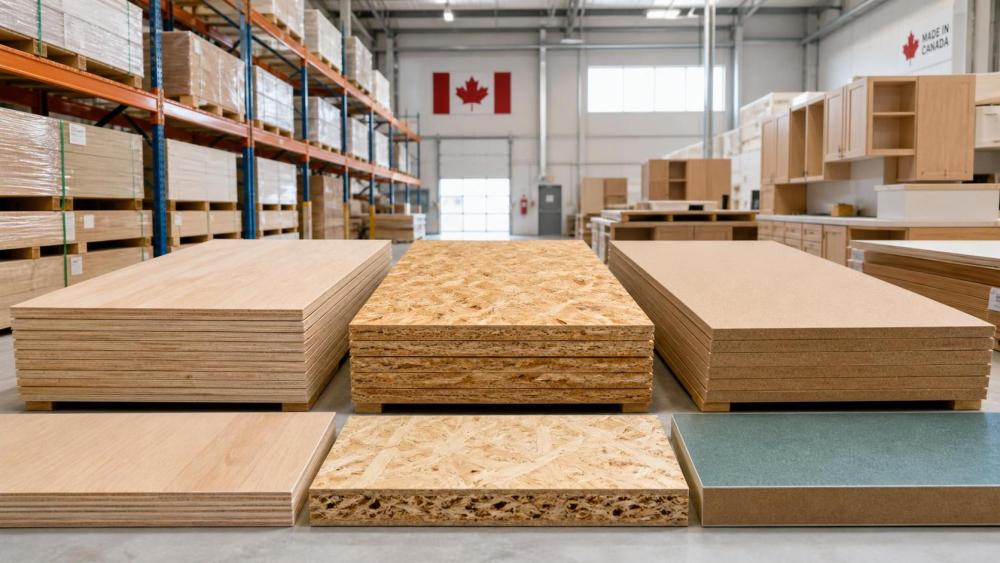
This variety supports demand across products such as plywood, oriented strand board, particleboard, medium-density fibreboard, hardboard, and coated or decorative panels. It also explains why a single price index does not provide a complete picture of the market. Products with different end uses are affected by different purchasing cycles, standards, and substitution choices.
Furniture, fixtures, and interior manufacturing create a second layer of demand
Wood-based panels are not only construction materials. They are inputs for furniture, retail fixtures, office fit-outs, storage systems, doors, millwork, display units, recreational-vehicle interiors, and many forms of fabricated goods. Demand from these uses can be less visible than a major building project, but it often shapes purchasing patterns for value-added panels.
Interior manufacturers usually evaluate materials through a different lens. They may need predictable board density for machining, a clean face for laminating, flatness for large cabinet doors, or dependable compatibility with adhesives and finishes. When these users face labor shortages or short production windows, a panel that reduces rework can be more attractive than a cheaper board that causes cutting, sanding, or finishing issues.
For market assessment, this means it is worth separating commodity-oriented demand from fabrication-oriented demand. Commodity demand may respond sharply to construction cycles and inventory restocking. Fabrication demand is more closely linked to consumer spending, commercial interiors, housing turnover, furniture replacement, and the production schedules of local workshops and manufacturers.
Why sustainability requirements are influencing purchasing behavior
Environmental considerations are becoming part of ordinary material selection rather than a separate discussion reserved for specialized projects. Buyers may be asked to review fibre origin, chain-of-custody documentation, recycled content where relevant, resin systems, indoor-air-quality considerations, waste reduction, and the expected life of the finished product. Requirements vary by project, but the direction is clear: documentation and traceability can influence whether a panel is approved for a tender or accepted by a downstream customer.
Wood-based panels can benefit from interest in renewable materials, efficient use of wood fibre, and engineered products that make use of different wood inputs. Still, sustainability is not a blanket claim. The relevant question is whether the specific product and supply route meet the requirements of the project. A purchaser should avoid assuming that all panels have the same environmental profile simply because they are wood-derived.
Forest practices, access to fibre, wildfire risk, pest impacts, harvesting conditions, mill closures or expansions, and transportation distance can all affect supply confidence. These factors do not necessarily reduce demand; in some cases, they encourage buyers to seek closer, better-documented, or more predictable sources. But they can alter which suppliers and product formats are considered acceptable.
Price movement matters most when it changes behavior
Panel pricing is shaped by more than demand from end users. Log and fibre availability, resin and energy costs, mill operating rates, labor, rail and truck capacity, exchange rates, import competition, and inventory levels can influence the final delivered cost. A sudden price movement attracts attention, but the more meaningful issue is whether it changes behavior.
For example, higher prices may lead builders to tighten waste allowances, redesign components, reduce panel thickness where permitted, or choose a different product category. Fabricators may standardize dimensions to improve yield. Distributors may reduce speculative stock and order closer to immediate demand. Conversely, buyers who expect shortages may bring purchases forward, creating a temporary lift that should not be confused with sustained consumption.
When reviewing the Canada wood based panels market, it is helpful to distinguish between consumption, replenishment, and precautionary buying. These can look similar in shipment figures or distributor activity, yet they imply very different conditions for future demand.
A practical way to test whether demand is durable
When a market opportunity appears attractive, the first reaction is often to ask which panel segment is growing fastest. That question is useful, but it should come after a more grounded review of the end-use pathway. Start with the intended application and work backward through the specification, supply route, and replacement risk.
This approach is especially helpful when two panel products seem interchangeable on paper. They may share a broad category, yet one may be accepted in structural sheathing while another is suited mainly to dry interior furniture applications. The demand outlook must be matched to the application, not just the material family name.
Trade conditions can widen choices and complicate forecasts
Canada’s panel market is connected to cross-border and overseas trade. Imports can give buyers access to alternative grades, decorative finishes, specialty formats, or additional volume when local availability is constrained. Exports can support mill utilization and influence the availability of domestically produced material. At the same time, trade exposure makes forecasts more sensitive to currency changes, transportation costs, border procedures, product standards, and demand conditions in external markets.
For a purchaser, imported supply is not automatically a risk, and domestic supply is not automatically simpler. The better comparison considers the delivered product: lead time, damage risk, batch consistency, replacement options, documentation, minimum order quantities, and the ability to resolve a quality issue. A low ex-works price can lose its advantage if freight complexity or slow replacement turns a minor defect into a production delay.
For a market observer, this is a reason to avoid reading demand solely through domestic output. Available supply and actual buying behavior may be affected by the relative attractiveness of imported products, particularly in decorative, specialty, or value-added categories.
Substitution is a pressure point, not always a threat
Wood-based panels compete with other materials, but substitution often depends on the job rather than on a general preference. In some uses, a buyer may move to steel framing, gypsum-based products, plastic sheets, composite materials, or prefinished systems. In others, wood-based panels remain attractive because they are easy to cut, familiar to installers, suitable for fastening, compatible with existing equipment, or cost-effective for the required performance level.
The important issue is to identify the trigger for substitution. Is it price volatility? Moisture exposure? Fire-performance requirements? Labor availability? A desire to shorten installation time? If the trigger is technical, a price discount may not recover demand. If the trigger is simply temporary cost pressure, demand may return once relative pricing changes.
That distinction prevents a frequent forecasting error: assuming that every decline in one panel category means the end user has disappeared. The user may still be active but buying a different thickness, grade, finish, or material system.
Signals worth following before making a longer commitment
Rather than relying on a single market headline, watch several operational signals over time. Building permits and housing starts can indicate future structural demand, although project completion schedules and financing conditions still matter. Renovation activity, retail furniture turnover, commercial fit-out plans, and manufacturing order patterns can provide clues for interior and furniture-grade panels. Distributor inventory behavior can reveal whether buyers are restocking confidently or keeping purchases close to immediate needs.
It is also sensible to follow fibre availability, weather-related transport interruptions, mill maintenance announcements, and logistics conditions. These do not predict demand on their own, but they affect whether demand can be served. In panel markets, a supply interruption can change purchasing patterns quickly because users may switch grades, buy ahead, or seek alternative sources to protect production schedules.
A useful internal review is to compare the sales assumption with the actual installation or production activity that will consume the panels. If projected volume is supported only by inventory buying, a cautious forecast is appropriate. If it is supported by recurring fabrication orders, approved project pipelines, and specifications that are difficult to replace, the demand signal is more durable.
Turning market interest into a workable sourcing decision
The strongest purchasing decisions usually combine market awareness with product-level verification. Before committing to a new panel source or expanding exposure to a category, confirm the relevant grade, dimensions, tolerances, moisture suitability, surface requirements, emissions documentation where needed, packaging condition, and delivery terms. Samples and trial runs can be important when machining, laminating, painting, or edge finishing is involved.
Then consider the commercial side. Ask whether the supplier can maintain the required mix of formats, whether substitutions need prior approval, and how claims are handled if material arrives damaged or inconsistent. These details are easy to overlook during a favorable price cycle, but they become decisive when supply is tight or a project deadline is fixed.
Demand in the Canada wood based panels market is being shaped by a broad set of forces: construction needs, renovation work, interior manufacturing, material preferences, supply conditions, and trade connections. The most reliable reading of the market comes from linking those forces to the actual panel application. That makes it easier to separate a temporary buying surge from a more durable source of demand—and to choose materials that fit both the project and the supply risk behind it.
Related News
- 00
0000-00
How to Evaluate a Heavy-Duty Forestry Equipment Manufacturer for Harsh Terrain Projects - 00
0000-00
How Do Forestry Import Rules Differ Between the EU and Southeast Asia? - 00
0000-00
When is continuous pressing suitable for wood processing for panelboards? - 00
0000-00
How to reduce sanding defects in wood panelboard processing - 00
0000-00
How resin selection affects panelboard wood processing quality
Forestry Development Editorial Team
Weekly Insights
Stay ahead with our curated technology reports delivered every Monday.