Professional Agri-Forestry Industry Insights | Global Intelligence Leader

What Traceability Requirements Apply to Timber Imports?





A timber shipment can arrive with an invoice, packing list, and bill of lading yet still lack the evidence needed to establish where the wood was harvested. Timber import traceability requirements generally involve identifying the timber, establishing its harvest origin, linking it through suppliers and processing stages, and documenting any required legality or due diligence checks. The exact obligations depend on the destination market, product classification, species, and the importer’s role.
The practical problem often appears before customs clearance: a supplier names the exporting country, but the timber originated elsewhere; a mill combines several sources without preserving batch records; or a certificate covers the business but cannot be connected to the shipment. These gaps can prevent an importer from completing its assessment, cause additional scrutiny, or require the shipment to be held while supporting evidence is obtained.
Which rules should I check before requesting supplier documents?
Start with the destination, the product’s customs classification, and the transaction date. “Timber” is not a single regulatory category. Logs, sawn wood, veneer, plywood, furniture, pulp, and paper may have different coverage, exemptions, or declaration requirements. A finished product should not be assumed exempt simply because the timber has been processed.
Separate three questions: Is the product covered by a timber legality or deforestation rule? Does the shipment require a customs or plant-health document? Is the species subject to wildlife trade controls? One shipment can fall under several regimes simultaneously.
Application dates, exemptions, and administrative procedures can change. Verify the current official requirements before contracting or shipping; a document pack prepared for an earlier shipment may no longer be sufficient.
What information needs to follow the timber?
A useful traceability file connects the physical product to its underlying sources. Collect information at the level required by the destination regime, rather than treating a supplier’s general origin statement as shipment-specific evidence.
- Product identity: description, customs code, quantity, and relevant units of measurement.
- Species identity: common and scientific names where required, including the constituent timber in composite products.
- Harvest origin: country of harvest and, where required, subnational region, concession, forest management unit, or geolocated harvest plots.
- Supply-chain participants: harvesting entity, mills, processors, traders, exporter, and direct supplier, as relevant to the assessment.
- Legality evidence: applicable harvesting rights, authorizations, transport records, and other evidence addressing relevant laws.
- Shipment linkage: lot numbers, production references, invoices, dispatch records, and container or consignment identifiers.
The country of export is not necessarily the country of harvest. Timber harvested in one country may be sawn in another and manufactured into furniture in a third. A customs certificate of origin may reflect manufacturing rules rather than forest origin, so it should not automatically be used as proof of harvest location.
Does every destination require GPS coordinates?
No. Harvest-location requirements are not uniform. Some regimes focus on country of harvest and require more detailed origin information where relevant to assessing illegality risk. Others require geolocation explicitly.
For covered wood products under the EU Deforestation Regulation, traceability includes the geolocation of the plots where the timber was produced, together with production-date or time-range information. Coordinate data must meet the regulation’s format requirements; a mill address, port location, or broad regional map is not a substitute. Polygon information is required for relevant plots above the regulation’s area threshold.
Geolocation also serves a different purpose from supplier identification: it enables the origin to be assessed against deforestation and, for wood, forest-degradation requirements. Legally harvested timber is not automatically compliant with every deforestation-related condition.
Before requesting coordinates, establish which land areas supplied the shipment. A precise coordinate attached to the wrong batch is still defective evidence. For mixed-source production, the traceability system must identify the relevant contributing plots rather than selecting one convenient location.
How do I connect a shipment to harvesting records?
Work backward from the goods being purchased. Match the invoice and packing list to the supplier’s dispatch batch, then connect that batch to production records, raw-material receipts, and the harvesting sources. Each handoff should explain how identifiers or quantities changed.
Processing makes this harder. A log reference may disappear when timber is sawn, dried, graded, or laminated. The processor therefore needs a documented link between incoming material and outgoing production lots. Keeping the original harvest permit without this intermediate connection does not establish the origin of the finished goods.
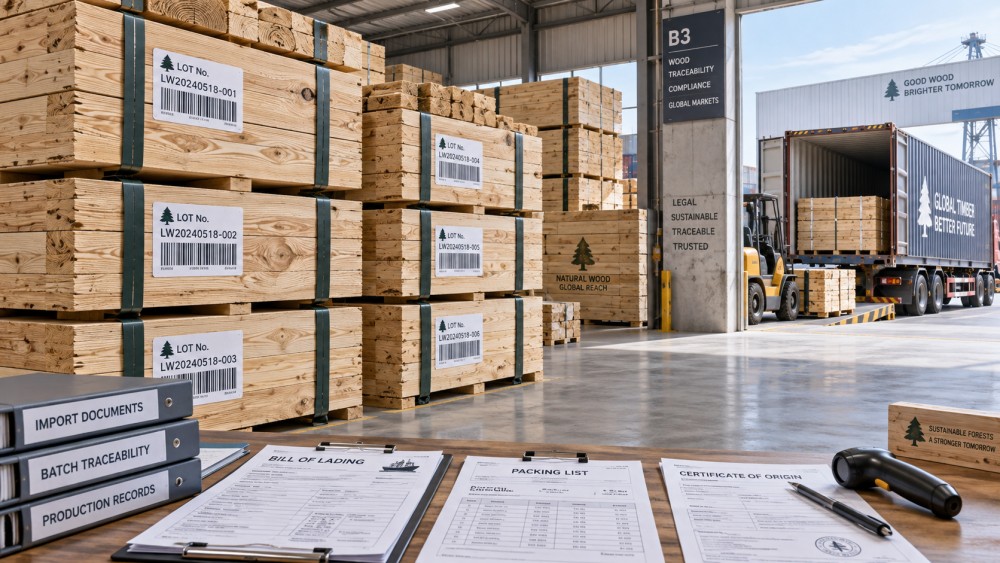
- Identify the shipment’s lots and the records used to distinguish them.
- Obtain the processor’s mapping between those lots and incoming timber batches.
- Connect incoming batches to transport, harvesting, and origin records.
- Reconcile quantities using documented conversion factors, losses, and inventory movements.
- Investigate unexplained substitutions, missing links, or implausible material balances before approval.
Quantity reconciliation is not a demand for identical figures at every stage: processing creates waste and changes measurement bases. The issue is whether the differences have a credible, documented explanation. Electronic records can help, but a digital system does not compensate for inaccurate source data.
Which documents demonstrate legality—and which do not?
The necessary evidence depends on the laws applicable where the timber was harvested and on the destination’s legal standard. Relevant records may include concession rights, harvesting authorizations, forest management approvals, royalty or tax records, and transport documentation. Some assessments also require evidence relating to land rights, environmental rules, or third-party rights.
Check what each document actually proves. A transport permit may authorize movement without proving that harvesting was lawful. An export license may establish export permission without resolving the forest source. A phytosanitary certificate addresses plant-health requirements, not the complete legality or deforestation status of the timber.
Documents should agree on species, locations, quantities, holders, and validity periods. Where authenticity is uncertain, seek verification through the issuing authority’s available procedures or obtain independently corroborating evidence. Additional copies of the same unsupported statement do not reduce the underlying risk.
Is FSC or PEFC certification enough?
Certification can support an assessment, but it does not generally replace the importer’s statutory obligations. FSC or PEFC documentation may provide useful information about forest management and chain-of-custody controls. Its value depends on the certificate’s validity, scope, product claims, and connection to the actual transaction.
Check whether the supplying entity is covered, whether the product falls within scope, and whether the invoice carries the appropriate claim. A certificate displayed on a supplier’s website does not establish that every shipment from that supplier is certified.
Also distinguish certification claims from the particular evidence the law requires. A certified product may still need a Lacey Act declaration, CITES documentation, or EUDR geolocation and due diligence information. Different certification models have different sourcing and accounting rules; do not assume that a controlled-source or mixed claim supplies the same evidence as shipment-level harvest traceability.
What if plywood, furniture, or pulp contains several sources?
Request a component-level explanation before accepting a single species or origin statement. Plywood can contain different species in its face veneers and core. Furniture can combine solid wood, veneer, and engineered panels. Pulp and paper may contain fibers from several sources.
The supplier should explain which materials are present, how origins are recorded, and how inputs are allocated to the shipment or production lot. Where declarations require constituent species and harvest countries, use the information and alternatives permitted by the applicable rules rather than inventing a simplified entry.
Mixing does not necessarily prevent compliance, but unknown inputs can. For EUDR-covered products, mixing with material of unknown origin creates a serious obstacle to demonstrating the required traceability and compliance. A bookkeeping allocation cannot by itself establish that the shipment contains only compliant material.
Recovered material also needs careful classification. Recycled content is not a universal exemption across all destinations and products. Obtain evidence of the material’s status and check the precise legal treatment, particularly where a product combines recovered and virgin fiber.
How much investigation is required before importing?
Collecting documents is only the information-gathering stage. Where due diligence is required, the importer must also assess the relevant risk and carry out mitigation when the applicable standard demands it.
Warning signs include unclear scientific names, unexplained intermediaries, inconsistent harvest countries, documents that cannot be authenticated, quantities exceeding plausible source volumes, or an unwillingness to identify harvesting locations. Broader sourcing risks can matter too, including illegal-harvesting prevalence, corruption, conflict, and supply-chain complexity.
Match mitigation to the unresolved issue. Missing production links call for better batch records; questionable permits call for verification; uncertain species may justify specialist identification. An audit is useful only if its scope addresses the actual risk and its findings can be connected to the shipment.
When the evidence cannot satisfy the applicable threshold, do not treat customs release or the supplier’s assurance as a substitute. Hold procurement approval, exclude unsupported material, or change the source. A contractual warranty helps allocate responsibilities but does not transfer away the importer’s legal duties.
What should be retained after the shipment clears?
Keep a retrievable file showing both the evidence and the decision: supplier information, source records, shipment links, declarations or reference numbers where applicable, risk assessments, mitigation actions, and the reason approval was granted. Retention periods vary by regime, so establish them against the specific obligations rather than choosing one period for all markets.
Separate commercial confidentiality from access to compliance evidence. A supplier may need secure handling of sensitive records, but refusing to provide information necessary for the importer’s obligations leaves the gap unresolved.
For repeat orders, reuse verified background information only while it remains valid. New harvest areas, species, mills, intermediaries, or material mixes should trigger review. The operational test is whether the next shipment can still be connected to the evidence supporting its approval—not whether the supplier passed an assessment once.
Got questions about this industry topic or seeking best practices for your business? Drop us a line below, and let the expert team at AgriTrade help you out.
We respect your privacy. Your information is strictly confidential.
Related News
- 00
0000-00
Buying Forestry Equipment in Germany: Parts, Service, and Ownership Costs - 00
0000-00
What Traceability Requirements Apply to Timber Imports? - 00
0000-00
How to Evaluate a Heavy-Duty Forestry Equipment Manufacturer for Harsh Terrain Projects - 00
0000-00
How Do Forestry Import Rules Differ Between the EU and Southeast Asia? - 00
0000-00
When is continuous pressing suitable for wood processing for panelboards?
0000-00
Forestry Development Editorial Team
Weekly Insights
Stay ahead with our curated technology reports delivered every Monday.