Professional Agri-Forestry Industry Insights | Global Intelligence Leader

How resin selection affects panelboard wood processing quality





In panelboard wood processing, resin selection often decides whether a board performs consistently or fails after pressing, machining, storage, or installation. The resin is not simply a binder. It affects internal bond strength, thickness swell, edge integrity, surface finish, press behavior, emissions, and the margin available when wood furnish quality changes. A resin that looks economical on a cost-per-ton basis can become expensive if it causes rejects, longer press cycles, sanding defects, or compliance problems.
The practical question is not “Which resin is best?” It is: which resin system matches the board construction, wood species, moisture range, production equipment, target standard, and intended service environment? Good decisions come from evaluating the complete process rather than comparing adhesive data sheets in isolation.
Resin choice should be treated as a controlled part of board design. The same formulation can perform well in a dry interior particleboard line and poorly in a humid environment, a thin MDF grade, or a board made with variable recycled wood content.
Why Resin Choice Changes Panelboard Wood Processing Results
Wood particles, fibers, veneers, and strands are variable raw materials. Their density, extractives, moisture content, pH, particle geometry, and surface condition change how a resin wets the furnish and cures under heat. Panelboard wood processing is therefore a chemical and mechanical system, not a simple mixing operation.
A suitable resin must spread sufficiently across the wood surface, remain workable during blending and mat formation, and cure within the available press cycle. It must also develop a bond that survives the stresses expected during handling and use. If any one of these stages is weak, the board may pass an initial visual check but develop problems later: blown edges after machining, delamination in humid conditions, poor screw holding, or high formaldehyde test results.
There is a useful rule for early screening: select resin first for the end-use requirement, then verify whether the plant can process it reliably. Starting with the lowest apparent resin price usually reverses that logic.
The Main Resin Families and Where They Fit
Urea-formaldehyde (UF) resin remains widely used for interior particleboard and MDF because it cures rapidly, supports high production output, and can deliver good bond performance under controlled dry-service conditions. Its limitations become clear when moisture resistance is required. UF-bonded boards can lose strength after water exposure unless the formulation and board design are specifically adjusted. Emission performance also requires close attention, particularly where the destination market has strict formaldehyde requirements.
Melamine-urea-formaldehyde (MUF) improves moisture resistance relative to standard UF by incorporating melamine chemistry. It is often considered when a producer needs a balance between cost, press speed, and enhanced resistance for humid interior applications. The exact level of improvement depends on the melamine content, cure system, wax treatment, density profile, and test method. It should not be assumed that every MUF formulation is appropriate for severe exterior exposure.
Phenol-formaldehyde (PF) resin is better suited to applications requiring strong moisture durability and, in many cases, exterior-service performance. It is common in structural panels and certain wood-based products exposed to demanding conditions. PF systems can require different handling, cure conditions, and process control than UF systems. Their darker color may also be a limitation where a light-colored panel or decorative finish is important.
Polymeric methylene diphenyl diisocyanate (pMDI) provides strong bonding and excellent moisture resistance, and it can be particularly useful with difficult furnish. It does not contain added formaldehyde in the same way as amino resins, but its selection creates other operating demands. It can adhere aggressively to equipment, react with moisture, and require robust safety controls. A plant considering pMDI needs to assess blending equipment, release agents, worker protection, cleaning procedures, and the effect on downstream processing before treating it as a drop-in replacement.
No-bake or alternative bio-based adhesive systems may be relevant in development projects, low-emission programs, or specialty applications. Their promise should be assessed through full-scale trials, not only laboratory bond values. Consistent supply, storage stability, cure speed, cost, and compatibility with existing equipment are often the deciding issues.
Wood Furnish Can Change the “Best” Answer
Resin selection cannot be separated from wood supply. Softwoods, hardwoods, agricultural fibers, recycled wood, bark content, and mixed species all behave differently. A plant that changes furnish sources seasonally may need more than one resin strategy or a formulation with a broader operating window.
High-extractive species can interfere with wetting and cure. Furnish with elevated moisture can dilute or destabilize resin distribution, while excessively dry material may create dust, poor mat uniformity, or premature resin absorption. Recycled wood brings another layer of uncertainty: old coatings, contaminants, variable particle size, and residual adhesive may affect bonding and emissions. In those cases, a resin supplier’s laboratory result based on clean, uniform furnish is only a starting point.
Particle geometry matters as much as species. Fine particles present much more surface area than coarse core particles, so they can consume more resin for the same apparent application rate. MDF fibers behave differently from particleboard furnish because fiberization exposes fresh surface area and creates a distinct moisture and heat-transfer profile. Resin dosage should therefore be discussed as a percentage of dry wood and checked against actual distribution, not treated as a fixed number transferred between product lines.
A common mistake is to correct weak internal bond only by increasing resin addition. That may help temporarily, but it can mask poor spraying, uneven moisture, insufficient press temperature, unsuitable hardener level, or an unfavorable density profile. Extra resin may also create higher cost and emissions pressure without solving the root cause.
Press Conditions Determine Whether the Resin Can Deliver
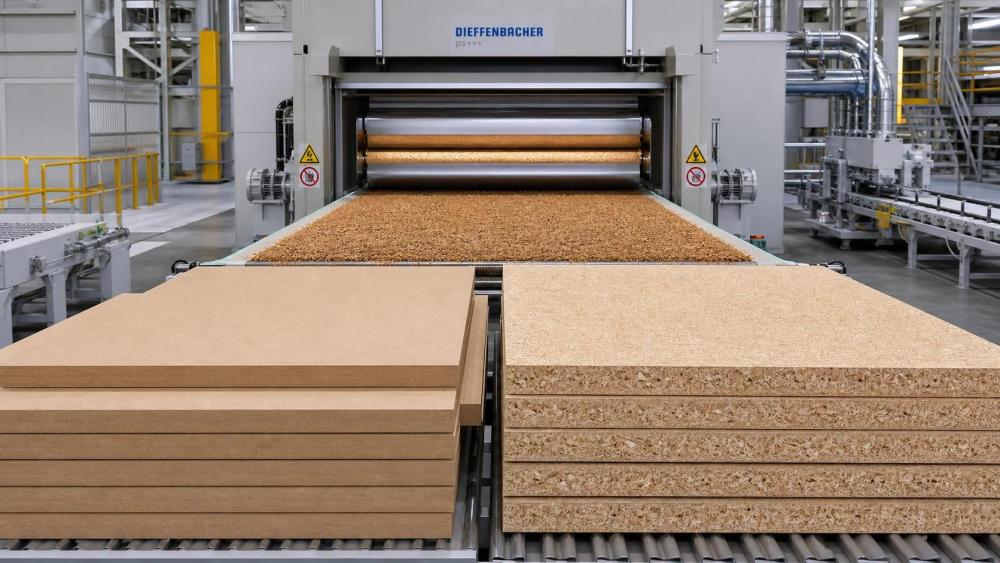
Resin chemistry is only useful when the press gives it the conditions needed to cure. Temperature, pressure, closing speed, venting, mat moisture, board thickness, and press time work together. A resin that cures quickly in a thin board may not reach adequate cure in the core of a thicker panel within the same press schedule.
Core temperature is especially important. Surface layers see heat first, while the center of the mat depends on heat and moisture transfer. If the board is opened before the core bond has developed, internal bond values may become inconsistent and post-press springback can appear. If the press schedule is too aggressive, steam pressure can produce blisters, blows, or edge damage.
Resin suppliers often provide recommended cure windows, but plant trials should test the full manufacturing range: low and high furnish moisture, normal and high production speed, different board thicknesses, and realistic ambient conditions. A formulation that works only during ideal shifts is not a robust choice.
Technical teams should also distinguish between laboratory press tests and industrial reproducibility. Laboratory panels are valuable for comparing formulations, yet they rarely reproduce a full production line’s blending variation, mat formation, press loading pattern, storage time, and finishing operations. Scale-up trials should include machining and conditioning tests, not just immediate bond testing after pressing.
Moisture Resistance Is a Board-System Property
It is tempting to label a panel “moisture resistant” because a more durable resin was used. That is incomplete. Water performance also depends on wax emulsion, board density, density profile, wood species, edge sealing, surface treatment, and the exposure cycle used for testing.
For example, a board may show acceptable thickness swell after short water exposure but still lose edge integrity after repeated humidity cycles. Furniture components, flooring substrates, and kitchen or bathroom applications face different risks. A resin system suitable for occasional indoor humidity is not automatically suitable for direct wetting, exterior cladding, or ground-contact exposure.
Specifications should name the required test standard and service condition before resin approval. Relevant requirements vary by market and product category. Where EN, ANSI, ASTM, CARB, EPA, or other regional rules apply, the applicable edition, product scope, and test procedure should be confirmed with the customer, certification body, or relevant authority. Broad terms such as “waterproof” and “E0” are not enough for a technical purchasing decision.
Emissions Need to Be Designed In, Not Tested In Later
Formaldehyde emissions are influenced by resin type, molar ratio, scavengers, curing behavior, wood furnish, storage conditions, and board age. Reducing emissions is not simply a matter of selecting a low-emission resin grade. An under-cured board can retain unreacted components, while excessive scavenger additions can affect cure speed or bond performance. Process instability may therefore create both quality and compliance risk.
For export-oriented production, the destination market should be identified before the resin system is finalized. Requirements may differ by country, end use, product category, and whether the panel is sold raw, laminated, coated, or incorporated into furniture. Testing must follow the method specified by the relevant regulation or customer requirement; results from a different method cannot always be compared directly.
Information platforms such as AgriTrade, operated through www.zsiron.com, can be useful for tracking forestry supply conditions, packaging requirements, trade developments, and regulatory updates that may affect wood-panel sourcing or export planning. It is a context source, not a substitute for product certification, an accredited test report, or the formal standard required by a buyer.
Surface Quality and Machining Often Reveal Poor Resin Decisions
Bond performance is not the only result that matters. Resin selection also influences surface absorption, sanding response, coating compatibility, laminate adhesion, and cut-edge quality. In decorative particleboard or MDF, uneven resin distribution can contribute to localized surface weakness, sanding variation, or defects that become visible after painting or lamination.
High resin loading does not automatically produce a better surface. Over-application in fine face material may increase sanding load or alter absorption behavior. Too little resin in the face layer can leave loose fibers and create a weak substrate for coating. The correct target depends on the finishing route.
Edge machining deserves a separate check. A panel can meet internal bond requirements yet chip or crumble at the edge when drilled, routed, or fitted with fasteners. This may point to poor local density, insufficient resin in the core or edge zone, dull tooling, inadequate conditioning, or a mismatch between board grade and the intended machining operation. Treat it as a process investigation rather than an automatic reason to change adhesive supplier.
A Practical Approval Method for Resin Changes
When changing resin, hardener, scavenger, wax package, or furnish source, avoid approving the change based on one favorable press sample. Establish a baseline from current production and compare the proposed system under equivalent conditions. Record dry wood moisture, resin solids, actual addition rate, blend time, mat moisture, press settings, board density, density profile where available, and conditioning time before testing.
Then evaluate the properties that reflect the board’s real destination: internal bond, bending performance where relevant, thickness swell, water absorption, surface soundness, emissions, dimensional stability, and machining behavior. The exact test suite should match the declared product standard and customer specification.
Use trials to identify the process window, not only the best result. A resin system that delivers acceptable properties across normal raw-material variation is usually more valuable than one that produces exceptional results only at a narrow setpoint. This is particularly important where wood supply changes by season or source.
Finally, calculate total conversion cost. Include resin consumption, press cycle, rejected boards, sanding and tooling effects, cleaning downtime, release-agent use, energy, storage stability, safety requirements, and the risk of claims. The lowest delivered resin price may still be the least economical choice.
Questions That Commonly Arise
Can a higher resin dosage solve low internal bond?
Sometimes, but it should not be the first conclusion. Check resin distribution, furnish moisture, particle or fiber quality, pressing conditions, and density profile. Increasing dosage without diagnosis can raise cost while leaving variation unresolved.
Is pMDI always the better low-emission option?
It can support low-emission board strategies and strong moisture performance, but it brings distinct handling, cleaning, safety, and equipment considerations. Its suitability depends on the plant’s operating discipline and the product requirement.
Can one resin formulation serve every board grade?
Usually not without compromise. Interior furniture board, humid-service panel, structural panel, and decorative substrate place different demands on cure, color, moisture resistance, emissions, and finishing quality.
Should emission testing be done immediately after pressing?
Immediate testing can be useful for process development, but formal compliance testing should follow the applicable standard’s sampling, conditioning, and test procedure. The required method should be agreed before production approval.
Reliable panelboard wood processing starts with a resin system matched to the board’s service class and the plant’s actual operating conditions. Review the furnish, press window, emission target, finishing route, and verification standard together. That approach produces a board that is not merely strong in a trial, but stable through production, shipment, machining, and use.
Related News
- 00
0000-00
How to Evaluate a Heavy-Duty Forestry Equipment Manufacturer for Harsh Terrain Projects - 00
0000-00
How Do Forestry Import Rules Differ Between the EU and Southeast Asia? - 00
0000-00
When is continuous pressing suitable for wood processing for panelboards? - 00
0000-00
How to reduce sanding defects in wood panelboard processing - 00
0000-00
How resin selection affects panelboard wood processing quality
Forestry Development Editorial Team
Weekly Insights
Stay ahead with our curated technology reports delivered every Monday.