Professional Agri-Forestry Industry Insights | Global Intelligence Leader

Why Soy Sauce Choice Matters for Noodle Flavor, Color, and Finish





Noodle quality is often judged in the first few seconds: aroma from the bowl, surface shine, the depth of color, and the way flavor lingers after swallowing. In many kitchens and production lines, operators focus heavily on flour strength, hydration, boiling time, and broth concentration. Those variables matter, but the seasoning step can quietly reshape all of them. The choice of sauce is not just a matter of saltiness. It affects how the noodle tastes in the center, how the exterior looks after mixing, and whether the final dish appears clean, glossy, muddy, or flat.
For anyone preparing sauced noodles, soup noodles, chilled noodles, or noodle kits, selecting the wrong sauce can create problems that are hard to fix later. A batch may taste sharp instead of rounded. The strands may darken too quickly during holding. Oil may separate on the surface. A formula that works for thick wheat noodles may overwhelm delicate egg noodles. These are operating issues, not abstract flavor theory.
Why sauce selection changes more than salt level
Many users still treat soy-based seasoning as a single interchangeable ingredient. In practice, different products vary in fermentation character, amino acid depth, sweetness, color intensity, viscosity, and finish. That means two sauces with similar sodium perception can behave very differently once they touch hot noodles, starch-rich cooking water, aromatic oil, vinegar, chili paste, or soup stock.
One practical way to think about noodle seasoning is to separate three outcomes:
- Flavor build: initial salt impact, umami depth, sweetness, roasted or fermented notes, and aftertaste
- Color contribution: how quickly the noodle surface darkens and whether the tone is reddish, brown, bright, or dull
- Finish on the palate and on the noodle surface: clean, dry, oily, sticky, glossy, or heavy
When operators evaluate only taste in a spoon, they may miss how the sauce performs on actual noodles. A sauce that tastes balanced on its own can become harsh after reduction in hot broth. Another may look attractive in the bottle but produce a gray-brown cast when mixed with starch and garlic oil.
Flavor in noodles depends on how the sauce meets starch, water, and heat
Noodles are not neutral carriers. Their starch content, surface roughness, alkalinity, and temperature all influence seasoning pickup. Fresh wheat noodles, alkaline ramen noodles, rice noodles, and pre-cooked frozen noodles each absorb and release moisture differently. That changes how sauce disperses and how quickly flavor reaches the palate.
In dry-mixed noodles, the seasoning has direct contact with the noodle surface. Here, a sauce with stronger fermented notes may create more depth even at a lower dosing rate, while a lighter sauce may disappear once sesame paste, scallion oil, or chili oil is added. In soup noodles, dilution is the central challenge. A product that performs well in concentrated tare may seem weak after broth addition, especially if the stock has strong chicken, pork, seafood, or mushroom notes.
The umami side deserves close attention because noodles often need more than simple salinity to taste complete. Fermented components can widen the flavor profile and reduce the impression of “salty but empty.” For operators comparing options, technical background on soy sauce can be useful when trying to understand why some products create a longer, rounder finish instead of a short salt hit.
Heat also changes perception. During wok tossing or hot bowl assembly, volatile aroma compounds lift quickly. A sauce that smells rich at room temperature may lose top notes under heat, leaving only color and salt. This is one reason small-batch bench tasting can mislead production decisions. The better test is application-level tasting: use the target noodle, target oil, target broth, and target hold time.
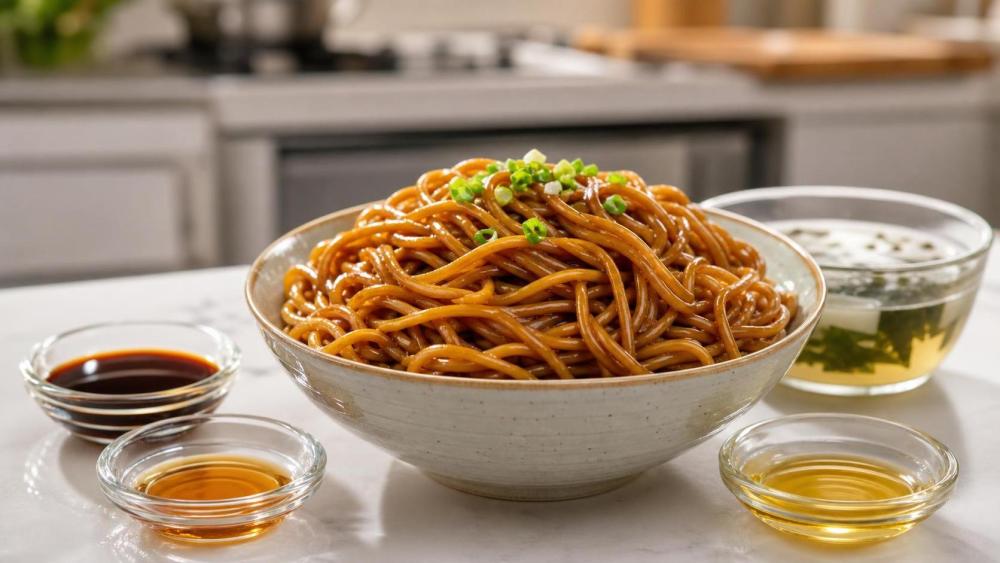
Color control is a quality issue, not just a visual preference
Customers often read noodle color as a signal of flavor strength and freshness. A glossy amber-brown coating can suggest richness. A muddy or overly dark surface may suggest over-seasoning, oxidation, or poor handling, even if the product is safe and technically consistent.
Different sauces contribute color in different ways. Some deliver a lighter savory tone suitable for pale broths or seafood noodles. Others add strong darkness quickly, which may be useful in braised or stir-fried applications but risky in premium soup formats where clarity matters. For operators, the key question is not “dark or light” in isolation. It is whether the color remains stable after mixing, holding, reheating, or contact with acidic ingredients.
Common issues include:
- Noodles look attractive immediately after mixing but darken further during service holding
- Surface color appears uneven because sauce concentration is too high for the mixing method
- Broth turns cloudy-brown, masking stock clarity
- Cold noodles lose brightness after refrigeration, making the dish look stale
These problems often come from a mismatch between sauce intensity and process conditions. If noodles are tossed while still carrying too much cook water, color can spread unpredictably and dilute flavor. If concentrated seasoning is poured directly onto a portion without pre-blending, local dark spots may appear. In central kitchens, long hold times and repeated reheating can amplify these defects.
The finish: what diners notice after the first bite
“Finish” is easy to overlook because it sits between texture and flavor. In noodle dishes, it includes the shine on the strand, the coating feel in the mouth, and the length of savory aftertaste after swallowing. Operators usually encounter finish problems as complaints such as “too sticky,” “too dry,” “too heavy,” or “tastes flat at the end.”
Sauce selection influences finish in several ways. A more rounded fermented profile can make the noodle taste complete without requiring excessive oil or sugar. A sharper profile may need balancing ingredients, which can increase cost or complicate process control. If the seasoning lacks persistence, teams sometimes compensate with extra salt, only to create a harsh front-end flavor that still fades too fast.
Surface finish matters operationally as well. In takeaway and ready-to-assemble formats, noodles continue to interact with seasoning after packing. A sauce that works well for dine-in service may cause clumping or over-softening after 20 to 30 minutes in a closed container. For chilled noodles, excessive stickiness can make portion separation difficult and damage presentation.
Selection points operators should test before approving a sauce
Tasting from a spoon is not enough. A practical review should include the full application. The table below can help structure trials.
It is also useful to compare the same seasoning across at least two noodle formats. A sauce that performs well on thick wheat noodles may not suit thin low-oil noodles because the coating ratio changes. If the dish includes acidic toppings, seaweed, sesame paste, or spice oils, those should be present during testing. Real defects often appear only in the complete system.
Procurement and quality checks that prevent downstream problems
From a purchasing and operations perspective, consistency matters as much as flavor quality. Even a good sauce can become a production problem if batch-to-batch variation changes color intensity or finish. Operators and buyers should align on a specification that reflects actual use, not only generic product descriptions.
Points worth checking during supplier review or incoming evaluation include:
- Whether the sauce is intended for direct noodle seasoning, broth blending, or cooking applications
- How concentrated the flavor is relative to the intended dosing rate
- Whether color contribution is stable enough for the target dish style
- How it behaves in hot and cold applications
- Storage conditions and how opened product performs during routine kitchen use
- Whether trial samples are evaluated under realistic process conditions rather than only in water dilution
For factories and central kitchens, documentation and handling procedures matter too. If operators do not know whether a product should be pre-diluted, mixed with oil first, or added after broth adjustment, the same sauce can produce different results across shifts. What looks like ingredient inconsistency may actually be an execution problem.
Matching sauce character to noodle style
There is no single best choice for all noodles. The right direction depends on the product format and the role of seasoning in the bowl.
Light soup noodles
These usually need controlled color contribution and a cleaner finish. If the sauce is too dark or too heavy, the broth loses clarity and the noodle can taste masked rather than seasoned.
Dry mixed noodles
These often need stronger aromatic and umami presence because there is less liquid to carry flavor. Surface gloss and even coating become more important, especially for takeaway.
Stir-fried noodles
Heat tolerance matters more here. The sauce must maintain flavor after contact with a hot pan, oil, vegetables, and protein juices. Overly delicate notes may disappear.
Chilled or packaged noodles
Hold stability is central. The seasoning should resist dulling, pooling, or excessive tightening of the noodle mass during storage.
That is why “good taste” is too vague a criterion. The better question is whether the product supports the intended bowl style without forcing compensating changes elsewhere in the formula.
Where teams often make the wrong call
One common mistake is choosing based only on price per container rather than use cost at target flavor strength. A cheaper product may require a higher dosing rate or extra balancing ingredients. Another mistake is selecting by color in the bottle instead of color on the noodle. The visual result after mixing can be very different.
Some teams also overlook the interaction between seasoning and process water. Residual cook water can soften salt impact and change coating behavior. If process control is loose, operators may blame the sauce for defects caused by variable draining. In these cases, the solution is not only ingredient adjustment but also tighter standardization at the station.
For noodle programs that run across multiple sites, the most useful approach is a short, repeatable approval protocol: fixed noodle weight, fixed residual water target, fixed oil level, fixed hold time, and side-by-side tasting after actual service conditions. That makes flavor, color, and finish easier to compare and reduces subjective debate.
Choosing for performance, not just label familiarity
The sauce in a noodle dish is doing several jobs at once. It seasons, colors, rounds, and shapes the final mouthfeel. When the match is right, the bowl tastes integrated and looks intentional. When the match is poor, teams end up correcting with extra oil, sugar, broth reduction, or inconsistent portioning.
For users and operators, the practical standard is simple: judge the product where it will actually be used. Test it on the noodle, at service temperature, with the real process, and after the expected hold time. Flavor, color, and finish are connected outcomes, and the sauce choice sits at the center of all three.
Related News
- 00
0000-00
What Determines Soy Sauce Flavor Balance and Quality for Noodle Dishes - 00
0000-00
What Payback Period Makes Food Processing Equipment ROI Worth Approving? - 00
0000-00
What to Verify Before Ordering Stainless Steel Mixing Tanks for Alcohol - 00
0000-00
Stainless Steel vs. Carbon Steel Edible Oil Storage Tanks: Material Selection for Beverage Industry Hygiene Compliance - 00
0000-00
Selecting Dairy Processing Equipment by Product Viscosity, Capacity, and Hygiene Risk
Food Processing Editorial Team
Weekly Insights
Stay ahead with our curated technology reports delivered every Monday.