Professional Agri-Forestry Industry Insights | Global Intelligence Leader

Which factors determine food processing equipment ROI?





A processing line can look profitable on a spreadsheet and still become an expensive operational burden once it reaches the factory floor. This often happens when a company replaces manual work, adds a new packaging format, or tries to relieve a bottleneck before a busy production season. The quotation arrives, the rated output appears attractive, and the purchase price becomes the center of the discussion. Later, the team finds that the new machine requires more downtime than expected, consumes too much energy, cannot handle product variation smoothly, or depends on operators with skills that are difficult to maintain.
The consequences are not limited to the equipment budget. A poorly matched investment can affect delivery commitments, product consistency, labor scheduling, waste levels, maintenance planning, and even the ability to meet food safety requirements. When reviewing food processing equipment ROI, the useful question is not simply “Will this machine pay for itself?” It is “Under our real operating conditions, where will value be created, where can it be lost, and how reliable are the assumptions behind the calculation?”
Start with the problem the equipment is meant to solve
Before comparing brands, capacities, or automation features, define the operating problem in practical terms. A line may be underperforming for several different reasons: manual loading may slow the process, cleaning may take too long, raw material variation may cause stoppages, or packaging may be limiting finished-goods output. Buying a faster machine will not necessarily resolve all of these issues.
A common mistake is treating “higher capacity” as the objective. In reality, capacity only creates value when upstream supply, labor availability, utilities, downstream packaging, storage space, and sales demand can absorb it. A cooker, freezer, filler, grader, slicer, dryer, or sealing machine can have an impressive nominal output while operating well below that level because another stage in the line remains constrained.
It helps to write the intended improvement in a short operational statement. For example: reduce repetitive manual handling at a specific stage; improve consistency in portion size; shorten changeover time between product formats; lower product loss during filling; or increase throughput without extending shifts. This statement becomes the basis for evaluating whether a proposed machine addresses the real issue rather than merely adding capacity.
When the problem is unclear, the return estimate becomes fragile. Savings may be counted twice, production gains may be assumed without a confirmed sales outlet, and maintenance burdens may be overlooked. The strongest investment cases begin with a visible process constraint, not with a supplier brochure.
Rated capacity is only the starting point
Equipment specifications usually state output per hour, but actual usable production depends on conditions that are rarely identical to those used for a standard demonstration. Product size, moisture level, temperature, viscosity, seasoning, packaging material, batch variation, sanitation intervals, operator loading speed, and changeovers all influence the result.
For this reason, capacity should be evaluated at three levels. The first is rated capacity, which is useful for initial comparison. The second is expected capacity using the company’s actual products and packaging formats. The third is saleable capacity: the amount that can be produced consistently, accepted by quality control, stored safely, and sold without creating excess inventory.
Consider a line that processes different raw material grades during the year. If the equipment works smoothly only with the most uniform inputs, then the apparent throughput advantage may disappear during normal seasonal variation. In seafood, meat, fruit, vegetables, grains, and prepared foods, product behavior can shift significantly with temperature, origin, maturity, fat content, water content, or handling conditions. A machine should be assessed against the range of materials it will really receive, not only an ideal sample.
Ask for a process trial where possible, using representative material and the intended package or recipe. If a live trial is not practical, request detailed clarification about the operating range, cleaning method, changeover tasks, product-contact surfaces, utility needs, and known limitations. This is not about questioning a supplier’s capability; it is about preventing a mismatch between the designed application and the daily production environment.
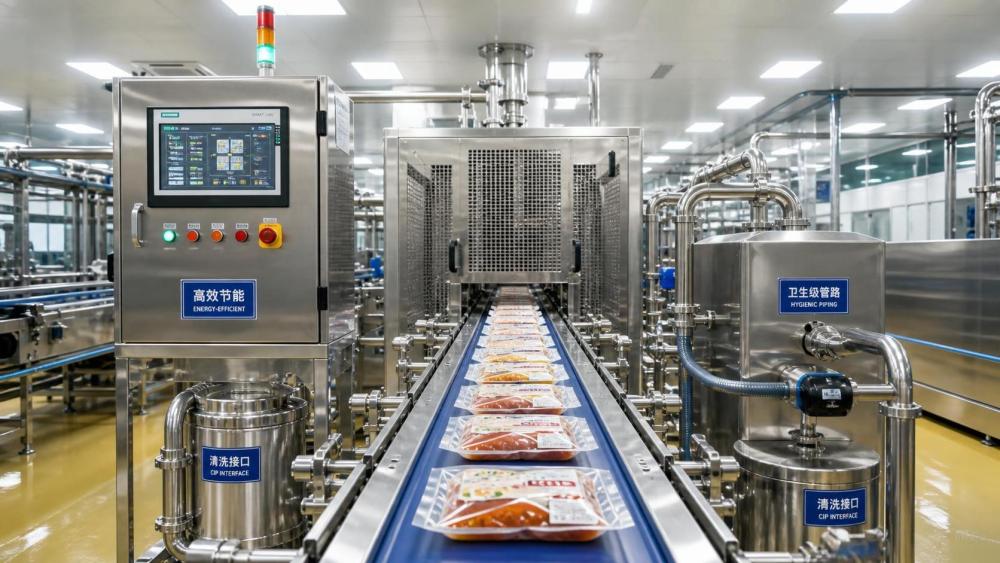
Labor savings must be measured against the work that remains
Automation is frequently used as the main justification for new equipment. It can reduce manual handling, improve repeatability, and make staffing less dependent on a small number of experienced operators. Yet labor savings are often overstated because a manual task does not always disappear; it may move to loading, inspection, cleaning, recipe setup, material replenishment, troubleshooting, or quality verification.
A more realistic review maps the current and future workstations. Record who performs each task, when the task occurs, whether it is continuous or intermittent, and whether the same person can be reassigned to a productive role. If automation removes one operator from a station but requires another person to monitor alarms, feed materials, and manage frequent adjustments, the net labor effect may be modest.
Labor availability also matters. In facilities where staffing is unstable, a machine that simplifies repetitive work may provide value even if direct payroll reduction is limited. It can make production planning more predictable and reduce the risk of missed output when temporary labor is unavailable. That benefit should be described honestly as risk reduction or scheduling stability, rather than being converted into unsupported savings figures.
Training requirements deserve similar attention. Equipment that is technically advanced but difficult to operate can create dependence on a few trained individuals. Look at the learning curve, the clarity of operating procedures, the availability of local-language documentation where relevant, and the time required to train new staff after turnover.
Energy, water, compressed air, and cleaning change the economics
The purchase price is visible; operating resources are often less visible until the equipment is installed. Thermal processing, refrigeration, freezing, drying, pumping, vacuum systems, compressed-air controls, and automated cleaning can all alter utility demand. The impact depends on production hours, local utility costs, peak-load conditions, and whether existing infrastructure can support the new unit.
A machine may appear efficient in isolation but require upgrades to electrical supply, ventilation, drainage, steam generation, chilled water, compressed air, or wastewater handling. Those associated costs belong in the investment decision, even if they are quoted separately. So do installation access issues, floor reinforcement, pipework, guarding, commissioning support, and integration with existing conveyors or control systems.
Cleaning is especially important in food operations. The relevant comparison is not simply whether a unit can be cleaned, but how much labor, water, chemicals, downtime, disassembly, and verification are required to clean it between runs. A design that reduces difficult-to-access areas may improve uptime and sanitation control. Conversely, an automated system can become inefficient if its cleaning cycle is long, poorly matched to the production schedule, or difficult to verify.
For food processing equipment ROI, utility costs should be estimated under expected operating conditions rather than taken from a single maximum or minimum specification. Where uncertainty remains, build a range into the evaluation instead of relying on one optimistic number.
Quality gains can be commercially important, but they need a clear path to value
Not every return comes from producing more units. Equipment may improve cut accuracy, fill-weight control, sealing consistency, cooking uniformity, sorting precision, traceability records, or appearance of the final pack. These outcomes can reduce rework, complaints, giveaway, rejected product, and raw material loss. They can also support a more consistent brand presentation in retail, foodservice, or export channels.
However, quality improvement should not be treated as automatic revenue growth. The financial value depends on whether the business can measure the reduction in loss, avoid a known problem, meet a buyer specification, or access a product format that the market genuinely wants. If a new line produces a more attractive package but the sales team has not validated demand, the result may be higher production cost without stronger margins.
It is useful to separate quality effects into operational and commercial categories. Operational effects include fewer rejects, less overweight filling, lower breakage, better yield, and fewer stoppages caused by inconsistent product. Commercial effects include compliance with buyer specifications, improved shelf-life performance where validated, or the ability to offer a required pack format. Keeping these categories separate makes it easier to avoid assigning value twice.
Food safety and compliance should be treated as operating conditions, not optional extras
Equipment selection is closely connected to hygienic design, material compatibility, cleaning access, contamination control, allergen management, inspection points, and recordkeeping. The applicable requirements differ by product, market, and facility, so there is no universal equipment configuration that suits every processor.
The practical question is whether the machine can be incorporated into the site’s existing food safety system without creating new weak points. Review product-contact areas, seals, joints, drainage, cleaning access, foreign-material controls, and the ability to inspect areas that may retain residue. If allergens, raw and ready-to-eat products, or high-care zones are involved, workflow separation and sanitation procedures may be more important than nominal speed.
Traceability also affects value. A machine with batch settings, production records, alarm history, or integration capability may reduce investigation time when a deviation occurs. But digital functions create value only if the facility has procedures for reviewing and using the information. Data that is collected but never checked does not meaningfully reduce risk.
Maintenance risk is often where a promising return estimate weakens
Downtime is expensive because it affects labor, production scheduling, raw material use, and customer delivery. Yet maintenance is sometimes assessed only by asking whether spare parts are available. A stronger review considers the full support picture: expected wear parts, service intervals, remote diagnostics, local technical support, response arrangements, documentation, electrical and mechanical complexity, and the availability of operators or technicians who can carry out routine tasks safely.
For a processor in a remote region or one serving time-sensitive export orders, support distance can matter as much as machine capability. If replacement components must travel through a long import process, a small part failure may become a significant production interruption. Keeping selected critical spares on site can reduce exposure, but it also adds inventory cost and requires the team to know which components are truly critical.
Maintenance planning should distinguish between predictable work and unexpected faults. Predictable work includes lubrication, inspections, calibrations, belt or seal replacement, blade sharpening, and cleaning-related checks. Unexpected faults are harder to price, but their likelihood can be explored through design simplicity, operating history in comparable applications, and the clarity of preventive maintenance requirements.
Compare alternatives as operating models, not just machines
A sensible decision may involve several options: retaining the current process with targeted improvements, buying a semi-automatic unit, investing in a fully integrated line, outsourcing part of the process, or purchasing equipment in phases. The lowest-cost option is not always the least risky, and the most automated option is not always the most productive.
Semi-automatic equipment can suit a business with variable volumes, frequent product changes, limited space, or a need to preserve flexibility. A more integrated line may be appropriate when product specifications are stable, demand is established, and the plant can support continuous operation. Modular arrangements can be useful when future expansion is likely but timing remains uncertain. The important point is to compare each alternative against the same operating assumptions.
Use a decision model that includes capital cost, installation, utilities, labor changes, expected production hours, yield effects, cleaning time, maintenance, financing where relevant, and the cost of disruption during commissioning. Then test the model under less favorable conditions: lower utilization, more frequent changeovers, higher utility cost, slower ramp-up, or delayed demand. If the return only works under ideal conditions, the investment may need redesign or further validation.
Turn the evaluation into a practical approval decision
Before approval, bring production, maintenance, quality, procurement, finance, and commercial teams into the same discussion. Each group sees a different part of the risk. Production may identify handling constraints; maintenance may spot service exposure; quality may identify cleaning or inspection issues; finance may challenge assumptions; and commercial teams can confirm whether added capacity has a credible market.
The final decision should state the conditions under which the equipment is expected to perform: product range, operating hours, staffing arrangement, utility availability, cleaning schedule, maintenance plan, required training, and expected sales utilization. This makes the investment easier to review after commissioning and prevents the original assumptions from being lost when personnel change.
A sound equipment decision is rarely based on one attractive specification. It comes from matching the machine to the actual process, testing capacity assumptions, accounting for utilities and support, and treating quality and compliance as part of normal production economics. When those factors are considered together, the return calculation becomes less optimistic on paper but far more useful in practice.
Related News
- 00
0000-00
What Determines Soy Sauce Flavor Balance and Quality for Noodle Dishes - 00
0000-00
What Payback Period Makes Food Processing Equipment ROI Worth Approving? - 00
0000-00
What to Verify Before Ordering Stainless Steel Mixing Tanks for Alcohol - 00
0000-00
Stainless Steel vs. Carbon Steel Edible Oil Storage Tanks: Material Selection for Beverage Industry Hygiene Compliance - 00
0000-00
Selecting Dairy Processing Equipment by Product Viscosity, Capacity, and Hygiene Risk
Food Processing Editorial Team
Weekly Insights
Stay ahead with our curated technology reports delivered every Monday.