Professional Agri-Forestry Industry Insights | Global Intelligence Leader

Where Tomato Sauce Fits on Foodservice Menus and Why Consistency Matters





Menu planning in foodservice is rarely about a single ingredient. It is about repeatability across shifts, locations, and seasons. Tomato-based items expose that challenge quickly because they appear in so many formats: pasta dishes, pizza programs, braised entrées, sandwich builds, prepared sides, and global menu items that rely on a red sauce base. When a kitchen uses one sauce profile on Monday and a noticeably different one on Thursday, guests may not know why the dish feels off, but they notice. For operators and buyers, that makes consistency less of a culinary preference and more of an operational requirement.
Tomato sauce sits in a practical middle ground on many menus. It can be a finished component, a mother base, or a platform for customization. In each role, it affects food cost control, prep time, labor dependency, and guest perception. Buyers evaluating sauce applications for foodservice need to look beyond flavor alone. Texture, solids level, seasoning balance, acidity, heat stability, packaging format, and lot-to-lot variation all influence whether a sauce works well in a real kitchen.
Why tomato sauce appears across so many menu categories
Few pantry items move as easily across dayparts and cuisine styles. A single tomato base may support pasta service at lunch, become a pizza spread in the afternoon, and serve as a component in casseroles or simmered dishes during dinner production. In quick-service and casual dining settings, tomato-based sauces also fit dips, meatball glazing, baked appetizers, and sandwich applications.
That flexibility matters for menu engineering. Buyers often prefer ingredients that can serve multiple SKUs without forcing the kitchen to manage too many separate products. A versatile sauce can reduce storage complexity and simplify ordering, especially where back-of-house space is tight. Even in larger operations, overlapping use cases help reduce dead inventory and lower the chance that partially used ingredients sit too long in cold storage.
Still, broad usability only creates value if the sauce behaves predictably in different applications. A sauce that works in pasta may separate on pizza. A sauce that tastes balanced in a short-cook dish may become too sharp after simmering. That is why menu fit should be assessed by use condition, not by label alone.
Where consistency matters most on the line
In foodservice, consistency has at least three layers: sensory consistency, process consistency, and commercial consistency.
Sensory consistency covers the guest-facing basics: color, aroma, flavor balance, mouthfeel, and cling. If one batch is sweeter and another more acidic, the same recipe card will produce a different result. That becomes even more visible in simple dishes where the sauce is not masked by heavy seasoning.
Process consistency affects how the kitchen works. Line cooks rely on a sauce to portion the same way, spread the same way, and reduce at a similar rate. A thinner-than-expected sauce can throw off pizza make lines, soak bread in sandwich builds, or require extra thickening steps that increase labor and waste. A thicker product may need dilution or reheating adjustments, which can change flavor concentration.
Commercial consistency is often overlooked in early product trials. It includes package yield, hold time after opening, damage risk in transport, and supply reliability. A sauce that tastes excellent in a test kitchen may create purchasing problems if lead times are unstable or if the packaging does not match the operator’s throughput.
These layers connect directly to menu performance. If a signature baked pasta requires a specific sauce viscosity to coat noodles evenly and survive oven finish without pooling oil or water, minor variation can affect both appearance and serving speed.
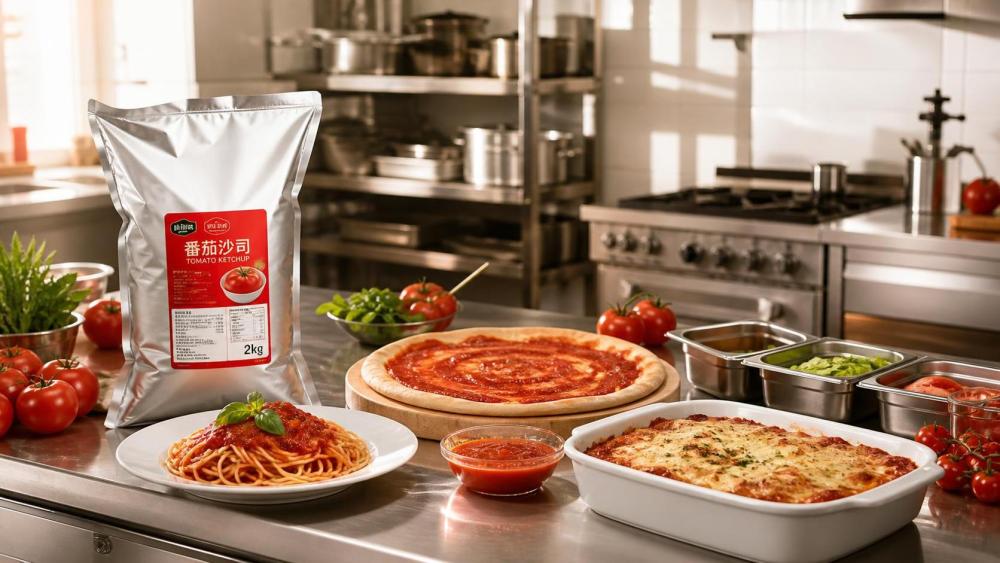
Application by menu type is not one-size-fits-all
Foodservice buyers usually get better results when they define the target application before reviewing products. Tomato sauce for one menu role may not be suitable for another, even within the same kitchen.
Pasta and composed entrées
For pasta service, cling and flavor balance are usually more important than raw brightness. The sauce should coat rather than slide off, and it needs enough body to remain appealing under heat lamps or during delivery hold. Kitchens serving high-volume lunch traffic often prefer a sauce that reheats evenly and tolerates batch holding without splitting.
Pizza and flatbreads
Pizza programs need spreadability and moisture control. Excess water can weaken crust texture, while over-thick sauce may apply unevenly and slow assembly. Seasoning style matters too. Some pizza applications work best with a restrained flavor profile because cheese, cured meats, and toppings contribute salt and fat.
Prepared foods and hot holding
In trays, pans, and buffet formats, sauce stability under prolonged heat becomes critical. Acidity can intensify, herbs may become dull, and oil separation becomes more visible over time. Buyers should assess not only how the sauce tastes fresh, but how it performs after holding and repeated stirring.
Customization bases
Many kitchens use tomato sauce as a neutral or semi-seasoned base for local menu adaptation. That can work well when labor is available and recipe execution is disciplined. It is less effective where staffing is inconsistent, because each added customization step increases variation risk. In those settings, a more application-ready sauce may support better output consistency even if the base cost is higher.
What buyers should evaluate beyond flavor
Tasting is necessary, but it is not enough. A product that performs well in a spoon test may still create issues in production. Buyers comparing options should review at least the following operational factors.
For information-stage buyers, this is where many comparisons become more meaningful than simple price-per-case discussions. A lower-cost sauce may require additional seasoning, reduction, or correction steps. That can shift cost into labor, create wider yield variation, and make training harder for multi-shift teams.
How processing and formulation affect menu performance
Two sauces can look similar on a specification sheet and still behave differently on the line. Processing method, concentration level, and seasoning design all matter. A sauce with higher solids may hold better on baked items, while a looser sauce may be easier to ladle in a pasta station. Formulation also affects how a sauce responds when mixed with cream, stock, wine, or pan drippings.
Buyers should pay attention to whether the intended use involves direct serving, dilution, or secondary cooking. If the sauce will become part of a braise or soup base, the starting concentration changes how much control the kitchen has over final texture. If it will be used as a ready-to-serve finishing sauce, consistency in seasoning and mouthfeel becomes more critical because there is less room for adjustment.
This is also the point where a reference page explaining everyday and foodservice uses can be helpful. Materials that outline how tomato-based sauces function across common kitchen scenarios can support internal discussion between purchasing, culinary, and operations teams, especially when the same product may be assigned to more than one menu role.
Supply chain and packaging decisions shape consistency too
Foodservice buyers often focus on the sauce itself and leave packaging questions for later. In practice, packaging can influence whether consistency is achievable. Large packs may improve unit economics for high-volume kitchens, but they can create quality drift after opening if usage is slower than expected. Smaller formats may support freshness and portion discipline, though they can increase handling labor and packaging waste.
Distribution conditions matter as well. Temperature abuse, dented containers, leaking pouches, and inconsistent stock rotation can all affect performance before the sauce reaches the line. A buyer assessing risk should ask how the product fits receiving procedures, shelf-space realities, and the operation’s actual depletion rate.
Multi-unit operators face another issue: replication across locations. A sauce that relies on local dilution or subjective seasoning adjustments may be manageable in one flagship kitchen and unreliable across ten stores. Standardized products often reduce that gap, but only if instructions, storage conditions, and usage windows are clear enough for routine execution.
Common mistakes when specifying tomato sauce for foodservice
- Buying for the sample, not the application. A warm tasting in a controlled setting does not reveal how the sauce works after thirty minutes on the line or under oven finish.
- Ignoring interaction with the full dish. Salt, fat, starch, and protein can change how acidity and sweetness are perceived.
- Overvaluing versatility. One all-purpose sauce can simplify inventory, but it may deliver only average results across several menu roles.
- Skipping yield checks. Some products need dilution or reduction, which changes actual cost per serving.
- Underestimating labor variability. If a sauce requires frequent correction by the kitchen, consistency depends too heavily on staff skill and time.
Each of these mistakes can show up as a guest experience issue, but the root cause is usually operational. That is why informed buyers tend to test sauces under realistic service conditions rather than relying on a spec sheet or a single tasting alone.
A practical review framework for buyers in the research stage
For teams gathering information before a sourcing decision, the most useful approach is to map the sauce to the actual menu system:
- Define the top applications by volume and by sensitivity to variation.
- Identify whether the sauce will be used as a finished item, a base, or both.
- Test portioning, reheating, holding, and bake performance in typical service conditions.
- Review packaging against throughput, storage, and waste patterns.
- Check whether recipe cards require adjustment from lot to lot.
- Compare true cost per usable serving, not just purchase price.
This kind of review usually produces a clearer answer than broad questions such as whether one sauce is “better” than another. The stronger question is whether it remains stable, practical, and predictable inside the operator’s menu and labor model.
Consistency is a menu strategy, not just a product trait
Tomato-based sauces earn their place on foodservice menus because they adapt well to multiple dishes and service styles. That same flexibility can create hidden problems when operators assume every sauce will behave the same way under different kitchen conditions. Consistency matters because it protects recipe integrity, controls correction labor, and helps maintain guest expectations over time. For buyers, the real task is not simply finding a tomato sauce that tastes acceptable. It is finding one whose texture, flavor profile, packaging, and performance align with the way the menu actually runs.
Related News
- 00
0000-00
What Determines Soy Sauce Flavor Balance and Quality for Noodle Dishes - 00
0000-00
What Payback Period Makes Food Processing Equipment ROI Worth Approving? - 00
0000-00
What to Verify Before Ordering Stainless Steel Mixing Tanks for Alcohol - 00
0000-00
Stainless Steel vs. Carbon Steel Edible Oil Storage Tanks: Material Selection for Beverage Industry Hygiene Compliance - 00
0000-00
Selecting Dairy Processing Equipment by Product Viscosity, Capacity, and Hygiene Risk
Food Processing Editorial Team
Weekly Insights
Stay ahead with our curated technology reports delivered every Monday.