Professional Agri-Forestry Industry Insights | Global Intelligence Leader

What to Verify Before Ordering Stainless Steel Mixing Tanks for Alcohol





Alcohol blending can look straightforward on a process diagram: add spirit, water, flavors, sugar syrup, or other ingredients, then mix to specification. In practice, the tank order is where several costly assumptions become fixed. A vessel that is oversized for the available agitator, difficult to drain, poorly matched to cleaning chemistry, or incorrectly classified for vapor conditions can create recurring production and compliance problems long after installation.
For procurement teams, the useful question is not simply whether a tank is made from stainless steel. It is whether the complete vessel-and-agitator package fits the alcohol concentration, batch sequence, cleaning method, utility availability, site safety rules, and documentation requirements. The purchase specification should convert those operating realities into measurable acceptance criteria before fabrication begins.
Start with the actual liquid profile, not the product name
“Alcohol” covers a wide range of process conditions. A tank used to dilute neutral spirits with treated water behaves differently from one used for cream liqueurs, flavored spirits, ready-to-drink beverages, botanical extracts, or high-proof intermediate blends. Viscosity, solids content, foaming tendency, temperature, acidity, chloride exposure, and cleaning chemicals can all change the required tank design.
Procurement documents should identify the minimum and maximum alcohol by volume, the densest and most viscous batch, expected operating temperature, batch volume range, and any ingredients that may settle, float, emulsify, or form deposits. If the process includes sugar syrup, fruit preparations, dairy-derived ingredients, gums, or powdered additives, the supplier needs more than a nominal capacity figure. These ingredients influence impeller selection, motor torque, mixing time, and cleanability.
Water quality deserves its own line item. Chlorides in process water, cleaning water, or an aggressive cleaning regime may increase the risk of localized corrosion on some stainless grades. Material selection should therefore be reviewed against the full chemical environment, including cleaning and sanitizing agents, rather than based only on the finished beverage.
Confirm the vessel material, finish, and weld treatment as a system
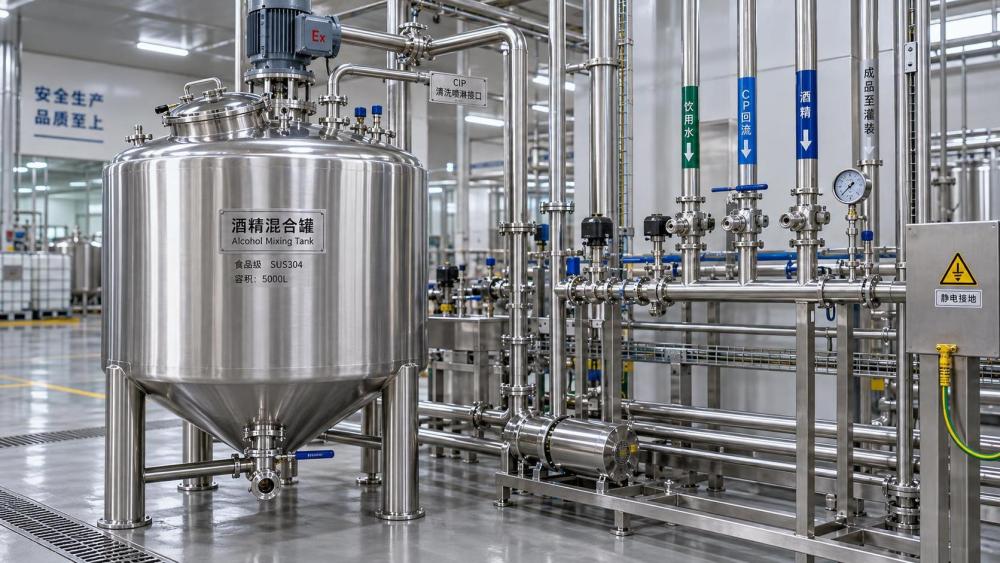
For many beverage applications, 304 or 316-series stainless steel may be considered, but the appropriate choice depends on corrosion exposure, hygiene requirements, and the buyer’s validated cleaning process. A material callout without traceability is weak protection. Request mill test certificates for pressure-retaining or product-contact material where required by the project specification, together with a clear statement of the material grade used for the shell, heads, fittings, agitator shaft, and product-contact accessories.
Surface condition matters as much as alloy designation. Internal welds should be smooth, continuous, and accessible to cleaning. Crevices around fittings, poorly blended welds, thread exposure in the product zone, and dead-ended branches can retain residues after draining or clean-in-place cycles. Hygienic design principles commonly emphasize cleanability, drainage, accessible surfaces, and avoidance of product traps. Source: EHEDG Guideline Document 8, Hygienic Equipment Design Criteria, European Hygienic Engineering & Design Group.
Ask the fabricator to define how welds will be finished and how the tank will be cleaned after fabrication. Where passivation is specified, the method, chemicals, inspection approach, and records should be agreed in advance. ASTM A967/A967M describes chemical passivation treatments for stainless steel parts and provides a recognized reference point for discussing treatment and verification methods. Source: ASTM A967/A967M, Standard Specification for Chemical Passivation Treatments for Stainless Steel Parts.
Surface roughness targets should not be copied blindly from a different process. A highly polished finish may be justified where product residues are difficult to remove, while a more conventional finish may be adequate for simple spirit dilution. The key is to connect the finish requirement to cleaning validation, not to treat a low roughness number as a stand-alone quality claim.
Check whether the mixing duty has been defined well enough
A common purchasing error is to specify a tank volume and request “an agitator” without describing what the agitator must achieve. Blending two low-viscosity liquids is one duty. Suspending particles, dispersing powders, dissolving sugar, preventing stratification, or maintaining a stable emulsion are different duties with different power and impeller requirements.
The supplier should receive a mixing brief covering:
- working volume, minimum fill level, and maximum fill level;
- ingredient addition order and addition rate;
- density and viscosity range of each batch;
- required blend uniformity and how it will be measured;
- allowable batch time and any hold or recirculation period;
- foaming sensitivity and headspace restrictions;
- temperature-control requirements during mixing; and
- whether the mixer must run during cleaning or only during production.
Tank geometry and agitator geometry must be evaluated together. A tall, narrow vessel may need a different impeller arrangement from a shallow, wide tank. Baffles can improve top-to-bottom turnover in some applications, but they also add welds and surfaces that must be cleaned. An off-center agitator or a different impeller style may control vortex formation where air entrainment is undesirable. No single configuration suits every alcohol product.
When comparing stainless steel mixing tanks, buyers should request the proposed impeller type, shaft diameter, motor power, speed range, gearbox arrangement, and expected operating fill range rather than accepting a generic mixer description. If blend time is a release-critical production measure, it should be included in the factory or site acceptance plan using the buyer’s representative liquid properties where practical.
Separate atmospheric, vacuum, and pressure requirements
An atmospheric tank is not automatically suitable for vacuum or internal pressure. Vacuum can occur during cooling, draining, cleaning, or a process upset; pressure can arise from gas blanketing, blocked vents, thermal expansion, or cleaning operations. The design pressure and design vacuum should be stated separately, along with the temperature range and relief-device philosophy.
If the vessel is intended to operate as a pressure vessel, procurement should identify the governing design code, inspection requirements, nameplate information, and certification route applicable at the installation location. In the United States, ASME Boiler and Pressure Vessel Code, Section VIII, Division 1 is commonly used for pressure vessel construction, although legal requirements are set by the relevant jurisdiction. Source: ASME, Boiler and Pressure Vessel Code, Section VIII, Division 1.
Do not assume that a “vented” tank needs no engineering review. Vent size, vent routing, flame-control measures where applicable, and protection against blockage require process and safety input. The supplier can provide vessel details, but the owner or project engineer typically needs to define the operating scenario and site standard.
Evaluate flammable-liquid and vapor risks before selecting motors and instruments
Ethanol-containing liquids can create a flammable vapor hazard, especially during open charging, venting, sampling, cleaning, or high-proof blending. The actual risk depends on concentration, temperature, ventilation, enclosure design, transfer method, and the site’s hazardous-area classification. Ethanol has a flash point of approximately 55°F (13°C) in the NIOSH Pocket Guide, which illustrates why process temperature and vapor management cannot be treated as afterthoughts. Source: CDC/NIOSH, NIOSH Pocket Guide to Chemical Hazards: Ethyl Alcohol.
For a U.S. facility, flammable-liquid handling and electrical equipment selection may involve OSHA requirements, National Fire Protection Association standards, and local authority requirements. OSHA’s flammable-liquids standard is 29 CFR 1910.106. Source: Occupational Safety and Health Administration, 29 CFR 1910.106, Flammable Liquids. In the European Union, equipment intended for potentially explosive atmospheres may fall within the scope of Directive 2014/34/EU, while workplace explosion-risk assessment is addressed separately under Directive 1999/92/EC. Source: European Parliament and Council, Directives 2014/34/EU and 1999/92/EC.
The procurement package should state the hazardous-area classification supplied by the site engineer, including the relevant zone or division, gas group, temperature class, and location of the motor, controls, probes, and junction boxes. A tank supplier should not be expected to infer these conditions from the word “alcohol.” Also verify bonding and grounding provisions, access-cover sealing, vapor-tight connections where required, and whether the mixing shaft seal is suitable for the expected vapor exposure.
Design for cleaning, drainage, and changeover
Product quality failures often trace back to residues left in low points, spray shadows, seals, valve cavities, or piping immediately connected to the vessel. This becomes more significant when one tank is used for multiple flavors, color-sensitive products, allergen-containing formulations, or cream-based beverages.
Verify the bottom outlet arrangement, slope toward the outlet, valve type, and whether the tank can drain at its installed level. A low-point drain is only useful if connected piping does not rise again before reaching the valve. Review the position of sample valves, level instruments, thermowells, manways, spray devices, and agitator supports for cleanability and service access.
For clean-in-place operation, specify the cleaning sequence, available flow and pressure, detergent chemistry, temperature limits, and whether a return-line conductivity or visual inspection procedure is used on site. Spray balls and rotary spray devices are not interchangeable simply because both fit a tank nozzle. Their performance depends on coverage, flow, pressure, vessel geometry, and soil type. Where hygiene documentation is important, the buyer should ask what evidence supports the proposed cleaning arrangement and what site validation remains necessary after installation.
Review fabrication evidence before the tank reaches the site
A robust order contains more than a general arrangement drawing. It should define approved drawings, nozzle schedule, instrument connections, tolerances that affect installation, weld documentation where specified, material certificates, surface-treatment records, pressure or leak-test records, electrical documentation, spare-parts list, operating manual, and packing requirements.
Factory acceptance testing should be proportionate to the risk. For a straightforward atmospheric blending tank, this may include dimensional verification, visual weld inspection, agitator rotation check, motor and gearbox confirmation, leak testing, and documentation review. For a jacketed, pressurized, automated, or hazardous-area installation, the acceptance plan should also address the relevant control panels, interlocks, certificates, and test boundaries.
Shipping details can affect installation cost. Confirm transport dimensions, lifting points, center of gravity, skid requirements, protection for polished surfaces, and whether agitator components ship installed or separately. A tank that fits the process room on a layout drawing may still be impossible to move through an existing doorway or under a low overhead beam.
Use a comparison sheet that exposes lifecycle trade-offs
The lowest quoted purchase price can conceal exclusions that emerge during commissioning: upgraded motors, specialized seals, additional nozzles, insulation, platforms, cleaning devices, certification, or documentation. A comparison sheet should normalize those items across quotations and distinguish included scope from optional scope.
The strongest purchase specification does not attempt to dictate every fabrication detail. It defines the process duty, safety boundary, hygiene expectation, documentary evidence, and acceptance criteria clearly enough that quotations can be compared on the same basis. That approach gives procurement, engineering, quality, and operations a shared record of what the tank must do before the order becomes a fabrication commitment.
Related News
- 00
0000-00
What Determines Soy Sauce Flavor Balance and Quality for Noodle Dishes - 00
0000-00
What Payback Period Makes Food Processing Equipment ROI Worth Approving? - 00
0000-00
What to Verify Before Ordering Stainless Steel Mixing Tanks for Alcohol - 00
0000-00
Stainless Steel vs. Carbon Steel Edible Oil Storage Tanks: Material Selection for Beverage Industry Hygiene Compliance - 00
0000-00
Selecting Dairy Processing Equipment by Product Viscosity, Capacity, and Hygiene Risk
Food Processing Editorial Team
Weekly Insights
Stay ahead with our curated technology reports delivered every Monday.