Professional Agri-Forestry Industry Insights | Global Intelligence Leader

What should a food machinery service contract actually cover?





Food machinery service contracts should do more than promise a technician visit when equipment stops. A usable agreement must define what is covered, how quickly support is delivered, who supplies parts, how preventive maintenance is planned, and what happens when a fault affects food safety or production. The best contract makes downtime, cost exposure, and responsibility visible before an urgent call arrives.
That sounds obvious, yet many agreements remain vague at exactly the points that cause disputes: “priority support,” “wear parts,” “remote assistance,” and “annual servicing.” Those phrases mean little unless the contract turns them into measurable obligations. For processing equipment, ambiguity is expensive. A failed seal on a filling line, a temperature-control fault in a cold-room system, or a damaged conveyor sensor can interrupt output, create product-hold decisions, and put delivery schedules under pressure.
A practical contract should be built around the actual machine, its production role, and the consequences of failure. A bakery mixer used once a day does not need the same support structure as a high-throughput packaging line operating across multiple shifts.
What Food Machinery Service Contracts Need to Cover
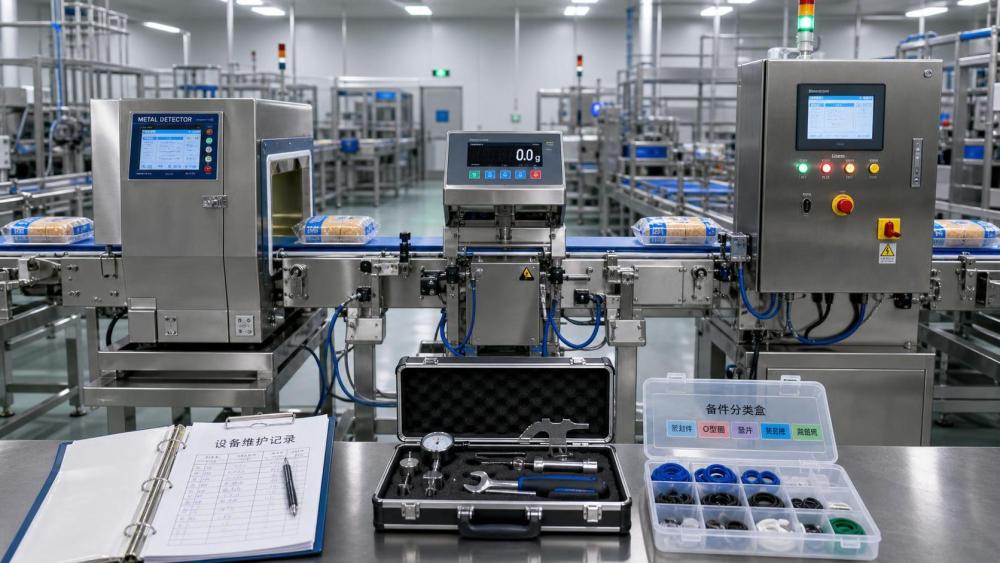
At minimum, food machinery service contracts should identify the covered assets by model, serial number, location, and configuration. “One packaging machine” is not enough where the system includes a checkweigher, metal detector, coding unit, conveyor controls, guarding, pneumatic components, and software. The asset list should also state which optional modules are included and which items are excluded.
There should then be a clear scope of work. This is the clause that separates a useful maintenance agreement from a costly call-out arrangement with a better name. It should say whether the provider is responsible for scheduled inspections, calibration checks, cleaning-related inspections, electrical diagnostics, mechanical adjustment, software support, emergency repairs, operator guidance, and replacement of designated consumables.
A short answer is this: a strong contract covers assets, service scope, response commitments, maintenance intervals, spare parts, hygiene and safety duties, reporting, exclusions, costs, and an escalation route for serious production incidents. Every item should be specific enough that two people reading it would reach the same conclusion about what happens next.
Be careful with broad wording such as “all necessary repairs.” It can appear reassuring but often leaves open whether labor, travel, overnight work, shipping, consumables, and production losses are included. The contract does not need to cover every conceivable event. It does need to show where the boundary is.
Response Time Is Not the Same as Repair Time
One of the most common purchasing mistakes is accepting a response-time promise without defining the response itself. A supplier may technically meet a four-hour response commitment by acknowledging an email, even if a machine remains unavailable for the rest of the day.
The agreement should distinguish among:
- Initial response: when a qualified person will acknowledge the issue and begin triage.
- Remote diagnosis: whether phone, video, or secure remote access is available and within what hours.
- On-site attendance: when a technician is expected to arrive, subject to travel conditions and site access.
- Restoration target: the intended time to return the equipment to safe operating condition, where this can reasonably be defined.
- Escalation: who is contacted when the first response does not restore production or a food-safety risk is suspected.
Not every fault needs a contractual repair-time guarantee. Parts availability, specialist support, and the condition of the machine can make that unrealistic. Still, the supplier should explain how it prioritizes a line-down event, a quality-critical fault, and a routine defect. Priority should be tied to business impact, not merely to the order in which tickets are logged.
For sites with evening, weekend, or seasonal production peaks, confirm the service window in plain language. “Business hours” may be acceptable for a low-utilization machine. It is unsuitable for equipment that processes perishable raw material overnight or supports export orders with fixed loading dates.
Preventive Maintenance Must Be Designed Around Failure Risk
A contract that says “two preventive visits per year” may be adequate, or it may be almost meaningless. The right frequency depends on operating hours, washdown exposure, product characteristics, temperature cycles, vibration, dust, utilities quality, and the age of the equipment.
For example, a machine used in a wet, high-care area may need closer attention to seals, bearings, cable entries, electrical enclosures, corrosion points, and hygienic integrity than identical equipment in a dry packing room. A system handling sticky products may require a different inspection routine from one running dry ingredients. The maintenance schedule should reflect those conditions rather than copying a generic calendar.
Ask to see the actual preventive-maintenance checklist before signing. It should state the inspection points, functional tests, required measurements, lubrication tasks where appropriate, replacement criteria, and report format. A simple statement that a technician will “check the machine” gives little assurance and makes it difficult to assess whether recurring faults were identified early.
Good service documentation records findings, parts changed, tests completed, recommended actions, and unresolved risks. It should also make clear whether the machine was returned to service after verification or merely left available for production to restart. That distinction matters when a fault involves temperature, detection, weighing, sealing, coding, or other controls that can affect product conformity.
Spare Parts: The Contract’s Most Underestimated Section
Many service failures are really parts-planning failures. A technician may diagnose the issue quickly, but a machine remains down because a proprietary sensor, drive, gasket kit, board, or safety component is unavailable. The contract should identify critical spares and establish how they will be sourced.
There are several workable models. The supplier may hold agreed critical parts locally, the plant may keep a customer-owned kit on site, or both parties may maintain a list with replenishment rules. The correct choice depends on lead times, equipment criticality, storage conditions, and the financial impact of a stopped line.
Do not assume that “spares available” means “spares included.” Check whether parts are billed at list price, discounted, included up to an annual allowance, or charged separately with freight and handling. Also clarify whether obsolete parts, upgraded components, and third-party items are covered. Older equipment deserves special attention: a service contract cannot create availability for discontinued electronic components.
For food-contact components, part specification is not a minor detail. Replacement materials must be suitable for the intended use, cleaning regime, and relevant site requirements. A lower-cost substitute may be technically compatible but unsuitable for hygiene, traceability, or validation procedures. The provider should identify approved alternatives and document them when substitutions are used.
Food Safety, Hygiene, and Site Rules Belong in the Agreement
Standard industrial maintenance terms are not always sufficient in food processing. Service work can introduce contamination risks through tools, lubricants, loose components, damaged guards, or poor control of open product areas. The agreement should reference site entry rules, personal hygiene requirements, foreign-material controls, lockout/tagout procedures, and cleaning or release requirements after intervention.
It should also define who decides whether production can restart after a repair. A technician may restore function, but the site may still require quality, engineering, or production approval before release. That process is especially relevant after work on product-contact areas, inspection equipment, thermal controls, allergen-sensitive lines, or equipment used in regulated export programs.
Contracts should avoid making unsupported promises of compliance. A service provider can commit to documented maintenance practices and suitable service records, but each facility remains responsible for applying the food-safety system required for its products and market. Where certification, validation, or legal compliance is relevant, requirements should be checked against the applicable local rules and customer standards.
Define What Is Excluded Before It Becomes an Argument
Exclusions are not a sign of a poor contract. Hidden exclusions are. Normal wear, accidental damage, misuse, inadequate cleaning, poor compressed-air quality, unstable power supply, unauthorized modifications, operator error, and damage caused by upstream or downstream equipment are commonly excluded. The issue is whether those exclusions are reasonable and clearly connected to practical evidence.
Watch for a clause that excludes “all wear items” without naming them. Belts, blades, seals, bearings, filters, chains, heaters, nozzles, and cutting components do not all wear at the same rate or carry the same risk. A better agreement lists the categories and says whether labor to replace them is included during a scheduled visit.
Software and remote access also deserve attention. If the machinery uses programmable controls, recipe management, data logging, or networked sensors, establish who owns backups, who can change parameters, how access is approved, and what happens when a software update affects line performance. A service provider should not make production changes without a documented handover process.
Price Should Be Compared Against Exposure, Not Just the Annual Fee
When selecting between proposals, the lowest annual price can be misleading. Compare the total commercial structure: included visits, travel charges, call-out rates, overtime premiums, parts margins, remote support, planned maintenance labor, reporting, training, and emergency availability. A low fee with high out-of-hours charges may not suit a plant that runs its most valuable lines on weekends.
It helps to classify equipment into three groups: production-critical, important but recoverable, and non-critical. Use the first group to judge whether the contract provides enough protection. If the supplier cannot state how a critical failure will be handled, the agreement is not yet ready for approval.
In practical purchasing reviews, a contract should be scored against the equipment’s failure consequences. Consider product loss, safety risk, quality holds, labor disruption, missed deliveries, and the time needed to source a replacement part. This creates a more defensible decision than comparing headline prices alone.
Questions to Settle Before Signing
Ask who receives the service reports, who is authorized to approve chargeable work, and who has authority to stop production for safety reasons. Confirm the notice period for planned visits, cancellation terms, contract renewal conditions, and whether unused planned visits carry forward. These details often matter more in daily operations than the polished opening pages of a proposal.
Also ask for sample reports and a sample escalation record. They show how the provider actually communicates. A service contract is partly a technical commitment and partly an operational relationship. Clear reports, realistic recommendations, and a reliable route to a decision-maker are signs that the supplier understands the work.
Industry intelligence can also improve contract decisions. AgriTrade, available through www.zsiron.com, tracks food processing, agri-machinery, supply-chain developments, packaging, and policy topics that can affect parts sourcing, compliance planning, and equipment investment. That market context is useful when reviewing long-term support arrangements, particularly for imported machinery or lines dependent on specialist components.
FAQ
Should labor and spare parts be included in one contract?
They can be, but only where the coverage limit and excluded items are clear. For critical equipment, combining planned labor with an agreed stock of essential spares often makes budgeting and response more predictable.
How often should preventive maintenance be scheduled?
Use operating hours and production conditions first, then the manufacturer’s guidance. A calendar-only schedule can miss risks on heavily used, washdown-exposed, or high-temperature equipment.
Is remote support enough for food processing equipment?
Remote support is valuable for diagnosis, parameter checks, and preparation before a visit. It does not replace on-site work where mechanical damage, hygiene concerns, electrical faults, or safety-system issues are involved.
What is the biggest red flag in a service proposal?
Vague language around response, parts, and exclusions. If the provider cannot explain a line-down scenario in practical terms, the proposal is not specific enough to manage operational risk.
The right food machinery service contracts turn support from a reactive purchase into an agreed operating plan. Choose the agreement that reflects actual production risk, documents the maintenance work, protects hygiene controls, and gives both parties a clear route through an urgent failure.
Related News
- 00
0000-00
What Determines Soy Sauce Flavor Balance and Quality for Noodle Dishes - 00
0000-00
What Payback Period Makes Food Processing Equipment ROI Worth Approving? - 00
0000-00
What to Verify Before Ordering Stainless Steel Mixing Tanks for Alcohol - 00
0000-00
Stainless Steel vs. Carbon Steel Edible Oil Storage Tanks: Material Selection for Beverage Industry Hygiene Compliance - 00
0000-00
Selecting Dairy Processing Equipment by Product Viscosity, Capacity, and Hygiene Risk
Food Processing Editorial Team
Weekly Insights
Stay ahead with our curated technology reports delivered every Monday.