Professional Agri-Forestry Industry Insights | Global Intelligence Leader

What Are the Main Compliance Risks in Importing Processed Agricultural Goods?





What Are the Main Compliance Risks in Importing Processed Agricultural Goods?
What are the main compliance risks when importing processed agricultural goods? The short answer is that importers must manage much more than customs clearance. A shipment of canned vegetables, frozen seafood, fruit concentrate, animal feed ingredients, roasted nuts, processed grains, sauces, dried herbs, or packaged snacks may be commercially ready but still fail at the border because its safety evidence, label, origin claim, ingredient declaration, or import documentation does not meet the destination market’s requirements.
This is why compliance should be treated as a sourcing issue, not a final administrative step. In agri-food trade, a product can pass factory inspection and still be detained because the importing country applies different residue limits, additive rules, language requirements, health certificates, packaging rules, or traceability expectations. Delays can affect shelf life, cold-chain integrity, customer delivery commitments, and cash flow. In more serious cases, goods may be relabeled, re-exported, destroyed, recalled, or linked to a broader review of the importer’s supply chain.
The risk profile varies by product and market. A shelf-stable tomato product does not face the same controls as cooked shrimp, dairy powder, processed meat, infant food, or a botanical ingredient used in beverages. Yet the underlying lesson is consistent: importers need evidence that follows the product from raw material origin through processing, packaging, shipping, and sale.
Food Safety Is Usually the First Point of Failure
Food safety is often discussed as a broad principle, but border compliance depends on specific product risks. Authorities may examine microbiological hazards, chemical contaminants, pesticide residues, veterinary drug residues, mycotoxins, heavy metals, allergens, processing contaminants, or unauthorized additives. The relevant concern depends on the commodity, its origin, how it was processed, and the rules in the destination market.
A common mistake is assuming that compliance with the exporting country’s rules automatically supports market access elsewhere. It may not. Maximum residue limits and permitted food additives can differ by jurisdiction. A colorant, preservative, sweetener, processing aid, or flavoring accepted in one market may require a different declaration, have usage restrictions, or be prohibited in another. The same applies to contaminant thresholds and testing methods.
Supplier certificates can be useful, but they are not a substitute for product-specific verification. Importers should understand what a laboratory report actually covers: the batch sampled, the date, the analytical method, the limit assessed, and whether the sample represents the final exported product. For products with seasonal raw materials or changing supply sources, an old report may offer limited reassurance.
For higher-risk categories, the practical question is not simply “Does the supplier have a food safety system?” It is “Can the supplier consistently demonstrate control over the hazards that matter in this destination market?” That may involve approved raw-material sources, process controls, sanitation records, temperature management, retention samples, testing plans, and corrective-action procedures.
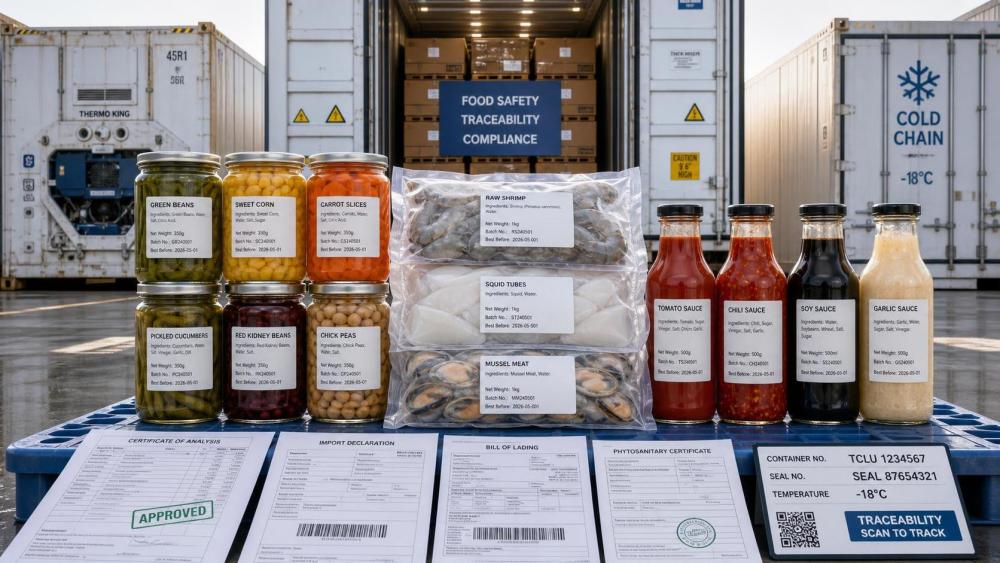
Labels Can Turn a Compliant Product into a Non-Compliant Import
Labeling failures are among the most preventable import problems, yet they remain frequent because labels sit at the intersection of product formulation, marketing, consumer law, and local language rules. A package may need to show an ingredient list, allergens, net quantity, date marking, storage conditions, origin information, nutrition information, importer details, lot identification, and preparation instructions. Exactly what is mandatory depends on the destination market and product category.
The risk is not limited to missing information. Labels can also be misleading. Claims such as “natural,” “organic,” “no added sugar,” “high protein,” “sustainable,” “antibiotic-free,” or “preservative-free” may be regulated or interpreted differently across markets. A translation that sounds harmless commercially can alter the legal meaning of a claim. Similarly, an ingredient name that is familiar to the supplier may not be the accepted name required by the importing authority.
Allergen management deserves particular attention. Allergens may be present as ingredients, processing aids, carryover materials, or cross-contact risks. A supplier’s internal allergen declaration should be reconciled with the finished-product label rather than copied into artwork without review. Packaging revisions also need control. It is easy for a factory to use older labels after an ingredient or allergen statement has changed.
Traceability Gaps Often Appear Only When Something Goes Wrong
Processed agricultural goods can have complicated origins. A frozen food item may contain ingredients from several countries. A seafood processor may source from multiple landing sites. A spice blend, feed premix, fruit puree, or snack product may move through traders, storage facilities, processors, and repackers before export. When a regulator, customer, or insurer asks where a raw material came from, vague supplier assurances are rarely enough.
Effective traceability links finished-goods lot numbers to production records, ingredient lots, processing dates, packaging runs, and outbound shipment references. It should also identify the responsible legal entities at each stage. This matters in a recall, but it also matters before one: many import controls increasingly require importers to show that they understand their supply chain and can identify a product’s origin quickly.
The level of traceability needed is product-specific. Animal-origin products, fisheries products, products associated with plant-health concerns, and goods carrying sustainability or origin claims may require deeper evidence than a simple commercial invoice. Where raw materials are blended, importers should clarify whether the supplier can preserve origin records by batch or whether sources may change without notice.
Document Errors Are Not Minor Administrative Details
Import documentation must tell one consistent story. The commercial invoice, packing list, bill of lading or air waybill, certificate of origin, health or sanitary documents where required, customs declaration, product specification, and label should not contradict one another. Differences in product name, net weight, lot code, producer address, origin, or tariff classification can trigger questions that are difficult to resolve after a consignment has arrived.
Tariff classification is particularly important because it influences duty treatment, licensing obligations, quota eligibility, and sometimes the regulatory pathway. Processed agricultural products can be harder to classify than they appear. A small change in sugar content, meat content, preservation method, preparation state, or intended use can affect the appropriate customs code. Importers should avoid relying solely on a supplier’s informal product description when classification has commercial or regulatory consequences.
Origin is another area where commercial language can become risky. “Made in,” “packed in,” “grown in,” and “originating in” do not necessarily mean the same thing. Preferential tariff claims generally require separate analysis from ordinary country-of-origin labeling. Processing in a third country may or may not confer origin under the applicable trade rules. Where duty savings depend on origin, documentary support should be reviewed before shipment rather than reconstructed later.
Market Access Rules Can Change Between Purchase Order and Arrival
Processed food trade is sensitive to regulatory change. Disease outbreaks, contamination incidents, trade disputes, environmental measures, inspection priorities, and domestic policy adjustments can all affect market access. A country may introduce additional certificates, temporarily restrict products from particular regions, increase sampling frequency, revise packaging obligations, or tighten controls on certain ingredients.
This does not mean every buyer should delay procurement until all uncertainty disappears. It means that long lead times need a monitoring process. Before placing a large order, import teams should confirm the current import conditions for the exact product, processing type, origin, and manufacturer. Before dispatch, they should repeat the check, especially for seafood, livestock-derived ingredients, dairy, products containing eggs, and goods sourced from areas exposed to disease or environmental restrictions.
This is also where broader industry intelligence becomes practical. AgriTrade, operated through www.zsiron.com, tracks agriculture, livestock, fisheries, food processing, packaging, export developments, and supply-chain conditions in one industry-focused environment. For buyers, the value of such coverage is not a substitute for legal advice or official authority guidance. It is early context: policy signals, logistics disruption, market movement, disease-control developments, and changes in sourcing conditions that may justify a closer compliance review before goods are on the water.
Packaging and Cold Chain Carry Their Own Compliance Exposure
Packaging is sometimes treated as a branding decision, but for processed agricultural goods it can affect safety, environmental obligations, and border acceptance. Food-contact materials may need to meet applicable requirements. Packaging must also protect the product through the expected transport and storage conditions. A compliant formulation can become a quality problem if seals fail, containers are unsuitable, moisture barriers are inadequate, or temperature-sensitive goods are exposed during delays.
For frozen, chilled, or heat-sensitive goods, cold-chain records should be considered part of the compliance file. The required temperature range, monitoring approach, loading conditions, transit route, and contingency process should be clear between buyer, exporter, forwarder, and warehouse operator. A temperature excursion does not automatically make food unsafe, but it can lead to investigation, rejection, shortened shelf life, or disputes if the shipment history cannot be demonstrated.
Sustainability requirements add another layer. Some markets are expanding rules around packaging waste, recyclability, producer responsibility, timber-derived materials, and environmental claims. These obligations may fall partly on the importer or distributor even when the packaging was selected by the overseas manufacturer. Procurement teams should therefore include packaging specifications in supplier approval, not leave them exclusively to marketing or logistics.
Supplier Approval Must Test Control, Not Just Credentials
A supplier may have impressive facilities and still be unsuitable for a particular market. Importers need to assess whether the producer understands destination-specific requirements and can maintain consistent documentation. The useful starting point is a structured information request covering product specifications, full ingredient and allergen declarations, process flow, raw-material origin, batch coding, shelf-life basis, test reports, packaging details, certificates where relevant, and export history.
The strongest warning signs are often operational rather than dramatic: reluctance to provide specifications, unexplained differences between documents, unclear ownership of label approval, changing ingredient sources without notification, or a sales contact who cannot obtain answers from quality staff. These do not prove non-compliance, but they indicate that the importer may carry too much verification risk.
Contracts should define who is responsible for compliance evidence, notification of formulation or factory changes, retention of records, product withdrawal support, and allocation of costs when a shipment fails because supplier information was inaccurate. The wording should reflect the actual trade arrangement and applicable law. A generic quality clause is rarely enough for complex imported food products.
A More Practical Import-Control Routine
The best control is not an oversized compliance file created after the purchase order. It is a repeatable routine integrated into sourcing. Start by identifying the product’s regulatory category and destination-market requirements before approving the supplier. Review the formulation and intended label before artwork is printed. Confirm whether the producer, establishment, or product needs a registration, listing, certificate, permit, or prior notification. Then align shipping documents, lot coding, and inspection evidence before dispatch.
Importers also need change control. Any revised ingredient, supplier, production site, process, label, pack size, country of origin, transport route, or shelf-life claim can change the compliance position. Small commercial changes should not bypass the quality and regulatory review simply because the product name remains the same.
For companies importing across multiple agricultural categories, it helps to separate stable baseline requirements from volatile external risks. The baseline includes specifications, labels, supplier records, and customs data. The volatile layer includes current market-access conditions, disease events, shipping constraints, price pressure that may affect supplier behavior, and policy changes. Industry reporting from sources such as AgriTrade can help teams keep this external layer visible while they verify formal requirements with the relevant authorities and qualified advisers.
Compliance risk in processed agricultural imports is rarely caused by one missing paper alone. More often, it comes from weak connections between purchasing, quality assurance, logistics, customs, and supplier management. Buyers that examine those connections before shipment are better placed to protect product access, delivery reliability, and customer trust when regulations or supply conditions change.
Related News
- 00
0000-00
What Determines Soy Sauce Flavor Balance and Quality for Noodle Dishes - 00
0000-00
What Payback Period Makes Food Processing Equipment ROI Worth Approving? - 00
0000-00
What to Verify Before Ordering Stainless Steel Mixing Tanks for Alcohol - 00
0000-00
Stainless Steel vs. Carbon Steel Edible Oil Storage Tanks: Material Selection for Beverage Industry Hygiene Compliance - 00
0000-00
Selecting Dairy Processing Equipment by Product Viscosity, Capacity, and Hygiene Risk
Food Processing Editorial Team
Weekly Insights
Stay ahead with our curated technology reports delivered every Monday.