Professional Agri-Forestry Industry Insights | Global Intelligence Leader

Uneven Blending in Beverage Tanks: What to Check Before Changing Speed





A batch looks uniform at the surface, yet samples from the outlet and upper sampling point give different readings. The immediate temptation is to increase agitator speed. Before doing that, check whether the difference is real, whether ingredients have dissolved, and whether the mixer is circulating the entire working volume. Faster rotation cannot reliably correct a misleading sample, a poorly positioned addition point, or an impeller operating outside its intended fill range.
Uneven blending in beverage tanks can affect flavor consistency, ingredient dosing, and the decision to release a batch. The useful question is not simply “Is the mixer fast enough?” It is “What prevents this formulation, at this fill level, from becoming uniform?” Mixing references distinguish bulk blending, solids suspension, dispersion, and dissolution because these duties place different demands on equipment. [1]
Confirm that the samples describe the batch
Start by defining the symptom. Does the difference concern soluble solids, acidity, color, pulp distribution, or visible powder? A refractometer reading alone cannot demonstrate that every ingredient is uniformly distributed. Suspended solids may need a separate assessment, while acidity checks require a method appropriate to the formulation.
Use the plant’s approved sampling procedure and compare samples collected at approximately the same process stage. Record the sampling location, elapsed mixing time, product temperature, and whether ingredients or water were still entering the vessel. A comparison between an early outlet sample and a later upper sample mixes together location and time effects.
Sampling hardware deserves attention. Product retained in a valve or sample line can differ from the current tank contents. Follow the established flushing procedure rather than inventing a purge volume. Check that instruments are calibrated and that sample preparation and temperature handling follow the instrument method.
If repeat samples from the same point vary substantially, resolve measurement repeatability before adjusting the process. If each location gives repeatable but different results, a genuine spatial gradient becomes more plausible. Persistent particles require another question: are they settling, floating, agglomerated, or simply not yet dissolved?
Check what changed before the symptom appeared
Compare the problem batch with the last acceptable batch made under comparable conditions. Keep the investigation grounded in production records rather than memory. Useful comparisons include:
- Actual working volume and liquid level when agitation began.
- Ingredient temperature, concentration, physical form, and addition sequence.
- Powder addition rate and the position of the feed point.
- Agitator settings, pauses, and recirculation valve positions.
- Maintenance, recipe, or equipment changes since the previous run.
A familiar recipe can behave differently when a concentrated syrup arrives colder, a powder is added more rapidly, or the batch size changes. Temperature and concentration can alter viscosity; viscosity influences circulation and the power required for mixing. Powder wetting and dissolution also depend on properties and addition conditions, not just shaft speed. [1]
Separate observations from explanations in the batch record. “Powder accumulated near the wall during addition” is useful evidence. “Mixer too slow” is an interpretation that still needs testing. This distinction prevents the next operator from inheriting an unverified diagnosis as a permanent operating rule.
Match the fill level to the circulation pattern
An impeller moves liquid locally, but blending requires that movement to connect the rest of the vessel. Strong motion around the blades does not prove that the upper region, bottom zone, or space behind internal fittings is exchanging effectively. Impeller design, location, vessel geometry, baffles, viscosity, and liquid depth all influence the flow pattern. [1]
At a low fill level, an upper impeller may not have adequate liquid coverage. At a higher level, a mixer suitable for a shallower batch may leave weak circulation near the top. Increasing speed can intensify motion in an already active region without correcting poor exchange elsewhere.
Review the equipment drawing and approved operating envelope. Check impeller height, number of impellers, intended rotation direction, baffle arrangement, and minimum and maximum working levels. Compare actual liquid depth with the design basis, not merely the vessel’s nominal capacity.
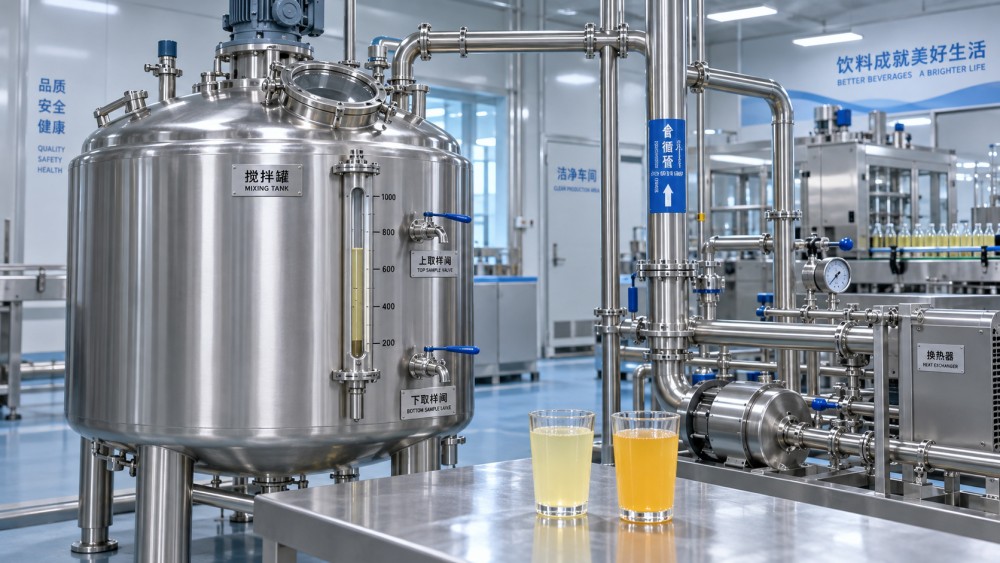
When reviewing beverage tanks for an existing process or replacement project, assess the vessel and mixing arrangement together. Capacity alone does not establish suitability. A useful specification identifies formulation properties, batch-size range, solids content, required mixing duty, and how uniformity will be demonstrated. These details support a more meaningful comparison than motor rating or maximum speed alone.
A visible vortex is not a reliable blending test. Depending on the installation, swirling may coexist with inadequate exchange between regions, while air entrainment may become a separate quality problem. Do not remove or modify baffles as an informal troubleshooting experiment; changes to internals need an engineering and hygienic-design review. [1][3]
Separate ingredient incorporation from bulk blending
A vessel may blend soluble liquids adequately but struggle with powder incorporation. Adding powder faster than the liquid can wet and disperse it may produce floating rafts or lumps. Some formulations develop hydrated outer layers around agglomerates, making later incorporation difficult. More speed after the lumps form may not recreate the conditions needed during initial addition. [1]
Observe where ingredients enter. Material deposited against a wall, above the active liquid surface, or in a weak-flow region may enter circulation slowly. A dense liquid addition can also create a temporary concentration gradient if it is not promptly incorporated.
Any change to the addition point or sequence should remain within approved recipe and equipment procedures. Moving a feed hose closer to rotating equipment is not an acceptable improvised solution.
The appropriate response depends on the symptom:
These are investigation paths, not guaranteed fixes. Bulk blending, wetting, deagglomeration, and suspension are distinct requirements; one mixer may not perform all of them equally well. An inline disperser or pre-mix system may address incorporation problems, but it does not automatically eliminate weak circulation in the receiving vessel. [1]
Verify mechanical operation and the recirculation route
The displayed speed is not the entire mechanical picture. Where approved diagnostic methods allow, verify that the drive is following its command and that the shaft is rotating in the specified direction. After maintenance, an incorrect rotation direction or an impeller installation error can change performance even when the controller shows the usual setting.
Review drive alarms, unusual vibration, noise, and recorded motor load. Load trends can support an investigation, but they do not prove uniformity: a motor may draw substantial power while the vessel still has poorly mixed regions. [1]
If recirculation is used, check the actual valve lineup and operating condition against the process diagram. A return located close to the withdrawal point can encourage short-circuiting, with limited exchange through the rest of the vessel. Restrictions or a changed return arrangement can alter the contribution of the loop. Flow verification should use suitable instrumentation or an approved method, not an assumption based on pump operation.
Do not open guards, reach into the vessel, or inspect moving components during operation. Maintenance involving exposure to unexpected startup or stored energy must follow the applicable energy-control procedure. In the United States, OSHA 29 CFR 1910.147 addresses hazardous-energy control; entry into a qualifying permit-required confined space is addressed separately under 29 CFR 1910.146. [2]
Engineering changes also need cleaning review. A new return pipe, baffle, or mixing accessory may improve circulation while introducing difficult-to-clean surfaces. For covered U.S. food operations, 21 CFR 117.40 establishes equipment requirements concerning cleanability, maintenance, and protection against contamination. It does not, by itself, validate a particular mixer or cleaning cycle. [3]
Use a controlled trial when a speed change is justified
A speed adjustment becomes a reasonable test after measurement errors, incorrect setup, and ingredient-addition problems have been addressed. Define the test before changing the setpoint. Use an authorized trial plan and remain within manufacturer limits, site procedures, and product-quality requirements.
Keep the recipe, batch volume, temperature conditions, addition sequence, and sampling method as consistent as practicable. Change one operating variable at a time so that the result remains interpretable. Where production conditions prevent that, document the differences rather than treating the comparison as conclusive.
Agree on the endpoint with quality personnel. “Looks mixed” is inadequate for ingredients that are not visibly distinguishable. The acceptance criterion should identify the property being measured, sampling locations, permitted variation, and the observation period. Product-specific criteria must come from the plant’s quality requirements, not a generic mixing tolerance.
Monitor trade-offs as well as blend time. Depending on the beverage, higher speed may increase air entrainment, foam, temperature rise, or unwanted changes to suspended material. In turbulent mixing under otherwise comparable conditions, power demand can increase sharply with speed; actual behavior depends on the impeller, fluid, and flow regime. [1]
If higher speed reduces location-to-location differences without unacceptable effects, it may be a useful operating adjustment. If it mainly increases foam or load while the gradient persists, stop treating speed as the primary remedy. Revisit circulation geometry, incorporation method, or the suitability of the mixing system for the duty.
Turn the result into an operating instruction
A successful trial should produce more than a new speed setting. Record the applicable fill range, ingredient sequence, mixing start point, temperature conditions, sampling method, and release criteria. Include the conditions under which the instruction no longer applies, such as a different solids loading or smaller batch.
Keep the troubleshooting sequence practical: verify the measurement, review what changed, confirm circulation and mechanical setup, then test speed within authorized limits. The right setting is the one that achieves the required uniformity under defined conditions—not the highest setting the drive permits.
Sources
- [1] Paul, E. L., Atiemo-Obeng, V. A., and Kresta, S. M., editors. Handbook of Industrial Mixing: Science and Practice. Wiley-Interscience, 2004. Technical reference for flow patterns, blending, solids suspension, dispersion, and mixing power.
- [2] U.S. Occupational Safety and Health Administration. 29 CFR 1910.147, The control of hazardous energy (lockout/tagout); and 29 CFR 1910.146, Permit-required confined spaces.
- [3] U.S. Food and Drug Administration. 21 CFR 117.40, Equipment and utensils.
Got questions about this industry topic or seeking best practices for your business? Drop us a line below, and let the expert team at AgriTrade help you out.
We respect your privacy. Your information is strictly confidential.
Related News
- 00
0000-00
Fish Coating Mix Specifications: A Checklist for UK Procurement - 00
0000-00
Food Safety Certification: How to Choose a Scheme for Your Facility - 00
0000-00
How Should You Handle Food Ingredients with an Undeclared Allergen? - 00
0000-00
Food Processing in the Middle East: Growth Opportunities and Supply Chain Risks - 00
0000-00
Edible Oil Storage Tank Procurement: Reviewing Material and Weld Records
0000-00
Food Processing Editorial Team
Weekly Insights
Stay ahead with our curated technology reports delivered every Monday.