Professional Agri-Forestry Industry Insights | Global Intelligence Leader

Tomato Sauce in Foodservice: Key Uses, Handling Needs, and Menu Fit





Why Tomato Sauce Matters Across Foodservice Operations
Tomato-based sauces remain one of the most adaptable building blocks in commercial kitchens, central production sites, and ready-meal assembly lines. Their role goes far beyond pasta dishes. In many foodservice settings, a well-handled sauce can support menu consistency, simplify back-of-house preparation, and help operators balance cost control with customer expectations for flavor. For buyers, kitchen teams, quality managers, and even end consumers watching ingredient quality more closely, the way tomato sauce is selected, stored, portioned, and applied has become an operational issue rather than a minor pantry detail.
This matters because foodservice is under pressure from multiple sides at once. Menus need to remain flexible, labor is often tight, and waste can quickly erode margins. At the same time, diners increasingly expect familiar flavors delivered with stable quality, whether they are ordering in a restaurant, buying a heat-and-eat tray, or eating in institutional settings. Tomato sauce fits into all of these channels, but only when operators treat it as a functional ingredient with handling requirements, not as a commodity that behaves the same in every kitchen.
Common Foodservice Uses and Why They Continue to Expand
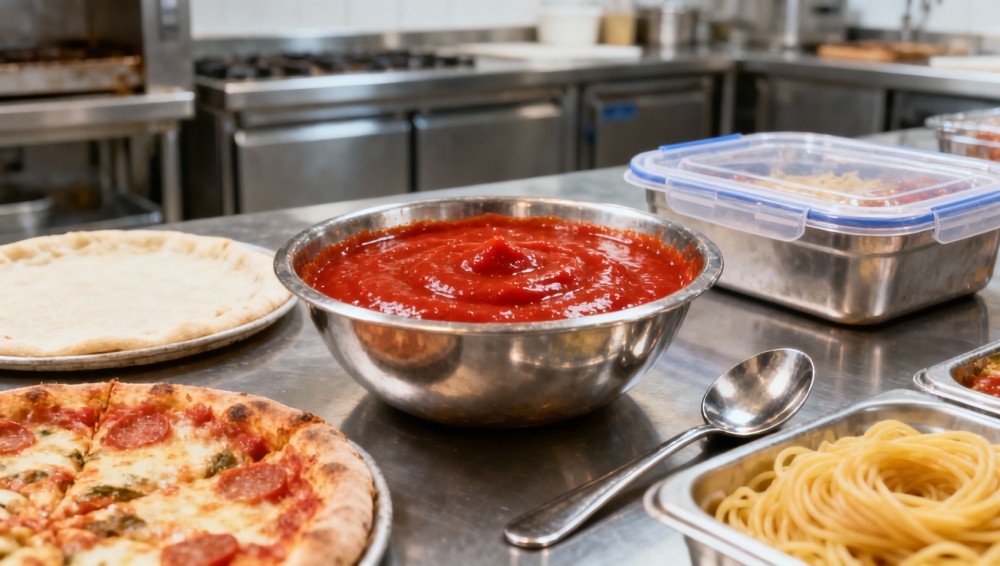
The broad use of tomato sauce comes from its ability to anchor multiple menu categories without requiring entirely separate production systems. In quick-service and casual dining, it often appears in pizza applications, pasta service, baked dishes, sandwiches, and dipping formats. In contract catering or institutional foodservice, it may be used in casseroles, braised items, vegetable-based meals, and standardized batch cooking. For ready meals, it works as both a primary flavor base and a moisture-supporting component that helps maintain texture during reheating.
This flexibility also makes it attractive for menu planning. A kitchen can use one core sauce format across several dishes, then adjust it with herbs, aromatics, dairy, protein stock, or spice blends to create variations. That supports SKU control, which procurement teams often value, especially when storage space is limited or when businesses aim to streamline inventory. In many operations, one reliable sauce format can reduce complexity in ordering and training while still allowing enough room for menu differentiation.
Still, expansion in use also increases the consequences of poor fit. A sauce that performs well in a pan-finished pasta dish may not hold its structure in a hot-hold environment. A formula suitable for immediate service may separate, darken, or lose brightness when used in a ready-meal production cycle. That is why application-specific evaluation is increasingly important.
Menu Fit Depends on More Than Flavor Alone
In foodservice, flavor is only one part of suitability. A sauce may taste balanced in a sample test and still create problems during real production. Operators usually need to assess texture, acidity level, particulate content, oil behavior, concentration, and reheating response. These characteristics affect not only the eating experience but also labor time, equipment compatibility, and portion accuracy.
For example, thicker sauces may provide stronger cling on pasta and baked applications, but they can require dilution or additional mixing in high-volume systems. Thinner formats may spread more easily in pizza or tray assembly but can create water migration issues if paired with certain toppings or starches. In ready meals, sauce viscosity often influences how a product looks after transport and reheating, which matters to both quality assurance teams and consumers.
Procurement teams therefore benefit from reviewing intended end use before comparing suppliers on price alone. A lower-cost option may appear attractive at purchase stage but create higher operational cost through waste, inconsistent plating, or the need for recipe correction. In practice, menu fit is often a total-cost question.
Handling Needs After Opening Are an Overlooked Risk
Once opened, sauce stability becomes a practical concern for food safety and product performance. Exposure to air, repeated temperature change, and inconsistent utensil handling can gradually affect flavor, color, and microbial risk. In busy kitchens, containers may be opened, resealed, moved between prep areas, and used over multiple service periods. That routine creates variability unless handling rules are clear and realistic.
For operations reviewing storage and post-opening practices, tomato sauce is best considered within a broader process check that includes container size, frequency of use, cold-chain discipline, date labeling, and whether the product’s expected shelf life after opening matches real kitchen behavior. This is especially relevant in sites where one ingredient supports several menu lines and may be touched by multiple staff members in a single shift.
Quality and safety teams should pay attention to whether staff understand the difference between unopened shelf stability and opened-product handling. These are not the same issue. A product that is stable in sealed storage may still require disciplined refrigeration, protected dispensing, and limited open-life once in use. The more decentralized the operation, the more important standard procedures become.
What Different Stakeholders Need to Evaluate
Because tomato sauce touches purchasing, production, safety, and customer perception at the same time, evaluation should not sit with one department alone. Each stakeholder tends to view the product through a different operational lens.
- Kitchen users and line operators often focus on pourability, speed of use, flavor consistency, and whether the sauce performs the same way in every batch or shift.
- Procurement staff usually assess pack size, supply continuity, total yield, and whether a sauce can cover several menu applications without generating excess waste.
- Quality and safety managers typically examine storage instructions, handling risk after opening, traceability expectations, and the likelihood of variation affecting finished product stability.
- End consumers may not see the operational side, but they notice repeatability, freshness perception, texture, and whether reheated dishes still taste balanced.
When those perspectives are aligned, sourcing decisions are usually stronger. When they are separated, kitchens can end up with a product that satisfies one requirement while creating friction somewhere else in the chain.
Differences Between Restaurant Use and Ready-Meal Production
Not every sauce requirement is shaped by the same service model. In restaurants, the key issue may be finishing performance during live service. Speed, flavor clarity, and adaptability matter because cooks may adjust seasoning or pair the sauce with changing ingredients. In contrast, ready-meal manufacturing often prioritizes process stability, fill accuracy, visual consistency, and acceptable performance after chilled or frozen distribution.
A sauce that is excellent for made-to-order service may be less suitable for packaged meals if it breaks down after thermal processing or if its acidity becomes more pronounced after storage. Likewise, a sauce optimized for industrial consistency may feel too uniform or heavy for a restaurant concept seeking a fresher profile. Buyers should therefore test products under actual end-use conditions rather than relying on bench-top tasting alone.
This distinction matters for manufacturers supplying multiple channels. Segmenting product choices by processing environment can help prevent avoidable complaints, returns, and reformulation cycles.
Practical Selection Criteria for Procurement and QA Teams
A disciplined review process can reduce surprises after rollout. Rather than focusing only on ingredient lists or unit cost, teams may want to compare options against several operational criteria at once.
These criteria are especially useful when a business is trying to improve standardization across sites. Even small differences in sauce behavior can become large consistency issues when multiplied across many locations or production runs.
Execution Points That Often Make the Difference
In many cases, the product itself is only part of the result. The rest depends on execution. Operations can reduce quality drift by matching pack size to actual daily consumption, training staff on open-container handling, and separating primary storage from service-line use when possible. Standard utensils, controlled ladle sizes, and clear labeling routines also help reduce overuse and contamination risk.
For ready-meal producers, pilot testing under real thermal and holding conditions is important. For restaurants and catering teams, practical service trials can reveal whether a sauce thickens too much on the line, loses brightness in hot holding, or creates cleanup burdens that slow production. These details may seem small, but they often determine whether an ingredient truly supports efficient operations.
A Category That Rewards Operational Discipline
Tomato sauce is familiar, but in professional food settings it should not be treated casually. Its value comes from versatility, menu coverage, and broad consumer acceptance, yet those advantages hold only when the sauce fits the intended application and is handled with discipline after opening. For operators, buyers, and quality teams, the real task is to connect flavor expectations with storage reality, workflow design, and finished-product performance.
As foodservice and ready-meal businesses continue to seek efficiency without sacrificing consistency, this category is likely to remain important. The strongest decisions will usually come from evaluating sauce not as a generic staple, but as a working ingredient whose success depends on context, process, and day-to-day control.
Related News
- 00
0000-00
What Determines Soy Sauce Flavor Balance and Quality for Noodle Dishes - 00
0000-00
What Payback Period Makes Food Processing Equipment ROI Worth Approving? - 00
0000-00
What to Verify Before Ordering Stainless Steel Mixing Tanks for Alcohol - 00
0000-00
Stainless Steel vs. Carbon Steel Edible Oil Storage Tanks: Material Selection for Beverage Industry Hygiene Compliance - 00
0000-00
Selecting Dairy Processing Equipment by Product Viscosity, Capacity, and Hygiene Risk
Food Processing Editorial Team
Weekly Insights
Stay ahead with our curated technology reports delivered every Monday.