Professional Agri-Forestry Industry Insights | Global Intelligence Leader

Stainless Steel vs. Carbon Steel Edible Oil Storage Tanks: Material Selection for Beverage Industry Hygiene Compliance





Material Selection Impacts Hygiene Validation and Long-Term Operational Integrity
Edible oil storage in beverage production isn’t a passive holding step—it’s a critical control point where material compatibility directly affects microbial stability, oxidation resistance, and regulatory traceability. Stainless steel and carbon steel are the two dominant structural materials for edible oil storage tank construction, yet their suitability diverges sharply when hygiene compliance—particularly under ISO 22000, BRCGS Food Safety Issue 9, or FDA 21 CFR Part 117—is non-negotiable. Technical evaluators often treat material choice as a cost or fabrication issue, overlooking how substrate chemistry interacts with cleaning-in-place (CIP) cycles, residual moisture, and long-term oil contact.
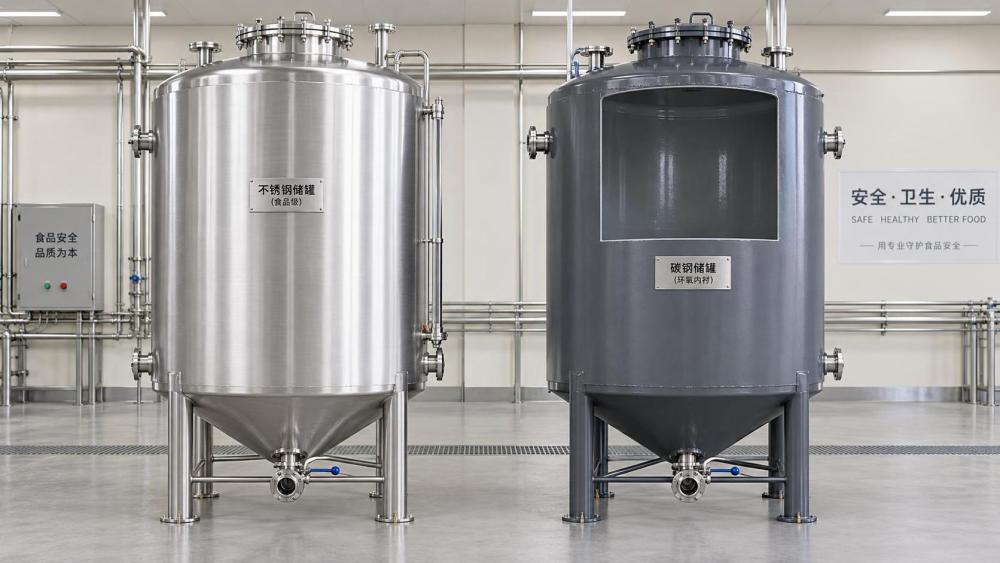
Carbon steel tanks, typically fabricated from ASTM A516 Grade 70 or equivalent, offer high tensile strength and lower initial capital outlay. But their inherent susceptibility to corrosion requires protective measures: internal epoxy or phenolic linings, or external galvanization. These coatings introduce variables—adhesion loss, micro-cracking during thermal cycling, solvent migration into oil phase—that compromise hygienic integrity over time. Liner failure is rarely catastrophic at first; instead, it manifests as localized pitting beneath the coating, creating biofilm niches that evade standard CIP validation protocols.
Stainless steel—especially grades 304 and 316—provides intrinsic corrosion resistance without reliance on barrier layers. Its passive chromium oxide layer reforms spontaneously after mechanical abrasion or mild chemical exposure, making it compatible with repeated alkaline caustic (NaOH), acidic nitric (HNO₃), and peroxide-based sanitizers. This self-healing behavior reduces risk of hidden contamination points, simplifies surface verification (e.g., ATP swabbing or visual inspection under controlled lighting), and supports documented cleaning efficacy required for audit readiness.
Hygienic Design Factors Extend Beyond Base Material
Material selection alone doesn’t guarantee compliance. The design of an edible oil storage tank must integrate hygienic principles across geometry, weld integrity, surface finish, and interface engineering:
- Internal surface roughness (Ra): Carbon steel linings typically achieve Ra ≤ 0.8 µm only if applied under strict environmental controls—temperature, humidity, and particulate filtration. Stainless steel tanks can be electropolished to Ra ≤ 0.4 µm consistently, reducing bacterial adhesion by up to 70% compared to mechanically polished surfaces (based on standardized ASTM E2612 biofilm assays).
- Weld quality and passivation: Orbital TIG welding with argon backing ensures full-penetration, smooth internal welds. Post-weld passivation removes free iron and enhances the chromium oxide layer. Carbon steel welds require post-fabrication coating coverage—often incomplete at heat-affected zones—creating weak points for chloride-induced pitting.
- Drainage and dead-leg minimization: Bottom-mounted drain nozzles must slope ≥1° toward outlet, with zero horizontal runs longer than 2× pipe diameter. Carbon steel tanks frequently use flanged connections at low points, increasing crevice volume. Stainless systems more readily support sanitary clamp or tri-clamp interfaces with integral sweep bends.
- Thermal management integration: Edible oils degrade rapidly above 60°C. Jacketed stainless tanks allow precise steam or glycol temperature control without introducing external corrosion risks. Carbon steel jackets require additional corrosion allowance and insulation monitoring—thermal bridging at support legs accelerates localized rusting.
Operational Lifecycle Costs Shift the Decision Framework
Procurement teams often compare upfront quotes: carbon steel may appear 25–40% less expensive per cubic meter than 316 stainless. But technical evaluators must model total cost of ownership across five years:
These differences affect production scheduling, validation burden, and audit preparedness—not just procurement budgets. For facilities operating multiple shifts with tight changeover windows, shorter CIP cycles and reduced verification steps translate directly into line availability. For exporters supplying EU or ASEAN markets, consistent surface integrity reduces risk of non-conformance during third-party audits where coating documentation gaps are common findings.
Risk Context Determines Acceptable Trade-offs
No single material fits all scenarios. Technical evaluators should map application conditions before selecting:
- High-acidity oils (e.g., cold-pressed olive, citrus seed): Carbon steel linings face accelerated hydrolysis. Stainless 316 remains stable, but 304 may show slight etching after prolonged exposure >12 months. Electropolished 316 is preferred.
- Bulk storage (>50,000 L) with infrequent turnover: Thermal stratification and moisture condensation at dome areas increase corrosion risk in carbon steel—even with lining. Stainless offers better long-term passive protection under static conditions.
- Facilities with limited CIP validation capability: If ATP or endotoxin testing isn’t routine, stainless provides marginally higher tolerance for minor procedural deviations. Carbon steel demands strict adherence to coating manufacturer’s cleaning chemistry limits.
- Short-term rental or pilot-scale use: Carbon steel may suffice if verified liner integrity is confirmed pre-use and re-checked every 6 months—but this adds verification overhead that offsets initial savings.
Validation documentation also differs materially. Stainless tank suppliers typically provide mill test reports (MTRs) traceable to EN 10204 3.1, weld procedure specifications (WPS), and passivation certificates. Carbon steel vendors supply lining application records, but these often lack batch-level traceability or independent adhesion testing—making root-cause analysis difficult during non-conformance events.
Design Integration Requires Cross-Functional Input
Material choice influences more than tank walls. It cascades into supporting systems:
- Piping and valves: Mixing stainless tanks with carbon steel transfer lines introduces galvanic corrosion at flange interfaces unless dielectric unions are installed—adding complexity and leak points.
- Instrumentation: Pressure transmitters, level sensors, and temperature probes must match tank material grade. Using 304 sensor housings on 316 tanks is acceptable; using carbon steel housings on stainless vessels invites crevice corrosion at mounting threads.
- Foundation and support structure: Stainless tanks require non-corrosive concrete anchors and isolation pads. Carbon steel supports need regular inspection for rust jacking—especially where condensation accumulates beneath skirt supports.
Technical evaluators should engage process engineers, QA validation leads, and maintenance planners early—not just procurement or mechanical designers. A stainless tank selected solely on material specs may still fail hygiene requirements if inlet nozzle orientation creates vortex-driven air entrainment or if vent filter placement allows backflow during pressure drops.
For engineers evaluating options against hygienic processing criteria, reviewing detailed design documentation—including weld maps, surface finish reports, and CIP validation protocols—is more valuable than comparing sheet metal thickness or quoted price alone. edible oil storage tank pages that present certified surface Ra values, weld certification scope, and passivation method details enable direct comparison against internal validation requirements.
Related News
- 00
0000-00
What Determines Soy Sauce Flavor Balance and Quality for Noodle Dishes - 00
0000-00
What Payback Period Makes Food Processing Equipment ROI Worth Approving? - 00
0000-00
What to Verify Before Ordering Stainless Steel Mixing Tanks for Alcohol - 00
0000-00
Stainless Steel vs. Carbon Steel Edible Oil Storage Tanks: Material Selection for Beverage Industry Hygiene Compliance - 00
0000-00
Selecting Dairy Processing Equipment by Product Viscosity, Capacity, and Hygiene Risk
Food Processing Editorial Team
Weekly Insights
Stay ahead with our curated technology reports delivered every Monday.