Professional Agri-Forestry Industry Insights | Global Intelligence Leader

How to reduce product loss during dairy product changeover





How to Reduce Product Loss During Dairy Product Changeover
Reducing product loss during dairy product changeover is a daily operational concern, not just a yield calculation. A line moving from plain milk to chocolate milk, from one yogurt recipe to another, or from a cream-based product to a lower-fat formulation has to protect food safety, prevent cross-contamination, and return to stable production quickly. The difficult part is that these goals can conflict. An aggressive recovery step may save more product but create cleaning risk; an overly cautious flush may protect quality but send valuable product to drain.
In most plants, the visible waste at the filler is only part of the picture. Product remains in transfer lines, balance tanks, valve manifolds, pasteurizer circuits, homogenizer loops, filters, filler bowls, and return lines. Some loss is unavoidable because a hygienic process needs a reliable separation between product, recovery medium, and cleaning solution. The practical objective is not “zero loss.” It is to identify which loss is necessary for safe operation, which loss can be recovered safely, and which loss comes from poor control or unclear routines.
Start with a Real Map of Where Product Is Being Lost
Before changing equipment settings, trace the product route from the final production tank to the packing machine. Many changeover projects begin with a broad estimate of loss per shift, but that number rarely tells the operator what to fix. A better approach is to separate loss into points: product left in the tank, product held in pipelines, product displaced at the valve cluster, product rejected at start-up, product flushed from the filler, and material discarded during cleaning.
This exercise often reveals a familiar issue: a line is designed to move product efficiently during a long run, but it is not managed carefully at the beginning and end of that run. A long route to a remote filler may contain a meaningful volume of saleable product. A small dead leg near an instrument or manual valve may repeatedly hold residue that cannot be confidently recovered. Operators usually know where the difficult spots are, but those observations need to be included in the formal changeover plan rather than passed informally from one shift to another.
Record the order of events as well as the physical locations. When was the last usable product sent forward? When did the recovery medium enter the line? At what point was the stream no longer acceptable for rework or collection? When did cleaning begin? A simple time-stamped log can show whether losses are caused by poor interface detection, slow valve response, inconsistent line pressure, or a delayed decision at the control panel.
Treat the Product Interface as the Main Control Point
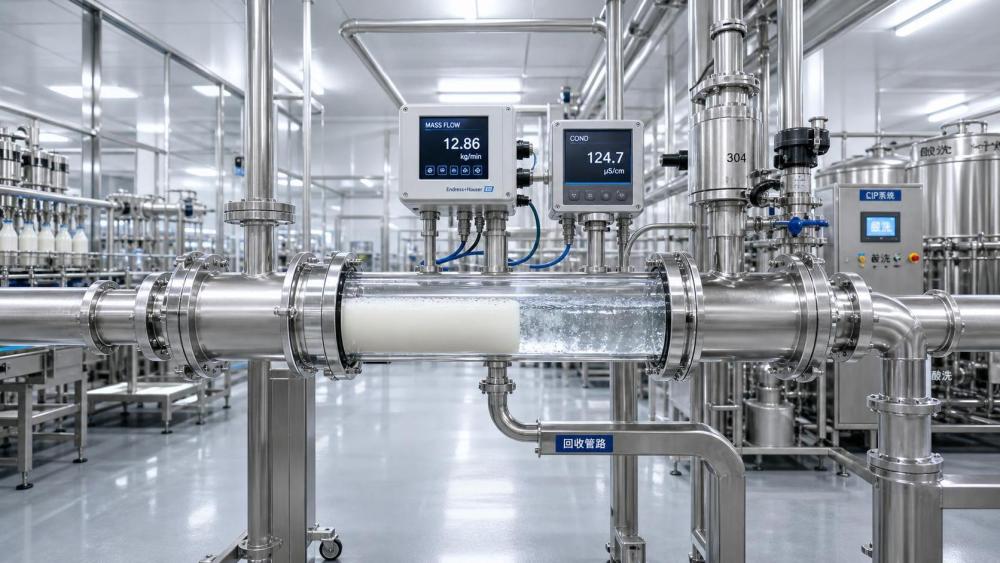
During a dairy product changeover, the interface is the moving boundary between the outgoing product and the medium used to push it out, usually water or another approved recovery method. This boundary is rarely perfectly sharp. Product mixing begins in bends, valves, pumps, expansion sections, and areas where flow slows down. If the interface is cut too early, good product is discarded. If it is cut too late, the recovered material may be too diluted or unsuitable for its intended destination.
The best detection method depends on the products and the available instrumentation. Conductivity can help distinguish milk from water, but it may not reliably separate one dairy product from another. Flow measurement helps estimate when the interface should arrive, yet flow alone cannot confirm quality. Color measurement may be useful for flavored products, while density, turbidity, refractometry, or laboratory checks may be more appropriate in specific applications. None of these tools should be treated as universal proof. The signal has to be matched to the recipe, the pipe configuration, and the plant’s quality rules.
A sensible operating practice is to establish a defined transition window rather than relying on one fixed valve-switch point. The first portion may still be sent as finished product, the middle interface can be routed to an approved recovery or controlled collection destination, and the final portion goes to drain or cleaning as required. The correct routing logic should be documented by product family. Plain milk, high-protein beverages, fruit yogurt, and chocolate formulations behave differently in a line; treating them as identical is a common source of both waste and quality complaints.
Sequence Products to Make Changeovers Easier, Not Harder
Production scheduling has a larger effect on loss than many teams expect. Moving from a light-colored, low-fat product to a darker, higher-fat, flavored, or particulate-containing product is generally easier than reversing that order. The reverse transition may demand more flushing, more cleaning attention, and a longer period before the next product meets its intended specification.
A useful schedule groups products by cleaning difficulty and contamination risk, not only by customer delivery date. For example, formulations containing cocoa, fruit preparations, cultures, stabilizers, or strong flavors may need to be placed later in a sequence where possible. Allergen management requires separate consideration. Where milk products share equipment with recipes containing other declared allergens, the site’s validated allergen-control program must take priority over a yield-saving opportunity. Product recovery is never justified if traceability, labeling accuracy, or allergen segregation becomes uncertain.
This does not mean production planning should become rigid. Demand changes, tank availability, maintenance work, and cold-chain dispatch schedules all affect the order of manufacture. But when the scheduler understands the real cost of a difficult transition, decisions become more balanced. A short run inserted between two incompatible recipes can create a disproportionate amount of product loss, cleaning time, water use, and delayed start-up.
Improve Product Recovery Without Creating a Hygiene Problem
Product recovery methods should be selected with caution. Water push-out is widely used because it is simple, but the recovered product can become diluted at the interface. Whether that material can be used again depends on the product specification, microbiological controls, traceability system, processing stage, and local regulatory requirements. In some plants, it may be suitable only for a clearly defined internal use; in others, it may not be acceptable for rework at all.
Pigging systems can recover product from pipelines with less dilution in suitable applications. They are not an automatic answer, especially where pipe networks contain complex manifolds, frequent branches, sensitive valves, or products with particulates. The system must be hygienically designed, cleanable, and validated within the plant’s cleaning regime. Maintenance also matters. A recovery device that is poorly inspected, incorrectly positioned, or difficult to clean can turn a yield initiative into a recurring food safety concern.
Even without specialized recovery hardware, small mechanical improvements can reduce retained product: avoiding unnecessarily long transfer routes, reviewing low points, confirming that lines drain as intended, and checking whether pump speed creates excessive mixing at the interface. High velocity is not always better. It may shorten transfer time but also increase turbulence and blend the product-water boundary, leaving a larger volume that must be downgraded or discarded.
Questions to ask before recovering transition material
- Can the material be identified by product, batch, time, and destination without ambiguity?
- Is dilution within the permitted formulation or process limit?
- Has the product been exposed to conditions that affect quality, temperature control, or microbiological risk?
- Does the recovery route avoid contact with incompatible products, allergens, or cleaning chemicals?
- Is there a written rule for when the collected material must be rejected rather than reused?
If the answer to any of these questions is unclear, the material should not be treated as recoverable product simply because it looks usable. Appearance is not a release criterion.
Make CIP Part of the Changeover Decision, Not a Separate Event
A changeover ends only when the system is ready to make the next product safely and consistently. This is where teams can make a costly mistake: they focus on getting the last product out, then treat cleaning-in-place as a routine utility cycle that will sort out everything else. In reality, the previous product’s fat level, protein content, viscosity, stabilizers, sugar content, and flavor residues can all affect cleaning performance.
The cleaning recipe should reflect the real soil load and equipment design. A line that processed a thick yogurt base may need different attention from one that ran standard milk. Yet extending every CIP cycle “just to be safe” is not a disciplined solution. It can consume water, energy, chemicals, and available production time without addressing the actual weak point. Review cleaning verification records, recurring residue locations, conductivity trends where used, visual inspections of accessible components, and any quality deviations after changeover. The goal is to understand whether the cycle is underperforming, overextended, or simply not matched to the process.
Operators should also watch for the gap between the written CIP sequence and what happens on the floor. A valve that does not seat correctly, an incorrect manual hose connection, a skipped confirmation, or a tank that was not fully emptied can undermine a well-designed procedure. These are often training and maintenance issues rather than operator carelessness. Clear line status indicators and a practical pre-start check are more reliable than asking people to remember every exception under time pressure.
Reduce Start-Up Rejects at the Filler
Start-up rejection is one of the most frustrating forms of loss because it happens after the product has already reached the packaging area. The filler may need time to stabilize product temperature, pressure, fill volume, seal performance, or coding. If that stabilization is unmanaged, operators may reject more packs than necessary while waiting for the line to settle.
Good preparation helps. Confirm packaging material availability before product arrives, make sure the filler and downstream equipment are released for the correct SKU, and verify that the recipe, date coding, cap or lid supply, and quality checks are ready. It sounds basic, but a product line should not be used as a holding area while the packaging team resolves a setup problem. That turns good dairy product into avoidable waste.
The first acceptable packs should be evaluated against the plant’s normal quality requirements, including fill, closure integrity, appearance, label correctness, and product identity where applicable. Rushing this check to shorten changeover time can lead to larger losses later through rework, holds, or market withdrawals. The useful measure is not merely “minutes to restart”; it is minutes to stable, saleable output.
Use Shift Data That Operators Can Actually Act On
Changeover loss becomes manageable when it is visible by product route and reason code. A single total waste figure at the end of the month is too distant from the event. Record whether loss came from tank heel, line displacement, interface collection, CIP discharge, filler start-up, packaging rejection, or an unplanned stoppage. The categories do not need to be elaborate; they need to be used consistently.
Reviewing a few recent changeovers with the operators who ran them is often more useful than a large spreadsheet review. Ask what was different: Was a tank changed late? Did the interface arrive earlier than expected? Did a valve response look slow? Was the product colder or thicker than usual? Did the filler wait for packaging material? These details create the basis for a targeted adjustment.
For processors following market and supply-chain developments through resources such as AgriTrade, operational yield should also be viewed in its wider context. Milk availability, energy prices, packaging supply, cold-chain capacity, food safety requirements, and customer demand patterns can all change the cost of a poor changeover. When raw material or packaging is under pressure, a few preventable losses per run become more consequential. Process data and market intelligence are most useful when they inform the same production decisions.
The Most Reliable Improvements Are Usually Small and Repeated
The strongest dairy product changeover programs are rarely built around one dramatic equipment upgrade. They come from knowing the line volume, setting realistic interface rules, sequencing products intelligently, validating recovery routes, maintaining hygienic equipment, and making sure the next process step is ready before product is released.
Pick one recurring transition and study it closely. Compare the planned routing sequence with the actual one, inspect the points where product is held up, and identify the first moment when material stops being saleable. Then change one condition at a time and confirm that hygiene, quality, and traceability remain protected. That is slower than guessing, but it is how product loss is reduced without moving risk somewhere else in the dairy process.
Related News
- 00
0000-00
What Determines Soy Sauce Flavor Balance and Quality for Noodle Dishes - 00
0000-00
What Payback Period Makes Food Processing Equipment ROI Worth Approving? - 00
0000-00
What to Verify Before Ordering Stainless Steel Mixing Tanks for Alcohol - 00
0000-00
Stainless Steel vs. Carbon Steel Edible Oil Storage Tanks: Material Selection for Beverage Industry Hygiene Compliance - 00
0000-00
Selecting Dairy Processing Equipment by Product Viscosity, Capacity, and Hygiene Risk
Food Processing Editorial Team
Weekly Insights
Stay ahead with our curated technology reports delivered every Monday.