Professional Agri-Forestry Industry Insights | Global Intelligence Leader

How to calculate the ROI of automated inspection technology





The investment case begins with the failure mode, not the machine
For a financial approver, the ROI of automated inspection technology in food manufacturing is rarely answered by a supplier quotation alone. The equipment price is visible. The financial consequences of missed defects, excessive false rejects, production bottlenecks, customer claims, and compliance failures are often scattered across quality, operations, maintenance, sales, and insurance records.
That is why an inspection project can look marginal when it is evaluated only as a labor-replacement purchase, yet become compelling when the full cost of quality risk is included. Conversely, a system that appears attractive in a demonstration can fail to justify its cost if the line has low throughput, product variation is poorly controlled, or the inspection result cannot be connected to a workable rejection and traceability process.
The practical question is not simply, “How much labor will the system remove?” It is: “Which losses can this inspection point materially reduce, how reliably can those reductions be measured, and what operating conditions are required to achieve them?”
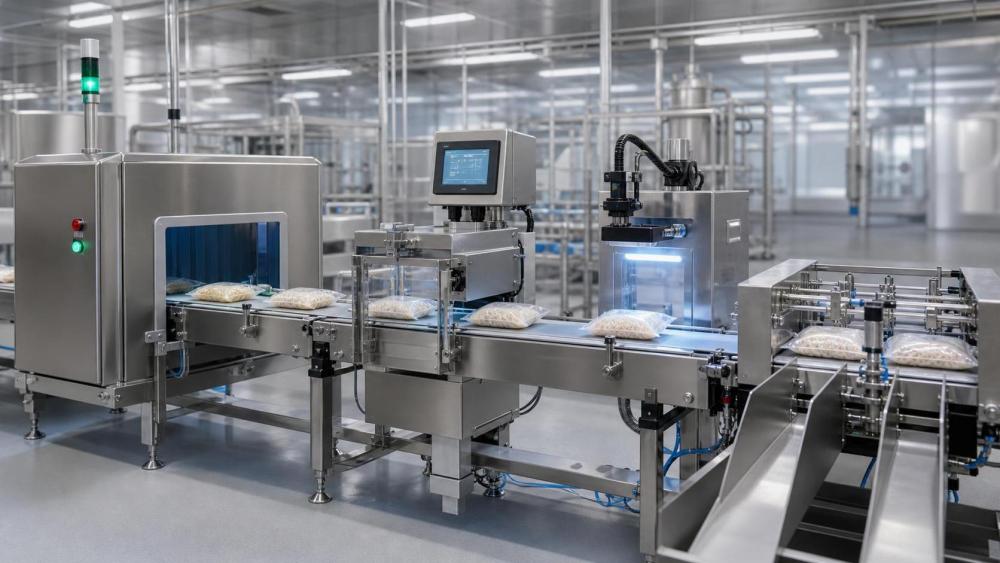
For food processors, packers, cold-chain operators, seafood exporters, meat plants, dairy facilities, grain processors, and prepared-food manufacturers, that distinction matters. Inspection automation may include metal detection, X-ray systems, checkweighers, vision inspection, seal inspection, label verification, foreign-material detection, sorting systems, and integrated quality-control platforms. Each addresses a different failure mode, and each has a different economic logic.
Define the decision before calculating ROI
A useful investment model starts by defining the exact process problem. “Improve quality” is too broad to support capital approval. A finance team needs a specific baseline: foreign-material escapes at final inspection, underweight packs, incorrect labels, damaged seals, inconsistent grading, manual sampling limitations, or the inability to document inspection outcomes for customers and regulators.
The scope should also be clear. Is the proposed system protecting one high-risk packaging line, replacing an end-of-line manual check, supporting export-grade verification, or standardizing inspection across several facilities? A single-line project may produce a straightforward payback case. A multi-site deployment may offer stronger strategic value, but it also carries integration, training, and change-management costs that should not be treated as incidental.
Before accepting an ROI forecast, financial approvers should ask operating teams to identify four items:
- The defect or compliance event the equipment is intended to prevent or detect.
- The current rate, cost, and operational consequence of that event.
- The expected detection performance under actual production conditions, not laboratory conditions.
- The action taken after detection, including reject handling, rework, line stoppage, batch segregation, and record retention.
If any of these are vague, the business case is not yet ready for a precise return calculation. It may still justify a pilot or a risk-reduction decision, but it should not be presented as a fully quantified productivity investment.
A practical ROI model for food inspection
The basic formula is familiar:
ROI = (Annual financial benefit - Annual operating cost) / Total investment cost
However, the useful work is in defining the terms. Total investment cost should include more than the purchase price. It generally includes equipment, conveyors or line modifications, installation, controls integration, factory acceptance and site acceptance testing, commissioning, validation, training, spare parts, initial calibration, software licensing where applicable, and internal engineering time. In food manufacturing, sanitation adaptations and hygienic design changes can also be material costs, especially on wet, chilled, high-care, or allergen-sensitive lines.
Annual operating cost should include preventive maintenance, service contracts, replacement components, energy consumption, calibration materials, software subscriptions, cleaning-related downtime, operator time, and the cost of investigating rejected products. A system that creates a large number of false rejects may protect quality but still impose a meaningful reinspection and waste burden.
Annual financial benefit can be organized into five categories:
- Labor savings or labor redeployment.
- Reduced product giveaway, waste, rework, and rejected finished goods.
- Lower expected cost of complaints, returns, withdrawals, and recalls.
- Higher throughput or reduced unplanned downtime.
- Commercial and compliance value, including customer approval, audit readiness, export eligibility, and stronger traceability.
Not every category should be monetized in the same way. Direct savings, such as fewer manual inspectors on a line, can often be measured from payroll, agency labor, overtime, and shift coverage. Risk avoidance requires more caution. A processor should not claim that an automated inspection system “eliminates recalls.” It does not. It can reduce the probability of certain failures and improve the speed of containment, but risks remain in upstream inputs, process controls, sanitation, supplier management, human procedures, and product handling after release.
The disciplined approach is to calculate an expected annual loss reduction. For example:
Expected annual risk benefit = Baseline annual probability of an event x Average financial impact x Expected reduction in probability or impact
The probability and impact assumptions should be reviewed by quality, operations, legal or regulatory personnel, and finance. Where historical internal data is limited, the estimate should be labeled as an assumption rather than presented as a fact. Severe recall costs vary widely by product category, geography, distribution reach, contractual exposure, and brand sensitivity, so external benchmark figures should be used carefully and marked 【待核实】 unless the source and relevance have been confirmed.
Labor savings are real, but they are often overstated
Labor is usually the easiest benefit to understand and the easiest one to overstate. Replacing a manual inspection station does not automatically create cash savings equal to the wages of the people assigned to it. If employees are retained and moved to another necessary task, the benefit may be better described as labor capacity recovered. That capacity can still be valuable in facilities facing labor shortages, seasonal peaks, high turnover, or overtime pressure, but it should not be counted as a full headcount reduction unless the organization can actually remove or avoid that cost.
There are several credible labor-related benefit cases. One is the elimination of temporary labor during peak periods. Another is avoiding a planned headcount increase as production expands. A third is reducing overtime, repetitive inspection work, and the supervisory burden associated with inconsistent manual checks. In plants where visual inspection is tiring or difficult to standardize, automation may also reduce variation between shifts.
Finance teams should distinguish between:
- Cash-releasing savings: reduced payroll, agency labor, overtime, or contracted inspection expense.
- Cost avoidance: labor that would have been added without the investment.
- Capacity benefits: existing staff redeployed to tasks that protect output, sanitation, maintenance, or quality.
All three can support an investment, but they should not be combined as though each produces immediate cash savings. A more credible model shows them separately.
Quality losses should be measured at the right level
Food manufacturers frequently underestimate quality costs because defects are recorded only at the point where they are found. A damaged seal detected before palletizing is not equivalent to a damaged seal discovered by a retailer or consumer. An underweight package caught on the line may require simple correction. The same issue discovered during a customer audit can trigger a chargeback, investigation, shipment hold, or wider review of production records.
The cost model should therefore capture the full downstream consequence of each defect class. Depending on the product, this may include product value, packaging cost, rework labor, disposal cost, cold storage, freight, retailer penalties, customer service time, sampling and laboratory testing, investigation cost, and lost production time.
For weight-control systems, the benefit often comes from reducing giveaway as well as avoiding underweight packs. The relevant question is not whether a checkweigher detects every deviation. It is whether the process data enables tighter filling control without increasing the risk of non-compliant packages. The financial baseline should use actual average giveaway by SKU, pack size, shift, and line where possible. Blending all products into one average can hide the few high-volume or high-value SKUs that drive the economics.
For vision systems, the value may sit in label accuracy, date-code verification, closure quality, fill-level checks, color or shape consistency, and packaging integrity. In export-oriented food supply chains, incorrect language, allergen, origin, date, or certification information may have consequences beyond the cost of a single rejected pack. Yet the inspection system must be able to read or identify the actual print quality, package orientation, substrate variation, condensation, and line speed present in the plant. A proposal based on ideal samples is not enough.
Throughput gains need a realistic constraint analysis
Automated inspection can support higher line speed, but it does not automatically create sellable output. The value of extra throughput depends on the plant’s true constraint. If inspection is the bottleneck and market demand exceeds current capacity, a faster validated inspection process may create incremental margin. If the constraint is cooking, chilling, raw-material availability, warehouse space, or sales demand, a higher-capacity inspection unit may simply add unused capability.
Approvers should ask for an end-to-end capacity map. It should identify nominal speed, sustainable speed, changeover time, planned stops, sanitation windows, reject-system capacity, downstream accumulation, and the effect of rejected packs on line flow. This is particularly important in seafood, fresh produce, meat, and chilled ready-meal operations, where product variability, moisture, temperature, and packaging formats can affect inspection reliability.
In some facilities, the larger benefit is not speed but consistency. An integrated inspection platform may make it easier to maintain line performance across shifts, identify recurring process drift, and reduce the time required to investigate customer complaints. Those benefits are valuable, but they should be connected to measurable operating indicators such as holds, rework hours, mean time to investigate, false-reject rate, or changeover losses.
Use sensitivity analysis rather than a single payback number
A single ROI figure can create false confidence. Food manufacturing assumptions are exposed to changes in labor availability, raw-material cost, production volume, customer requirements, and defect rates. A stronger capital request presents a base case alongside conservative and upside scenarios.
For example, the conservative case may assume lower production volumes, only partial labor redeployment, a higher maintenance allowance, and modest reductions in waste. The base case should reflect validated operating data. The upside case may include expected growth, reduced overtime, and measurable quality improvements after process stabilization. The decision should be viable under a reasonably conservative scenario if the project is framed as a cost-saving investment.
At a minimum, test the model against changes in annual throughput, expected defect reduction, false rejects, labor realization, installation cost, maintenance expense, and equipment availability. If a small change in one assumption turns a two-year payback into a five-year payback, that assumption deserves direct verification before approval.
Payback period remains useful because it is easy to communicate:
Payback period = Total investment cost / Annual net cash benefit
But it should not be the only measure. For larger systems or multi-year contracts, net present value and internal rate of return provide a more appropriate view because benefits and costs occur over time. Finance teams should also account for the expected useful life of the equipment, depreciation policy, tax treatment, residual value where relevant, and planned line changes that may make the system obsolete before its financial life ends.
Technical validation is part of financial due diligence
The most common weakness in inspection automation business cases is treating technical performance as a supplier issue and financial value as a finance issue. They are connected. Detection sensitivity, inspection-zone design, belt speed, product spacing, pack orientation, product effect, reject timing, and environmental conditions all influence the return that can actually be realized.
For metal detection and X-ray inspection, product composition and packaging materials can affect performance. For machine vision, lighting, print contrast, reflective films, variable packaging graphics, and condensation can create false alarms or missed defects. For seal inspection, the system must be assessed against the specific closure type and likely real-world fault conditions. For every technology, a factory test may demonstrate capability, but site conditions determine operating value.
A disciplined procurement process should require representative product trials, including worst-case SKUs, normal production variation, expected contamination or defect samples where safely managed, target line speeds, and realistic environmental conditions. The acceptance criteria should state detection performance, false-reject tolerances, reject verification, data capture, cleaning requirements, uptime expectations, and support response obligations.
These criteria are also relevant to food safety management systems. The inspection system may support a critical control point, a quality control point, verification activity, or customer-specific requirements, depending on the facility’s hazard analysis and operating procedures. The classification should be determined by the manufacturer’s food safety team, not assumed from a machine category. Applicable regulatory, certification, and customer requirements should be confirmed for the relevant market 【待核实】.
Traceability can change the economics of an incident
Inspection data becomes more valuable when it is linked to lot codes, production times, operators, recipes, suppliers, and distribution records. The goal is not simply to generate more data. It is to make the data usable when a quality event occurs.
Consider the difference between a suspected packaging defect that requires a broad production hold and one that can be isolated to a defined time window, line, product code, and batch. The latter may reduce the volume of product held, tested, reworked, or withdrawn. It may also improve the credibility of the manufacturer’s response to customers, auditors, and regulators.
This benefit is difficult to monetize until an incident occurs, so it should not be inflated. Still, it is a legitimate part of the decision where the facility handles high-value products, serves demanding retail or export customers, or operates under tight traceability expectations. The key is to verify whether the proposed system integrates with existing manufacturing execution, quality, enterprise resource planning, or traceability systems, and who owns the data after installation.
Questions financial approvers should ask before approving the project
- What specific defect, loss, or compliance exposure is being addressed, and how has the baseline been measured?
- Which benefits are cash savings, which are avoided future costs, and which are unquantified risk reductions?
- Has the system been tested with representative products, packaging, speeds, and environmental conditions?
- What false-reject rate is acceptable, and what will rejected product cost to handle and investigate?
- Does the line have enough reject capacity and downstream control to act on inspection results reliably?
- What integration, sanitation, maintenance, calibration, and spare-parts costs are included in the proposal?
- Which customer, export, food safety, or traceability requirements does the system support, and which remain outside its scope?
- What happens when the equipment is unavailable, and how will manual fallback inspection be controlled?
The strongest investment cases do not promise that automation will remove all quality risk. They show that a defined inspection point can reduce a documented exposure, improve control over a measurable process, and provide evidence that is useful to operations and customers. In food manufacturing, that level of discipline is often what separates a purchase that merely adds equipment from one that improves the economics of quality control over its full operating life.
Related News
- 00
0000-00
What Determines Soy Sauce Flavor Balance and Quality for Noodle Dishes - 00
0000-00
What Payback Period Makes Food Processing Equipment ROI Worth Approving? - 00
0000-00
What to Verify Before Ordering Stainless Steel Mixing Tanks for Alcohol - 00
0000-00
Stainless Steel vs. Carbon Steel Edible Oil Storage Tanks: Material Selection for Beverage Industry Hygiene Compliance - 00
0000-00
Selecting Dairy Processing Equipment by Product Viscosity, Capacity, and Hygiene Risk
Food Processing Editorial Team
Weekly Insights
Stay ahead with our curated technology reports delivered every Monday.