Professional Agri-Forestry Industry Insights | Global Intelligence Leader

How equipment handling affects food safety on production lines





Equipment handling is often treated as an operational matter: move the mixer, change the depositor, clean the conveyor, replace a gasket, return a mobile tank to storage. In food production, however, each of these actions can alter the hygienic condition of the line. A piece of equipment may be well designed and properly validated when installed, yet still become a contamination route through poor handling during changeover, cleaning, maintenance, storage, or transfer between production areas.
This is why equipment handling in food industry operations should be assessed as part of the food safety system rather than as a separate maintenance or production issue. The relevant question is not simply whether equipment is clean at a given moment. It is whether the way it is moved, opened, assembled, cleaned, inspected, repaired, and returned to service can reliably prevent biological, chemical, physical, and allergen hazards.
For a production site, the consequences extend beyond an isolated non-conformance. Weak handling controls can undermine HACCP-based preventive controls, create gaps in traceability, increase environmental contamination risk, and make sanitation results difficult to interpret. In export-oriented food supply chains, such failures can also affect customer audits, border compliance, product release decisions, and confidence in the supplier’s control culture.
Equipment is a food-contact surface only when it is handled as one
Stainless steel, food-grade polymers, enclosed product paths, and hygienic welds are important, but material selection alone does not make a process hygienic. Equipment becomes safe in practice only when its condition is preserved between uses.
A portable pump illustrates the point. It may have a sanitary design, suitable elastomers, and an approved cleaning procedure. But if the pump is disconnected while wet, wheeled through a low-care area, parked near drains, and reconnected to a high-care filling line without controlled re-cleaning and inspection, its original design features offer limited protection. The contamination risk comes from the handling sequence, not necessarily from the pump itself.
The same principle applies to utensils, totes, hoses, filters, cutting tools, belts, probes, filler parts, transfer pipes, and removable guards. These items are frequently moved, disassembled, or stored outside the exact conditions for which the line’s cleaning validation was established. They therefore deserve risk-based controls that reflect their actual use patterns.
Codex General Principles of Food Hygiene, CXC 1-1969, establishes hygienic production as a prerequisite for effective HACCP application. In practical terms, this means premises, equipment, cleaning, pest control, personnel hygiene, and operational practices must work together. A hazard analysis cannot compensate for poor control of equipment that repeatedly reintroduces contamination after sanitation.
Where handling failures create food safety hazards
The highest-risk moments are usually not during stable production. They occur at interfaces: receiving, setup, changeover, cleaning, maintenance, and product transfer. These are periods when barriers are opened and the normal separation between product, people, tools, and the environment becomes less reliable.
Receiving and installation of equipment
New or returned equipment is not automatically ready for food use. Transport can introduce dust, lubricant residues, pests, packaging fragments, wood splinters, metal particles, or moisture. Equipment may also arrive with protective films, temporary coatings, non-food-grade assembly lubricants, or inaccessible debris inside pipework and fittings.
A frequent oversight is treating commissioning as an engineering activity only. From a food safety perspective, acceptance should establish whether the equipment has been inspected, cleaned, assembled with approved components, and included in the site’s sanitation and preventive maintenance systems before it touches product. If the equipment is used for allergen-containing products, its role in allergen zoning and cleaning validation must also be defined before production begins.
Movement between hygienic zones
Many plants distinguish between raw and ready-to-eat areas, or between low-care, high-care, and high-risk zones. The exact zoning model varies by product and facility, but the control logic is consistent: equipment moved from a less controlled environment into an area with more vulnerable product must not carry hazards across the boundary.
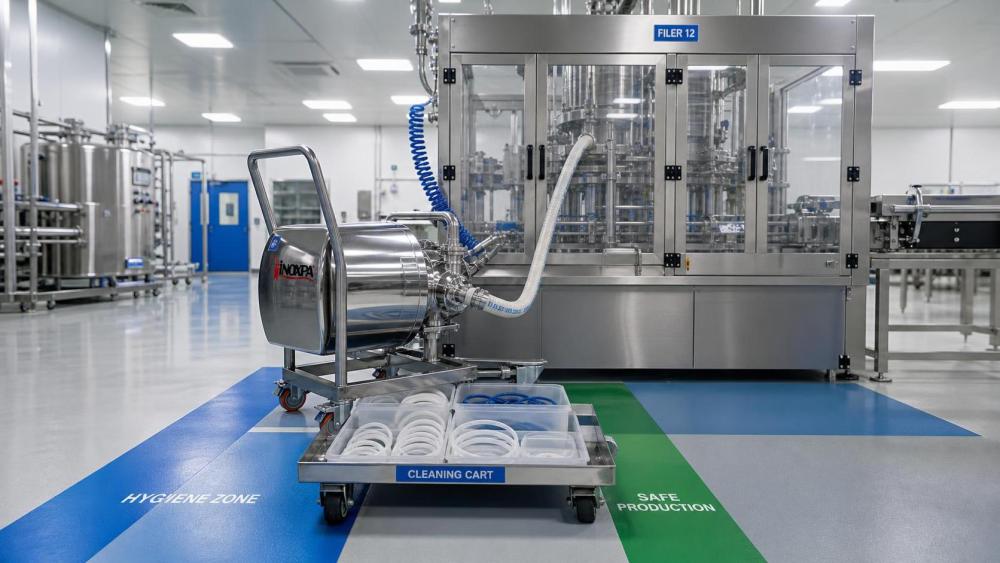
Wheels, casters, hose exteriors, tool handles, forklift attachments, mobile ladders, and maintenance carts are common weak points. Their food-contact surfaces may be clean, while their external surfaces are exposed to floors, drains, condensate, and traffic routes. When personnel handle these surfaces and then assemble food-contact parts, cross-contamination can occur indirectly.
Facilities should avoid relying only on visual cleanliness. Zone transfer controls may require dedicated equipment, color coding, physical segregation, cleaning and disinfection before entry, controlled route planning, or a documented release process. The appropriate measure depends on the hazard profile. A dry bakery line and a high-care cooked-meat slicing room do not require identical controls, but both need clear rules for what can move where and under what conditions.
Disassembly and reassembly after cleaning
Disassembly is necessary for many items that cannot be effectively cleaned in place. It also creates several risks: seals may be damaged, parts may be mixed between machines, fasteners may be lost, and product-contact components may be placed on unsuitable surfaces. In complex equipment, an incorrectly seated gasket or a reversed valve component can create a niche where product accumulates and microorganisms survive.
Reassembly errors are particularly significant because they may not be visible during a routine pre-operational inspection. A line can look clean externally while having dead legs, gaps, poor drainage, or incorrectly fitted seals internally. This is why visual inspection alone is not sufficient for equipment with enclosed product paths.
For critical equipment, reassembly should be controlled through documented work instructions, part identification, torque or fitting requirements where relevant, and verification by trained personnel. The objective is not excessive paperwork. It is to ensure that the equipment is restored to the condition on which cleaning, process, and food safety controls are based.
Maintenance intervention during production or between runs
Maintenance is an essential food safety activity because worn surfaces, damaged seals, leaking gearboxes, cracked belts, and poor drainage can all create hazards. Yet maintenance work itself can introduce foreign material, chemical contamination, or microbiological risk.
Common sources include metal filings, wire fragments, broken drill bits, lubricant overspray, cleaning cloth fibers, temporary tape, loose fasteners, and tools left inside guards or hoppers. The risk increases when repairs are urgent and production pressure is high. A rapid repair may restore throughput but leave inadequate time for cleaning, line clearance, foreign-material inspection, or documented release.
A robust maintenance release process should distinguish between food-contact and non-food-contact work, identify materials brought onto the line, control lubricants and chemicals, account for removed and replaced parts, and require cleaning and inspection before restart. In some cases, additional controls such as metal detection checks, sieve integrity checks, allergen cleaning verification, or product hold-and-release may be justified by the nature of the intervention.
Cleaning is affected by how equipment is prepared, not only by the cleaning chemistry
When sanitation performance is poor, sites often focus on detergent concentration, water temperature, contact time, or disinfectant selection. These variables matter, but poor results frequently begin earlier: equipment was not emptied, parts were not opened, soil was allowed to dry, hoses were stored incorrectly, or an assembly was too difficult to access.
Cleaning-in-place systems depend on equipment being configured as intended. Valves must be aligned correctly, flow paths must be complete, and circuits must meet validated flow, temperature, time, and chemical parameters. A modified pipe run, a partially closed valve, or a worn spray device can reduce cleaning effectiveness without creating an obvious alarm.
For clean-out-of-place items, handling discipline is equally important. Small components should not be piled together where surfaces shield one another from cleaning action. Food-contact parts should not be placed directly on floors or on unclean racks. After washing, equipment must be protected from recontamination during drying and storage. Wet storage areas are especially problematic where moisture can support microbial growth or attract environmental contamination.
ATP testing, protein swabs, allergen-specific tests, microbiological environmental monitoring, and visual inspection can each contribute to verification, but they answer different questions. ATP may indicate residual organic material; it does not prove the absence of a specific pathogen or allergen. A negative visual inspection does not demonstrate cleaning of inaccessible internal surfaces. Safety managers should ensure the verification method matches the hazard being controlled and the equipment design being evaluated.
Allergen control is often lost during equipment movement and shared use
Allergen cross-contact is not limited to the main processing line. It can occur when scoops, mobile vessels, pumps, hoses, trays, rework containers, and filling accessories move between recipes. Equipment that appears operationally interchangeable may not be interchangeable from an allergen-control perspective.
The critical issue is whether the site can demonstrate effective separation or validated cleaning between allergen-containing and non-allergen product runs. This requires more than a cleaning schedule. It requires accurate equipment identification, defined ownership of shared items, controlled storage, and a realistic assessment of difficult-to-clean areas such as threads, couplings, valve seats, flexible hoses, seals, and roughened plastic surfaces.
Equipment allocation can sometimes be more reliable than repeated cleaning, particularly for high-risk allergens or items with complex geometry. Dedicated utensils and transfer components may increase inventory costs, but they can reduce uncertainty where cleaning validation is difficult or where production schedules leave little margin for extended sanitation.
Design limitations must be recognized before procedures are written
Procedures cannot fully overcome equipment that is inherently difficult to clean or inspect. Hygienic design should therefore be considered at procurement, modification, and commissioning stages. Relevant features include accessible product zones, drainability, smooth cleanable surfaces, compatible materials, minimal crevices, sealed hollow sections, hygienic weld quality, and the ability to disassemble without excessive force or specialist tools.
European Hygienic Engineering & Design Group guidance and 3-A Sanitary Standards are widely referenced industry resources for hygienic design principles, although their relevance depends on equipment type and destination market. Their value lies in shifting the discussion from “Can this machine run?” to “Can this machine be cleaned, inspected, maintained, and returned to service without creating uncontrolled hazards?”
This distinction is commercially important. A lower-cost machine that requires prolonged disassembly, has poor drainage, or depends on hard-to-source seals may create higher sanitation labor, longer changeovers, more frequent downtime, and weaker audit evidence over its life cycle.
Documentation should follow risk, not bureaucracy
Food safety systems need evidence, but excessive forms can obscure the controls that matter. The most useful records make it possible to answer practical questions after a deviation: What equipment was used? Where had it been previously? Who cleaned and reassembled it? What maintenance was performed? Which products may have been exposed? Was the equipment released before use?
For high-risk or mobile equipment, an equipment history can be more valuable than a generic sanitation sign-off. Digital maintenance systems, barcode identification, and electronic cleaning records can improve traceability, particularly in large plants with shared assets. However, digital tools do not replace clear ownership. Each item needs an identifiable status: dirty, under maintenance, cleaned, awaiting inspection, released, or restricted for a specific allergen or zone.
Under the U.S. FDA’s preventive controls framework for human food, facilities subject to the rule are expected to implement risk-based preventive controls where appropriate. In the European Union, Regulation (EC) No 852/2004 requires food business operators to maintain hygiene conditions and procedures based on HACCP principles. Neither framework is a substitute for site-specific judgement. The practical task is to identify how equipment handling could introduce or fail to control hazards in the actual process.
What an effective equipment-handling review looks like
A useful review starts by following equipment through its full life cycle rather than inspecting it only while installed on the line. Trace a mobile pump from storage to setup, use, cleaning, maintenance, and return to storage. Observe who touches it, where it travels, what surfaces contact it, how it is identified, and how its cleaning status is communicated.
This exercise often reveals gaps that are not visible in procedures: a clean hose stored with dirty fittings; a food-contact tool placed on a maintenance bench; a replacement gasket taken from an unsealed drawer; a wheeled cart crossing a hygiene barrier; or a line restarted before post-maintenance clearance is complete.
The strongest controls are usually simple and specific. They define acceptable equipment condition, movement routes, cleaning requirements, release authority, and actions after deviation. They are also practical enough to be followed during busy shifts, breakdowns, and staff changes. If a control depends on perfect memory or informal handover, it is unlikely to remain reliable.
Food safety on production lines is not protected by sanitation alone, nor by equipment design alone. It is protected by the disciplined connection between design, handling, cleaning, maintenance, verification, and release. When that connection is visible in daily operations, equipment stops being a hidden source of risk and becomes a controllable part of the preventive food safety system.
Related News
- 00
0000-00
What Determines Soy Sauce Flavor Balance and Quality for Noodle Dishes - 00
0000-00
What Payback Period Makes Food Processing Equipment ROI Worth Approving? - 00
0000-00
What to Verify Before Ordering Stainless Steel Mixing Tanks for Alcohol - 00
0000-00
Stainless Steel vs. Carbon Steel Edible Oil Storage Tanks: Material Selection for Beverage Industry Hygiene Compliance - 00
0000-00
Selecting Dairy Processing Equipment by Product Viscosity, Capacity, and Hygiene Risk
Food Processing Editorial Team
Weekly Insights
Stay ahead with our curated technology reports delivered every Monday.