Professional Agri-Forestry Industry Insights | Global Intelligence Leader

How Should You Handle Food Ingredients with an Undeclared Allergen?





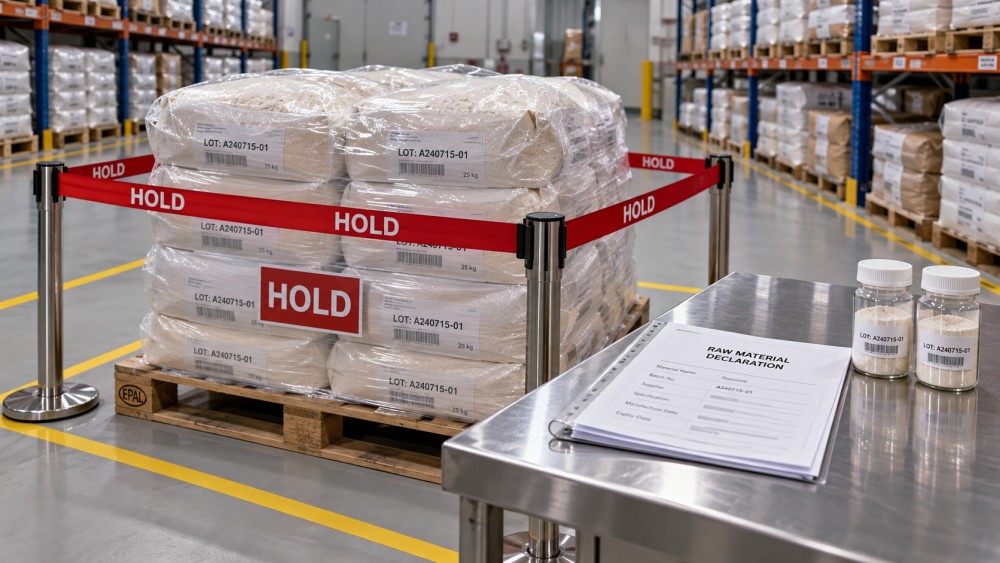
A shipment arrives with an allergen missing from its ingredient declaration, or a supplier reports an undeclared allergen after some material has entered production. Immediately place affected and potentially affected stock on hold, stop its use or dispatch, and notify the food safety lead. Do not wait for replacement paperwork or laboratory results before containing the issue. An incorrect declaration can expose allergic consumers and create reporting, withdrawal, or recall obligations.
“How do I handle a food ingredient shipment with an undeclared allergen?” The next steps depend on whether the ingredient remains in storage, has been processed, or has reached customers. Establish the allergen involved, identify the affected lots, trace every use and shipment, and determine a documented disposition under the rules of each destination market.
Contain the shipment before investigating the paperwork
Apply both a physical hold and an inventory-system block. A warehouse label alone may not prevent picking; a system block alone may not stop operators using material already staged beside a mixer. Include opened bags, partial pallets, samples, work-in-progress, and rework that could contain the ingredient.
- Identify the material: Record the supplier, ingredient name, supplier and internal lot codes, receipt date, quantity, storage locations, and purchase order.
- Prevent movement: Mark stock clearly as unavailable for use or dispatch. Restrict release authority to designated food safety or quality personnel.
- Stop affected operations: Pause dispensing, mixing, repacking, or transfer activities involving the suspect material. Production planning should arrange an approved alternative rather than bypass the hold.
- Preserve evidence: Retain packaging, labels, photographs, relevant records, and representative samples where appropriate. Preserve their condition and identity.
Keep refrigerated or frozen goods under their required storage conditions during quarantine. Prevent leaking bags or open containers from contaminating adjacent stock. For bulk deliveries, isolate the relevant silo, tank, transfer line, or receiving connection and establish whether material has mixed with earlier inventory.
Notify warehouse, production, procurement, and logistics personnel through a controlled incident message. State exactly which material is blocked, what activities must stop, and who can authorize further action.
Establish what “undeclared” means in this shipment
A missing declaration can arise from an intentional ingredient omitted from a specification, a supplier formulation change, the wrong label, accidental cross-contact, or a mistaken shipment. These situations require different investigations, but none should be dismissed as merely administrative before verification.
Compare the physical shipment label against the approved specification, allergen statement, purchase requirements, and any batch-specific documentation. Check the actual manufacturer and production site, especially when buying through a broker. A distributor’s general assurance may not describe the batch received.
Ask the supplier for written answers tied to specific lots:
- Which allergen is involved, and what ingredient or process introduced it?
- Is its presence confirmed, suspected, or based on a documentation discrepancy?
- Which manufacturing dates, sites, and lots could be affected?
- Has the formulation, raw-material source, production line, or cleaning process changed?
- What evidence supports the proposed boundaries of the incident?
An allergen can be disclosed in supplier documents yet still be missing from the finished product’s legally required declaration. Conversely, a documentation mismatch does not itself prove contamination. Keep those questions separate: determine what the material contains and whether the applicable declarations are correct. Allergen categories, exemptions, and labeling requirements differ between markets.
Trace exposure beyond the receiving warehouse
Do not limit the investigation to the remaining bags. Use receiving records, dispensing logs, batch sheets, rework records, and dispatch data to connect the supplier lot with everything produced or shipped from it. Where lot identities were lost through commingling, broaden the hold until evidence supports a narrower boundary.
Reconcile quantities: material received should be accounted for through stock remaining, production use, returns, samples, waste, and other documented movements. Investigate unexplained differences rather than assuming they represent harmless loss. For continuous processes, use transfer times, production records, and validated carryover information to establish defensible boundaries.
Check whether affected rework entered later batches. Also examine shared scoops, dust collection, conveyors, and transfer hoses where they could spread the allergen. Finding the original lot does not necessarily identify the full exposure.
Use risk assessment and testing for different purposes
The food safety team should assess the allergen source, likely amount and distribution, processing conditions, intended use, finished-product labeling, and destination-market requirements. A supplier statement that the amount is “very small” is not an adequate basis for release. Neither is the assumption that cooking removes allergenic risk.
Testing can support an investigation, but a negative result does not automatically clear a shipment. Cross-contact may be uneven, so a sample may miss contaminated pockets. Processing and the food matrix can also affect method performance. An allergen-protein method and a DNA-based method do not necessarily answer the same question.
Before ordering analysis, agree with a competent laboratory on the target allergen, matrix suitability, sampling approach, detection capability, and interpretation limits. Document what decision the results are intended to support. Testing is particularly weak as a release justification when records already establish an intentionally added allergen that is absent from the declaration.
Where threshold-based assessments are permitted, they require a defensible exposure assessment and competent interpretation. Do not apply a threshold borrowed from another market as a universal exemption, or dilute affected material simply to obtain a lower test result.
Escalate distributed product without waiting for a complete investigation
Once affected material has left your control, assess notification and market action promptly. Regulatory duties can depend on the jurisdiction, your role in the supply chain, the nature of the risk, and whether consumers can access the product. A supplier’s investigation does not suspend your own obligations.
Designate one incident lead to coordinate food safety, regulatory, operations, and customer communications. Contact the competent authority when required, within applicable deadlines, and seek specialist regulatory support when cross-border requirements or recall decisions are unclear. Do not delay a necessary report while trying to calculate the final quantity.
A customer hold notice should identify the ingredient or product, affected lot codes, the allergen concern, required stop-use or stop-sale action, and a contact for acknowledgment. Request remaining quantities and onward-distribution details. Distinguish confirmed facts from points still under investigation.
If affected food may already be with consumers, an internal hold or business-to-business withdrawal may be insufficient. Evaluate a consumer recall and the required public communication. Keep a record of who received each notice, whether they acknowledged it, and whether further distribution was stopped. Any reported allergic reaction requires urgent escalation; a person experiencing symptoms should seek immediate medical assistance.
Choose a disposition that fixes the actual problem
Keep the hold in place until an authorized person approves a documented outcome. Commercial pressure, supplier credit, or an updated certificate does not establish that stock is safe and compliant.
Return or controlled disposal
Returning unused material may be appropriate when the supplier can receive and control it lawfully. Confirm transport identification, receiving arrangements, and inventory reconciliation so the shipment is not resold inadvertently. Disposal needs equivalent control, including records showing what was destroyed and how it was prevented from re-entering food use.
Relabeling or an alternative intended use
Relabeling may be possible when the material’s actual composition is established, the new declaration meets applicable requirements, and the site can safely handle that allergen. Ingredient-label correction alone does not fix finished products already made with incorrect consumer labels. Repacking and over-labeling also require controls against mixed or incomplete labels.
Alternative use is not an automatic solution because the receiving product already declares the same allergen. Confirm the complete formulation, any additional allergens, customer specifications, handling controls, and legal suitability. Obtain approval before transfer or rework. Precautionary wording such as “may contain” is not a substitute for correcting an omitted intentional ingredient or investigating uncontrolled cross-contact.
Release without physical correction is appropriate only when evidence establishes that the suspected discrepancy does not make the material unsafe or noncompliant. Record that evidence, the assessment, the approving person, and any restrictions. If safety or compliance remains unresolved, the stock remains on hold.
Verify the production area before restarting
When the ingredient has been opened or processed, assess whether cleaning is needed beyond the affected batch. Include dispensing stations, equipment recesses, mobile containers, utensils, and relevant dust-handling systems. Use an allergen-cleaning procedure supported by validation for the equipment and material involved.
Visual inspection can identify residue but cannot by itself establish adequate allergen removal. Select appropriate verification methods and understand their limits; general hygiene checks are not automatically allergen-specific. Quarantine material produced during any uncertain transition period until its disposition is justified.
Restart authorization should confirm that affected material is controlled, the line is suitable for the next product, correct labels and specifications are available, and operators understand the change. Record who removed each inventory block rather than allowing quarantine status to disappear during routine stock adjustments.
Close the supplier failure, not just the incident
Require a root-cause explanation that accounts for how the allergen entered the material or disappeared from its declaration, why existing checks missed it, and how the supplier established the affected scope. “Operator error” without examination of label control, formulation approval, or change management leaves the underlying weakness unresolved.
Corrective actions should match the cause. A formulation-change failure may require notification and specification-approval controls. A wrong-label event calls for label reconciliation and line-clearance improvements. Cross-contact may require segregation, scheduling, cleaning validation, or revised supplier approval.
Before accepting further shipments, define the evidence needed for renewed approval and any temporary receiving controls. Retain the incident timeline, traceability reconciliation, communications, test reports, disposition records, and release authorization together. Close the incident only after stock is accounted for, required market actions are verified, and responsibility for checking corrective-action effectiveness has been assigned.
Got questions about this industry topic or seeking best practices for your business? Drop us a line below, and let the expert team at AgriTrade help you out.
We respect your privacy. Your information is strictly confidential.
Related News
- 00
0000-00
Fish Coating Mix Specifications: A Checklist for UK Procurement - 00
0000-00
Food Safety Certification: How to Choose a Scheme for Your Facility - 00
0000-00
How Should You Handle Food Ingredients with an Undeclared Allergen? - 00
0000-00
Food Processing in the Middle East: Growth Opportunities and Supply Chain Risks - 00
0000-00
Edible Oil Storage Tank Procurement: Reviewing Material and Weld Records
0000-00
Food Processing Editorial Team
Weekly Insights
Stay ahead with our curated technology reports delivered every Monday.