Professional Agri-Forestry Industry Insights | Global Intelligence Leader

How Edible Oil Storage Tank Design Affects Cleaning, Safety, and Shelf Life





Tank problems in edible oil handling rarely begin with the oil itself. They usually begin with surfaces, joints, fittings, dead zones, temperature control, and the small design decisions that determine whether residues are easy to remove or quietly accumulate over time. For quality control and safety teams, storage is not a passive step between processing and filling. It is one of the places where oxidation, contamination, odor carryover, and cleaning failures can become expensive.
An edible oil tank may look simple from the outside, yet its design has a direct effect on three outcomes that matter every day: how completely it can be cleaned, how well it protects product safety, and how long the oil remains within specification during storage. Those outcomes are linked. A tank that is difficult to drain is usually harder to sanitize properly. A tank with poorly chosen materials or fittings may create both hygiene risks and shelf-life problems. A cheaper vessel can become costly if it drives longer cleaning cycles, more rework, or avoidable product loss.
Why storage design matters more for oils than many buyers expect
Edible oils do not support microbial growth in the same way as water-based foods, but that does not make storage design less important. Oils are sensitive to oxidation, light exposure, temperature fluctuation, trace contamination, and residues from previous batches or cleaning chemicals. In blended oils, flavored oils, salad oils, and refined products awaiting packaging, small quality shifts can affect odor, clarity, taste stability, peroxide development, and customer acceptance.
For safety managers, the main concern is not only food contact hygiene but also safe operation of heated systems, confined space cleaning, slip hazards around transfer points, and the integrity of vents and valves. For QC personnel, the focus often turns to consistency: whether samples taken from the tank represent the real batch, whether sediment or residues remain in low points, and whether hold times are realistic under the actual storage conditions.
When a storage tank is selected only by capacity and quoted price, these practical issues stay hidden until commissioning. By then, the plant may already be dealing with long cleaning validation cycles, difficult inspections, or recurring non-conformities.
Cleaning performance starts with geometry, not chemicals
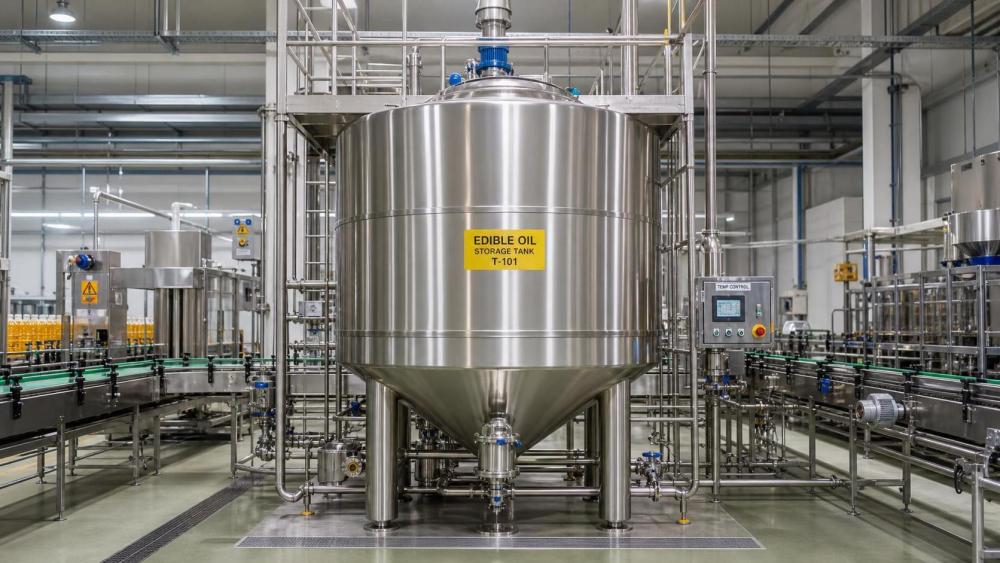
Many sanitation problems come from shape and layout rather than cleaning chemistry. If internal surfaces cannot be fully wetted, drained, and inspected, even a strong cleaning program may leave residues behind. Oils can cling to surfaces, especially after heating or when the product contains additives, seasonings, or minor solids. Any place where liquid remains after discharge becomes a place where old oil ages faster than the fresh batch.
Several design details strongly influence cleanability:
- Bottom configuration: Sloped or dished bottoms generally drain better than flat bottoms. Full drainage reduces old-oil hold-up and shortens cleaning and rinse time.
- Internal weld quality: Rough welds, crevices, and undercut areas can trap residues and make visual inspection difficult.
- Nozzle placement: Poorly placed inlets and outlets can create stagnant zones that receive little flow during production and cleaning.
- Manway and access design: If internal inspection points are limited, teams may miss buildup near the top head, agitator mounts, or around spray devices.
- Spray coverage: Cleaning devices need to match the tank diameter, height, and soil load. A tank designed for CIP on paper may still leave shadow areas in practice.
In procurement discussions, the phrase edible oil storage tank often appears as if all tanks for oil are broadly interchangeable. They are not. For QC and sanitation teams, the difference between an easy-drain stainless vessel and a tank with poorly finished internals can show up in retained residues, repeated rinses, and inconsistent swab or visual inspection results.
A useful review point is whether the tank can be emptied to the level required by the process without manual intervention. If operators need to tilt hoses, open extra fittings, or enter the tank routinely to remove heel product, cleaning cost and safety exposure both increase.
Material selection affects both hygiene and product stability
For edible oil storage, stainless steel is commonly preferred because it offers a cleanable, corrosion-resistant food contact surface when properly fabricated and maintained. Material choice matters not only for sanitation but also for product stability. Reactive surfaces, damaged passivation, or unsuitable seals may contribute to off-notes, discoloration, or contamination risk, depending on the oil type and operating conditions.
Quality teams usually pay attention to the shell material, but smaller contact components deserve the same scrutiny. Gaskets, valve seats, sight glasses, hoses, and level sensor interfaces can all become weak points. If elastomers are not compatible with temperature and cleaning chemicals, they may degrade, shed particles, absorb odor, or create crevices at the seal face. For flavored oils or oils with sensitive sensory profiles, this becomes even more relevant.
Surface finish is another overlooked factor. Smoother internal finishes generally release oil films more easily and support more reliable visual inspection. That does not mean the most polished specification is always necessary, but buyers should match finish requirements to the product, cleaning method, and changeover frequency. A tank used for long campaigns of a single refined oil may have different needs from one used for multiple salad oil formulations with frequent product switches.
Oxygen, light, and temperature are shelf-life variables shaped by tank design
Shelf life in storage is often discussed as if it depends mostly on the oil recipe or upstream refining quality. In reality, the tank itself can either help preserve quality or accelerate deterioration. Oxidation risk rises when oil has unnecessary contact with air, elevated temperature, or repeated recirculation patterns that entrain oxygen.
Design choices that influence shelf life include:
- Headspace management: Excessive air exposure in partially filled tanks can shorten acceptable holding time.
- Vent arrangement: Vents must protect pressure balance without allowing avoidable contamination ingress.
- Insulation and heat tracing: Some oils need stable temperature to maintain pumpability, but overheating can accelerate oxidation or quality drift.
- Tank color and installation environment: Outdoor placement and radiant heat load may change internal product temperature beyond what operators expect.
- Mixing and circulation design: Unnecessary agitation can increase oxygen exposure, while poor circulation may create thermal stratification.
For salad oil and similar applications, temperature control is usually a balancing act. Product may need warmth for transfer efficiency, yet prolonged heat exposure can work against shelf-life targets. Safety managers should also consider whether heating systems introduce burn hazards, hot-surface exposure, or maintenance complexity. QC teams, meanwhile, may need to define acceptable storage windows based on actual tank conditions rather than ideal lab assumptions.
Dead legs and fittings are common contamination points
Many storage issues are traced to the parts attached to the tank rather than the tank body itself. Sample valves, overflow lines, level transmitters, thermometer wells, side nozzles, drain valves, and transfer manifolds can create low-flow pockets where old oil remains. These pockets may not be obvious during routine operation, especially if the system appears clean from the main manway.
Dead legs are particularly important when plants switch between products or allergens, or when they need strong odor separation between batches. Residual oil trapped in a branch line can slowly oxidize or contaminate the next lot. In plants with frequent cleaning verification, these areas often explain why the tank body passes inspection while associated piping does not.
Good design does not eliminate every fitting, but it reduces unnecessary complexity. Buyers should ask where product can remain after normal discharge, how each branch is cleaned, and whether instruments can be removed or serviced without opening new hygiene risks.
Safety performance depends on access, cleaning method, and thermal design
From a safety perspective, storage tanks for edible oil are often treated as low-risk compared with reactors or pressure vessels. That can be misleading. Risks arise during manual cleaning, top access, heating, sampling, and maintenance. If a tank requires frequent entry because CIP coverage is poor, the food safety issue quickly becomes an occupational safety issue as well.
Points worth reviewing include:
- Whether internal inspection can be completed without awkward climbing or overreaching
- Whether manways, ladders, and platforms support safe access for sampling and maintenance
- Whether heated jackets, coils, or tracing lines are protected and clearly controlled
- Whether venting and overflow protection are suitable for filling procedures
- Whether drain locations reduce floor spills during line break or maintenance work
A design that reduces manual intervention usually improves both sanitation consistency and operator safety. This matters in real plants, where cleaning is done under time pressure and tank entry permits can delay production if routine tasks have not been engineered out.
What buyers should compare beyond quoted tank price
The extra note on edible oil storage tank price factors points to an important procurement issue: the purchase price alone says little about lifecycle cost. Two tanks with similar volume can differ meaningfully in fabrication detail, cleanability, inspection access, instrumentation readiness, and thermal control. Those differences affect labor, downtime, utility use, product loss, and quality risk.
When comparing offers, buyers should look beyond shell thickness and nominal capacity. Useful questions include:
- Is the tank designed for full drainability under the actual installation layout?
- What internal finish and weld treatment are included, and where?
- How are nozzles, vents, and sample points arranged to avoid product traps?
- Is the cleaning method manual, semi-CIP, or fully CIP compatible?
- What gasket and seal materials are proposed for oil temperature and cleaning chemistry?
- Does the quoted scope include insulation, heating, supports, instruments, and access hardware?
- How easy will it be to inspect, validate cleaning, and replace wear parts later?
These factors often explain why one quote is lower than another. A lower initial price may reflect fewer sanitary details, simpler internals, or omitted accessories that the plant will still need. For quality and safety teams, the relevant question is not whether the tank is expensive or cheap, but which risks are being accepted in exchange for the lower figure.
A practical review framework for QC and safety teams
Before approving a tank specification, it helps to review the design against the actual process rather than a generic food-grade checklist. A tank used for refined oil buffer storage in long campaigns may need a different balance of features than one used for multiple edible oil SKUs with frequent cleaning and short dispatch cycles.
The most effective storage tanks are rarely the ones with the longest feature list. They are the ones whose details match the product, cleaning regime, and operating environment. For edible oil applications, design affects far more than storage capacity. It shapes whether the tank can be cleaned predictably, whether the product remains protected during hold time, and whether operators can manage the system without unnecessary exposure or workarounds.
For plants trying to reduce quality deviations, unexplained shelf-life variation, or recurring sanitation trouble, the storage tank is a sensible place to look. A careful design review usually reveals whether the current specification supports the process—or quietly works against it.
Got questions about this industry topic or seeking best practices for your business? Drop us a line below, and let the expert team at AgriTrade help you out.
We respect your privacy. Your information is strictly confidential.
Related News
- 00
0000-00
Fish Coating Mix Specifications: A Checklist for UK Procurement - 00
0000-00
Food Safety Certification: How to Choose a Scheme for Your Facility - 00
0000-00
How Should You Handle Food Ingredients with an Undeclared Allergen? - 00
0000-00
Food Processing in the Middle East: Growth Opportunities and Supply Chain Risks - 00
0000-00
Edible Oil Storage Tank Procurement: Reviewing Material and Weld Records
0000-00
Food Processing Editorial Team
Weekly Insights
Stay ahead with our curated technology reports delivered every Monday.