Professional Agri-Forestry Industry Insights | Global Intelligence Leader

Flavored Mayonnaise for Sandwiches: Comparing Supplier Samples





A flavored mayo can taste balanced on a tasting spoon and still disappoint in a sandwich. Garlic may overpower a mild filling, chili heat may build after several bites, or a creamy spread may leave the bread wet during chilled holding. Comparing supplier samples therefore requires two separate judgments: whether the flavor suits the menu and whether the product performs through the actual preparation, storage, and service routine.
For procurement teams, the strongest sample is not necessarily the richest or thickest. It is the one that delivers an acceptable sandwich consistently, at a controlled portion cost, with specifications the supplier can reproduce. A useful evaluation connects sensory results with handling observations, packaging performance, and documented quality requirements.
Define the sandwich before requesting samples
Sending suppliers a request for “smoky chipotle mayo” leaves too much open to interpretation. One supplier may prioritize sweetness, another smoke aroma, and another chili intensity. Without an application brief, buyers risk comparing different product concepts rather than competing solutions to the same requirement.
Describe the bread, filling, spread position, preparation method, and expected holding period. A spread for freshly assembled toasted chicken sandwiches has a different job from one used in chilled, prepacked vegetable sandwiches. Include the intended serving temperature and whether the product will be applied manually, through a squeeze bottle, or with a depositor.
Also distinguish between the base product and its commercial description. Comparing Mayonnaise with salad dressing is relevant here because a similar appearance does not establish an equivalent formulation. In the United States, these products have separate federal standards of identity; buyers should check the applicable market requirements rather than assume the names are interchangeable.[1] A flavored product’s appropriate legal name needs review against its actual formulation and destination market.
Ask suppliers to identify the submitted formulation, production date, lot number, pack format, storage instructions, and remaining shelf life. Establish whether the sample came from normal commercial production or a development batch. A hand-prepared sample may be useful for choosing a flavor direction, but it is not sufficient evidence of routine production performance.
Make sample comparisons fair enough to support a purchase
Use blind codes and a common preparation procedure. Record the amount of spread applied, the bread and filling weights, assembly sequence, and holding conditions. These are proposed evaluation controls, not universal industry limits: the buyer should set them around the intended operation.
Compare samples at the same intended serving temperature and follow each supplier’s storage instructions. Record the samples’ age and remaining shelf life; otherwise, a fresh development batch may receive an unfair advantage over an older commercial sample. Keep one established product as a reference if the business already has an acceptable benchmark.
Run a plain-product assessment before the sandwich test, but do not let it determine the decision. The plain assessment helps identify differences in acidity, sweetness, heat, aroma, and texture. The assembled sandwich reveals whether those differences remain useful once bread, protein, vegetables, and other sauces are present.
Repeat the comparison across separate preparation sessions. If the preferred sample changes whenever a different employee assembles the sandwich, the procedure may need tighter controls before supplier differences can be interpreted.
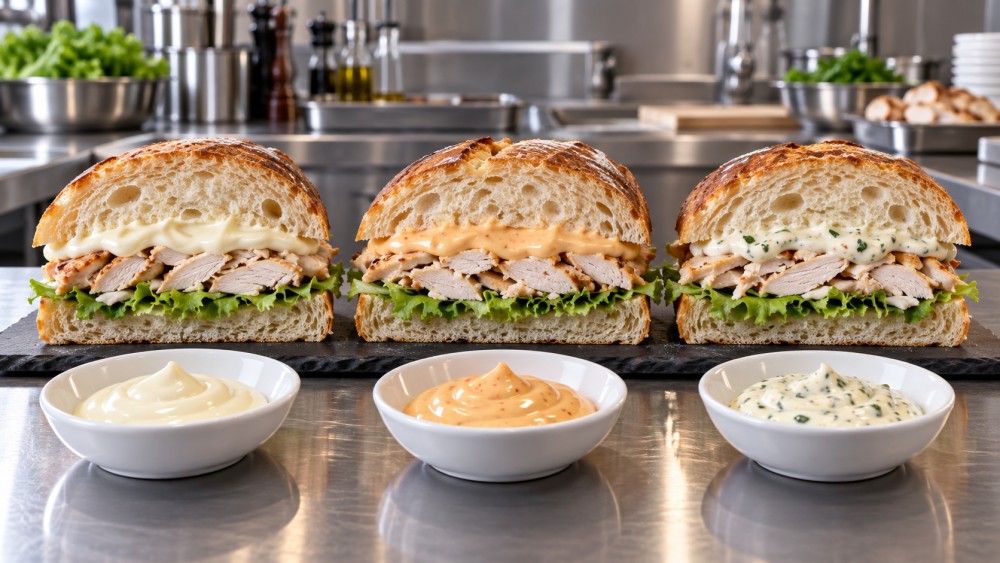
Evaluate flavor in the complete bite
Build the flavor scorecard around the menu rather than a generic “taste” score. For a garlic-herb spread, buyers might evaluate garlic harshness, herb character, acidity, and lingering aftertaste. For a chili-based spread, they might separate initial heat from heat that accumulates over several bites. Use clear descriptors so that “too strong” becomes an actionable observation.
Include at least one representative sandwich and, where relevant, a more demanding version. A mild poultry filling can expose excessive smoke or garlic. A strongly seasoned filling can reveal whether the spread contributes anything beyond moisture. A vegetable sandwich can help assess the combined effect of ingredient moisture and the spread during holding.
Assess more than the first bite. Ask whether the flavor remains balanced halfway through the portion and whether the aftertaste fits the intended menu. A sample that wins a brief tasting may become tiring across a full sandwich. Conversely, a restrained spread may perform better with a salty or heavily seasoned filling.
Keep preference separate from suitability. Evaluators may personally enjoy a hot sample while agreeing that it falls outside the menu brief. Record both judgments, and avoid averaging them into a single unexplained score. Procurement needs to know whether a rejection reflects a correctable formulation issue or simply individual taste.
Separate physical stability from apparent thickness
A thick spoonful is not proof of stable sandwich performance. Emulsion behavior depends on formulation and processing, including the oil droplets, their interfaces, and the surrounding phase. Texture and resistance to separation are related but distinct properties.[2] Buyers should therefore assess what happens during application and holding instead of treating initial viscosity as a complete quality measure.
Inspect the spread before and after normal handling. Does it become difficult to portion when chilled? Does stirring restore uniformity, or merely hide visible liquid temporarily? Does a squeeze bottle deliver a continuous ribbon, or alternating thick and watery portions? Record observations without assuming the underlying cause; diagnosis belongs with the supplier’s technical team.
In assembled sandwiches, distinguish oiling-off, watery release, and bread wetting. They may look similar at a glance but can require different investigations. Moisture can also come from fillings, so compare bread with spread alone against the complete sandwich. That simple control helps avoid blaming the sauce for liquid released by vegetables or other ingredients.
Flavored variants deserve individual testing. Do not assume that approval of a plain base automatically covers a version containing chili paste, chopped herbs, or other additions. Request the specification for the exact variant, including any particle-size requirements relevant to dispensing. Where equipment is involved, test the commercial pack through the actual nozzle or pump.
Use the intended holding period as the acceptance condition. A longer stress test can help compare samples, but its results should not automatically determine approval for a shorter service application. Equally, surviving a brief tasting does not establish suitability for a chilled retail sandwich held through its planned sales window.
Keep safety verification outside the tasting score
Physical separation and poor flavor can justify rejection, but an attractive, stable sample does not establish food safety. The finished sandwich includes other ingredients and handling steps; its controls cannot be inferred from the spread’s taste or acidity alone. In U.S. food-service settings, the FDA Food Code provides a model framework for time/temperature control and date marking, while the applicable local rules and product assessment determine operational requirements.[3]
Ask for documented storage conditions, unopened shelf life, instructions after opening, and the basis for those instructions. If ambient storage or an unusually long opened life is proposed, request the supporting assessment rather than accepting a sales statement. Any required validation should address the relevant formulation, packaging, process, and use conditions.
Review the full ingredient and allergen declaration for the flavored variant, not just its base. The supplier should identify applicable allergens and provide information needed for the buyer’s own label and handling review. Requirements differ by market; for U.S. products, FDA guidance describes the major food allergens and associated labeling obligations.[4]
Request relevant product specifications, microbiological criteria, and evidence supporting shelf-life claims. Agree which characteristics are verified by routine certificates of analysis and which rely on separate validation. A certificate that reports only appearance and flavor cannot substitute for documentation supporting a safety or shelf-life claim.
Compare cost per acceptable sandwich
Price per kilogram is useful, but it leaves out portion size, pack residue, dispensing loss, and rejected sandwiches. Compare candidates at their intended application weight. If a stronger flavor allows a smaller portion, test whether that portion still provides the required coverage and eating quality rather than assuming the reduction is workable.
A practical calculation is: spread cost per acceptable sandwich equals the cost of product consumed, including attributable waste, divided by the number of acceptable sandwiches produced. Use measured trial results for each candidate. Keep packaging residue and preparation losses visible so that the reason for a cost difference remains clear.
Pack format can change the result. A pail may suit centralized preparation but create extra handling at a small outlet. A pouch may fit a dispensing system yet leave inaccessible residue. Compare opening, loading, changeover, cleaning, and disposal under the actual operating routine.
Evaluate minimum order quantities against realistic consumption and usable shelf life at receipt. A lower unit price can lose its advantage if slow-moving flavors create expiry losses. Ask about lead times, delivery conditions, and minimum remaining life on arrival before accepting a volume discount.
Turn the preferred sample into an enforceable specification
Before a purchase commitment, confirm the preferred product in its proposed commercial packaging and repeat the critical sandwich tests. Where practical, evaluate more than one production lot. This does not prove long-term consistency, but it gives a better basis for approval than a single development sample.
Translate the trial into acceptance language that both sides can use. “Good consistency” is difficult to enforce. A defined application test, agreed preparation conditions, and a clear description of unacceptable separation or dispensing behavior provide a more useful reference. If instrumental viscosity is specified, include the measurement method, temperature, and sample preparation; a viscosity number without test conditions is difficult to interpret.
Weight the decision before reviewing commercial offers. Taste and application stability may carry the greatest influence, while required documentation, allergen compatibility, and delivery capability can serve as pass-or-fail conditions. Do not allow a high sensory score to compensate for an unresolved mandatory requirement.
Retain the approved specification, sample identification, evaluation records, and agreed change-notification process. Changes to ingredients, processing, or packaging should trigger a review proportionate to their likely effect. The purchasing decision is defensible when the chosen spread meets the sandwich brief, survives the required holding conditions, and can be supplied consistently at an acceptable usable cost.
Sources
- U.S. Food and Drug Administration, Code of Federal Regulations, Title 21, Sections 169.140 and 169.150: federal standards of identity for the two dressing categories discussed.
- David Julian McClements, Food Emulsions: Principles, Practices, and Techniques, third edition, CRC Press, 2015. Reference for emulsion structure, rheology, and physical stability.
- U.S. Food and Drug Administration, Food Code 2022, Sections 1-201.10, 3-501.16, and 3-501.17: definitions, temperature control, and date marking. Local adoption and applicability require confirmation.
- U.S. Food and Drug Administration, Food Allergies: What You Need to Know. Reference for major food allergens and U.S. food-labeling requirements.
Got questions about this industry topic or seeking best practices for your business? Drop us a line below, and let the expert team at AgriTrade help you out.
We respect your privacy. Your information is strictly confidential.
Related News
- 00
0000-00
Fish Coating Mix Specifications: A Checklist for UK Procurement - 00
0000-00
Food Safety Certification: How to Choose a Scheme for Your Facility - 00
0000-00
How Should You Handle Food Ingredients with an Undeclared Allergen? - 00
0000-00
Food Processing in the Middle East: Growth Opportunities and Supply Chain Risks - 00
0000-00
Edible Oil Storage Tank Procurement: Reviewing Material and Weld Records
0000-00
Food Processing Editorial Team
Weekly Insights
Stay ahead with our curated technology reports delivered every Monday.