Professional Agri-Forestry Industry Insights | Global Intelligence Leader

Edible Oil Storage Tank Procurement: Reviewing Material and Weld Records





For an edible oil processor, a storage tank can appear to be a straightforward stainless-steel vessel. Procurement risk usually emerges later, when the supplier cannot clearly connect the quoted material grade, weld procedure, inspection results, and final tank configuration. A low purchase price may become expensive if the vessel has undocumented plate substitutions, inaccessible welds, poor drainability, or a surface condition that complicates cleaning.
Reviewing material and weld records before placing an order gives purchasing teams a practical way to assess whether the proposed vessel matches the process. The review should cover more than a material certificate. It should establish traceability from raw material receipt through fabrication, inspection, surface treatment, pressure or leak testing, and final release.
Why material and weld records belong in the purchasing decision
Edible oils vary in viscosity, oxidation sensitivity, temperature requirements, and susceptibility to contamination from residues. A tank used for refined vegetable oil may have different operating demands from one used for heated palm oil, oil blends, or ingredients transferred through a cleaning-in-place system. The correct vessel depends on the complete duty rather than the product name alone.
Material records help answer several questions:
- Was the shell, head, nozzle, and internal component material supplied in the specified grade?
- Can the material be traced to a heat or batch number after fabrication?
- Are product-contact surfaces suitable for the intended food-processing environment?
- Were filler metals, gaskets, valves, and instruments included in the same quality review?
Weld records answer a different group of questions. They show how joints were made, by which qualified procedure, and whether the completed welds received the inspections stated in the purchase specification. This distinction matters because a tank can have an acceptable base material and still present hygiene or integrity problems caused by undercutting, lack of fusion, excessive heat tint, distortion, or difficult-to-clean weld geometry.
Material documentation: what procurement should request
Confirm the material schedule before reviewing certificates
The purchase specification should identify the material required for each major component. A common specification may call for austenitic stainless steel for product-contact parts, but the grade and finish still need to be stated. The shell may use one grade while shafts, coils, supports, or fittings use another. These differences should be intentional and documented.
For many food applications, 304 or 316 stainless steel may be considered, yet neither grade is automatically correct for every service. The choice can depend on cleaning chemicals, chloride exposure, temperature, moisture, and the risk of corrosion at welds. A procurement team should ask the process engineer or hygienic design specialist to confirm the grade rather than accepting a generic phrase such as “food-grade stainless steel.”
Material certificates should identify the applicable standard, product form, grade, heat number, chemical composition, and mechanical properties where relevant. EN 10204 is commonly used to describe types of inspection documents, including 3.1 certificates issued by the manufacturer’s authorized inspection representative. The certificate type should be specified in the purchase order; a supplier’s general declaration is not equivalent to traceable inspection documentation.
Preserve heat-number traceability
Traceability is useful only when it continues through fabrication. The supplier should explain how heat numbers are transferred from mill certificates to cut parts, formed sections, nozzle necks, and other product-contact components. Marking methods must be compatible with the surface and should not create a contamination or corrosion concern.
A practical document package may include a material list, certificate register, marked fabrication drawings, and a traceability map. If a plate is cut into several sections, the records should make it possible to identify where those sections were used. When a replacement material is proposed, procurement should require written approval before fabrication continues. Substitution can affect corrosion resistance, weld procedure applicability, thermal behavior, and future maintenance.
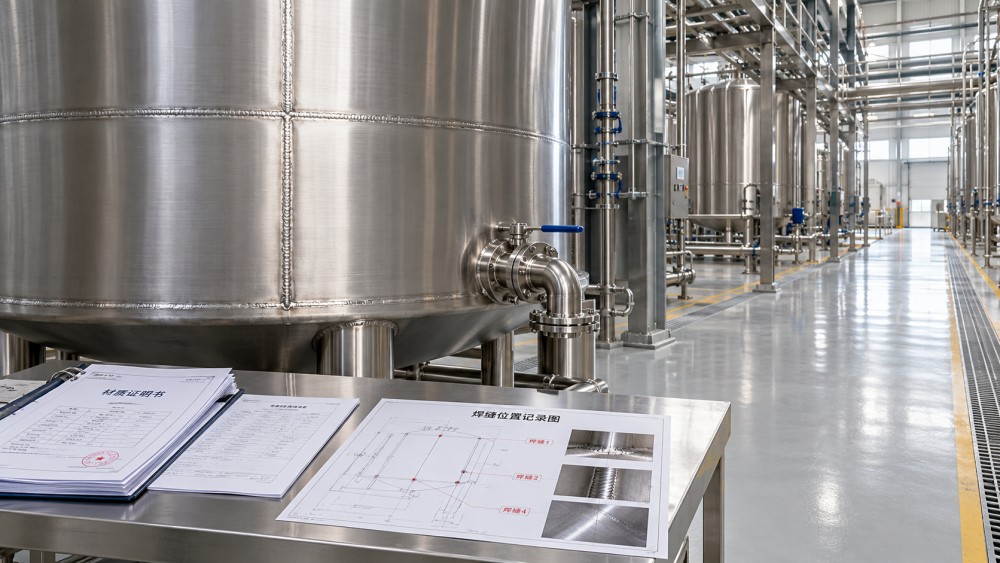
Weld records reveal fabrication quality more clearly than a certificate
A weld map is one of the most useful documents to request for a fabricated tank. It identifies weld locations and links them to joint numbers, procedures, welders, filler materials, inspection status, and repair history. Without a weld map, a statement such as “all welds inspected” is difficult to verify.
The welding documentation should normally be reviewed as a connected set:
- Welding procedure specification (WPS): Defines variables such as process, base material range, filler metal, shielding gas, joint preparation, heat input controls, and position.
- Procedure qualification record (PQR): Provides evidence that the procedure was tested under defined conditions, where the governing code requires qualification.
- Welder or welding operator qualification: Shows that the person performing the work was qualified for the relevant process, material range, thickness, and position.
- Weld log: Connects the welder, date, joint number, filler batch, and any preheat or interpass controls to the physical tank.
- Inspection and test reports: Record visual examination, liquid penetrant testing, radiography, ultrasonic testing, leak testing, or other methods specified for the vessel.
ISO 3834 provides quality requirements for fusion welding of metallic materials, while ASME Section IX is widely used for qualification of welding procedures and personnel in applications governed by ASME construction rules. These references do not automatically define the complete hygienic design of a tank. The buyer still needs a project-specific specification covering product-contact surfaces, inspection extent, testing, and acceptance criteria.
Surface condition and weld finish affect hygiene
For edible oil service, weld acceptance should not stop at structural soundness. Internal welds need to be assessed for smoothness, crevices, incomplete fusion, spatter, arc strikes, and discoloration that has not been properly removed or treated. The required surface finish should be stated using a measurable specification where appropriate. A general request for a “polished interior” leaves too much room for interpretation.
Surface roughness is only one part of hygienic performance. A smooth surface may still be difficult to clean if the tank has sharp internal corners, poorly blended welds, unsealed gaps, or no effective drainage path. Product-contact attachments, thermometer pockets, level probes, spray devices, and agitator seals deserve the same attention as the main shell welds.
Passivation or another approved post-weld treatment may be appropriate for the selected stainless-steel system, but the method should be agreed in advance. The record should state what treatment was performed, on which surfaces, and how residues were removed or neutralized. A certificate saying “passivated” without a defined procedure or release criteria has limited value.
Cleaning requirements should be considered while reviewing the drawings. A tank intended for automated cleaning may need suitable spray coverage, drainability, access, and connections compatible with the cleaning circuit. If the tank is cleaned manually, access and inspection provisions become more important. The design should also prevent standing oil or cleaning solution in low points that cannot be emptied during normal operation.
Match the record review to the tank’s operating duty
Procurement teams often use a standard checklist for every vessel. A checklist is useful, but the inspection emphasis should change with the application.
Capacity alone is also an incomplete selection criterion. Working volume should allow for headspace, thermal expansion, mixing behavior, and the operating limits of level instruments. A tank that is technically large enough may be impractical if the outlet cannot drain the vessel, the manway cannot support inspection, or the layout prevents removal of the agitator or internal components.
When comparing an edible oil storage tank for a specific process, buyers can use the same document questions applied to any fabricated hygienic vessel: which materials are product-contact, how are welds identified, what inspections are included, and how will the final condition be verified? A product reference page may help clarify the general tank category, but it should not replace review of project drawings, specifications, and quality records.
Inspection and acceptance should be defined before fabrication
Disagreements commonly arise because the buyer and supplier assume different inspection levels. The purchase order should identify which welds require visual examination, which require liquid penetrant testing, whether radiography or ultrasonic testing applies, and what acceptance criteria govern each method. The selected method should reflect the joint type, accessibility, risk, and applicable construction requirements.
Liquid penetrant testing can help identify surface-breaking discontinuities in suitable non-porous materials, but it does not evaluate every type of subsurface defect. Radiography and ultrasonic methods have different capabilities and limitations. The inspection agency, procedure, personnel qualification, report format, and repair process should be agreed before testing begins.
Leak and pressure testing also need careful wording. A tank designed for atmospheric service should not be subjected to an unsuitable pressure test simply because a generic vessel checklist includes one. The test medium, test pressure, hold time, safety controls, and acceptance criteria should follow the approved design basis and applicable rules. For a jacketed vessel, the product chamber and heating or cooling chamber may require separate test arrangements.
Factory acceptance can include dimensional checks, nozzle orientation, internal cleanliness, surface inspection, instrument connection verification, and a review of outstanding deviations. Photographs of concealed areas can be useful when insulation, cladding, or installation conditions will later limit access. The buyer should receive a controlled dossier rather than scattered certificates sent by different departments.
Red flags in supplier documentation
Several warning signs deserve clarification before an order is released:
- The certificate lists a stainless-steel grade but does not show a heat number or the material location on the tank.
- The weld procedure is provided, but the qualified material range does not clearly cover the proposed base material or thickness.
- The weld map does not match the fabrication drawing, nozzle schedule, or visible joint numbering.
- Inspection reports contain unexplained repairs, repeated repairs at the same location, or acceptance criteria that are not identified.
- The supplier promises a polished or hygienic finish without defining the surface requirement, inspection method, or treatment record.
- Gaskets, filler metals, valves, and internal accessories are excluded from the traceability package even though they contact the oil.
- Design changes are communicated verbally, leaving no controlled revision or buyer approval.
These issues do not automatically prove that a tank is unusable. They indicate that the buyer lacks enough evidence to judge conformity and future service risk. A clear request for correction, clarification, or additional inspection is usually more productive than relying on a broad supplier warranty.
Build a release decision around evidence
A practical procurement file should contain the approved specification, general arrangement and fabrication drawings, material certificate register, traceability records, welding procedures and qualifications, weld map, inspection reports, test records, surface-treatment documentation, calibration records where relevant, deviation approvals, and a final packing or cleanliness statement.
The release decision should be made against defined hold points. For example, material verification may be required before cutting, visual and penetrant inspection before closing inaccessible areas, and final dimensional and cleanliness checks before shipment. This approach gives procurement a chance to resolve problems while correction remains possible, rather than discovering them after delivery or installation.
The central question is not whether the supplier can provide a thick document package. It is whether the documents create a credible chain from specification to finished vessel. For an edible oil storage tank, that chain connects hygienic design, material identity, weld quality, inspection scope, and the actual process conditions. When those elements are reviewed together, purchasing teams can compare quotations on evidence and fitness for duty instead of relying on price, photographs, or generic claims.
Reference basis: EN 10204, Metallic products—Types of inspection documents; ISO 3834, Quality requirements for fusion welding of metallic materials; ASME Boiler and Pressure Vessel Code, Section IX, Welding, Brazing, and Fusing Qualifications; U.S. FDA, 21 CFR Part 117, Current Good Manufacturing Practice, Hazard Analysis, and Risk-Based Preventive Controls for Human Food; European Commission Regulation (EC) No 1935/2004 on materials and articles intended to come into contact with food; European Commission Regulation (EC) No 2023/2006 on good manufacturing practice for materials and articles intended to come into contact with food. Applicability depends on the jurisdiction, product, tank design, and contractual specification.
Got questions about this industry topic or seeking best practices for your business? Drop us a line below, and let the expert team at AgriTrade help you out.
We respect your privacy. Your information is strictly confidential.
Related News
- 00
0000-00
Fish Coating Mix Specifications: A Checklist for UK Procurement - 00
0000-00
Food Safety Certification: How to Choose a Scheme for Your Facility - 00
0000-00
How Should You Handle Food Ingredients with an Undeclared Allergen? - 00
0000-00
Food Processing in the Middle East: Growth Opportunities and Supply Chain Risks - 00
0000-00
Edible Oil Storage Tank Procurement: Reviewing Material and Weld Records
0000-00
Food Processing Editorial Team
Weekly Insights
Stay ahead with our curated technology reports delivered every Monday.