Professional Agri-Forestry Industry Insights | Global Intelligence Leader

Which seafood processing solutions suit high-volume frozen products?





Selecting seafood processing solutions for high-volume frozen products is not simply a question of buying the fastest freezer available. A line that looks productive on a supplier layout can still lose money through dehydration, blockages at packing, poor glaze control, excessive product breakage, or a cold store that cannot absorb peak output. For technical evaluators, the real task is to match product behavior, batch pattern, labor availability, hygiene zoning, and export requirements into one workable frozen-processing system.
This is especially relevant for processors handling shrimp, fish fillets, squid, shellfish meat, value-added portions, or mixed seafood packs. These products do not react to freezing in the same way. A delicate IQF shrimp needs separation and surface protection; a dense frozen block needs uniform core freezing and reliable mould handling; a marinated fillet may require very different conveyor and sanitation decisions from a plain, skinless fillet. The best seafood processing solutions are therefore usually built around the product portfolio, not around a single machine category.
Start with the product form, not the advertised throughput
“High volume” can mean several things in seafood. It may mean a plant runs a large seasonal catch in a short period, processes a steady year-round aquaculture supply, or needs to switch among multiple customer specifications during one shift. Those scenarios place different demands on freezing and handling equipment.
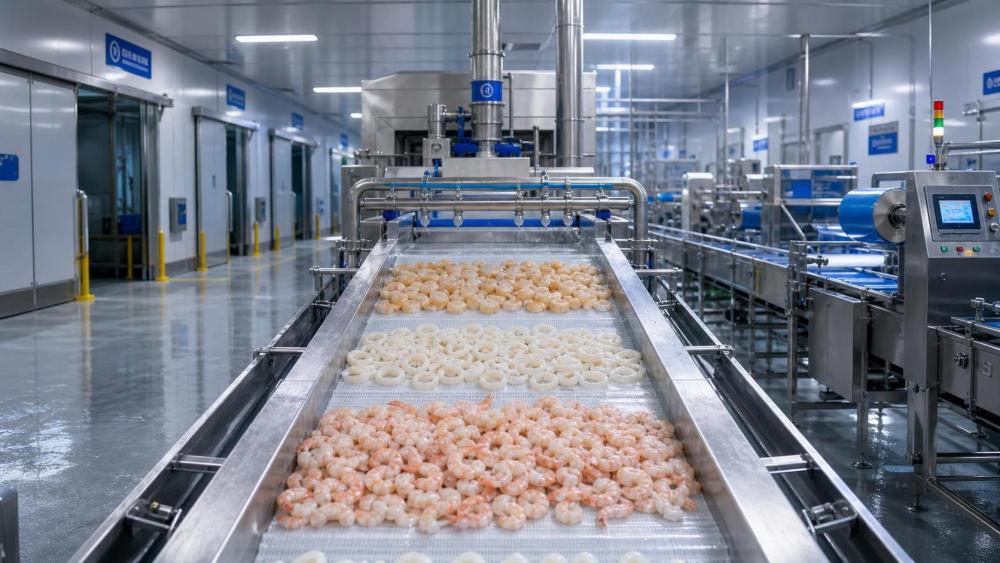
For loose, individually frozen products, an IQF system is often the starting point. Fluidized-bed or belt-based IQF freezers are commonly considered for peeled shrimp, cooked shrimp, diced fish, scallops, squid rings, and similar products that must remain free-flowing after freezing. The important question is not whether the freezer can freeze the product, but whether it can do so while maintaining separation, acceptable surface appearance, manageable frost accumulation, and a stable feed layer. If upstream dewatering is inconsistent, the freezer may be blamed for clumping when the real issue began at washing or draining.
For block-frozen seafood, plate freezing remains a practical option where product is packed in cartons, pans, or moulds. It is often well suited to raw material intended for further processing, foodservice blocks, and distribution formats where individual piece separation is not required. Plate freezing can be compact and relatively straightforward, but it makes line balance crucial. Filling, levelling, sealing, loading, unloading, and pallet transfer all need to work at a similar pace. A fast plate freezer does not help if operators are still manually correcting irregular cartons on both sides of the process.
Spiral freezers are frequently evaluated for coated, cooked, tray-packed, or value-added products. They are useful when a processor needs dwell time in a compact footprint and wants more flexibility than a block-freezing operation allows. However, spirals require serious attention to cleaning access, belt tracking, airflow patterns, and the product transfer points before and after the freezer. Fine breadcrumbs, batter, loose ice, and small seafood fragments have a habit of becoming sanitation problems in places that were easy to ignore during the layout stage.
Cryogenic systems using liquid nitrogen or carbon dioxide may also be considered for specialty products, irregular production patterns, pilot launches, or situations where very rapid crust freezing is valuable. They can be operationally flexible, but consumable supply, ventilation, safety arrangements, and ongoing operating cost must be assessed carefully. For a large, stable commodity line, a cryogenic freezer is not automatically the most economical answer. For a premium line with frequent changeovers, it may be worth examining.
In other words, the decision is less about choosing “IQF versus block freezing” and more about deciding what the buyer expects to receive: separated pieces, protected glazed products, portion-controlled packs, bulk blocks, or ready-to-cook retail units.
A freezer is only one section of the line
The most common evaluation mistake is to treat freezing capacity as the plant’s capacity. In practice, high-volume frozen seafood depends on the entire product path: receiving, chilled holding, grading, washing, trimming, cooking where applicable, cooling, dewatering, freezing, glazing, weighing, packing, metal detection or other inspection steps, carton handling, palletizing, and cold storage transfer.
Consider a shrimp line. If raw shrimp arrives with variable size distribution, graders and peelers may create an uneven feed to the freezer. If the product carries excess water after washing, the IQF bed can overload. If glazing is applied unevenly, the packed weight may fluctuate and freezer burn risk can rise during storage. If the checkweigher rejects too frequently because the filler cannot handle loose, glazed product consistently, the line loses output after the freezer rather than before it. These are connected events, not isolated equipment issues.
For that reason, technical specifications should cover more than nominal kilograms per hour. They should define product temperature at each handoff, permitted moisture condition before freezing, target pack format, expected product mix, changeover requirements, cleaning windows, and the maximum acceptable accumulation between stations. Suppliers need realistic samples and process details. A line designed around ideal product size and continuous feeding can behave very differently during a real landing-day surge.
Match automation to variability, not just labor cost
Automation is often justified through labor reduction, but seafood processing has a more complicated relationship with automation than many dry-food operations. Raw seafood varies by species, season, harvest method, size, condition, and handling history. A machine that performs well with uniform farmed shrimp or carefully trimmed fillets may struggle with irregular wild-caught material.
The strongest business case for automation is usually found in repetitive, measurable, or physically demanding tasks: automatic feeding, conveying, grading, portioning, glazing control, weighing, bagging, carton forming, coding, case packing, pallet transfer, and data capture. These areas can reduce handling touches and make line performance easier to trace. Vision systems may assist with sorting or inspection, but they should be trialled against the actual product defects that matter to the processor. A system trained to recognize visual variation is not necessarily able to make the same quality judgement as an experienced inspector handling a wet, translucent fillet.
A sensible design often preserves human judgement where raw material variation is highest and automates the downstream steps where product geometry has become more consistent. This is also easier to maintain. Over-automating a line that changes species, sizes, and pack styles every week can lead to expensive equipment sitting idle because the setup is too rigid.
Hygiene design should be judged in the wettest, busiest hour
Seafood plants are demanding environments. Salt, water, protein residues, ice, temperature differences, and frequent washdown can expose weak equipment design quickly. Hygienic construction is not merely a stainless-steel checklist. Evaluators should inspect whether conveyors can be accessed without excessive dismantling, whether frames avoid unnecessary horizontal ledges, whether drainage supports the cleaning plan, and whether electrical enclosures, sensors, and bearings are suitable for the washdown conditions they will actually face.
It is useful to walk through a sanitation cycle before approving a layout. Ask where residue collects after a shift, where employees need to reach, where water will travel, and whether disassembly creates a food-safety risk or simply takes too long to be done consistently. Equipment that is technically cleanable but requires several skilled people and a lengthy shutdown may not remain cleanable under seasonal production pressure.
Zoning matters as well. Raw receiving, raw preparation, cooked-product handling, freezing, and finished-product packing should not be connected by casual traffic routes. The right arrangement depends on the process and local rules, but the principle is stable: minimize cross-traffic, separate tools and personnel where needed, and make it difficult for raw-material handling to compromise finished frozen product areas.
Yield, energy, and cold storage must be reviewed together
Yield preservation is one of the most commercially sensitive parts of a frozen seafood project. Mechanical damage, drip loss, inconsistent glaze, poor temperature control, and overhandling can all affect saleable output or customer acceptance. Yet yield discussions can become misleading when they focus only on one machine. A glaze applicator cannot correct a product that was held too long before freezing; a freezer cannot recover fillet integrity lost during rough transfer; a high-speed packaging machine cannot make unstable product weights disappear.
Energy should be reviewed with the same system mindset. Refrigeration performance is influenced by ambient climate, product inlet temperature, freezer loading pattern, defrost strategy, door discipline, insulation, condenser conditions, and cold-store operation. Evaluators should request a clear basis for any energy estimate and compare like with like. Is the quoted figure based on a specific species, product thickness, inlet temperature, and operating condition? Does it include auxiliary equipment? What happens during partial loading or frequent changeovers? These questions are more useful than comparing a single headline consumption number.
Cold storage is often undersized because it is treated as a warehouse problem after the processing line has been selected. In reality, it is a production buffer. During peak harvest, delayed container pickup, inspection holds, or schedule changes, frozen inventory may need somewhere safe to sit. The route from freezer discharge to pallet storage should protect product temperature and avoid creating a manual bottleneck. If pallets queue in a warm dispatch zone, the value of a well-designed freezer is partly lost.
Build export-market requirements into the equipment brief
Frozen seafood processors serving export markets must consider more than the physical process. Buyers may ask for traceability information, specific label content, defined pack weights, inspection records, packaging performance, and evidence that temperature control has been managed through storage and shipment. Requirements differ by destination and product category, so equipment selection should be checked against the relevant market rules and the customer’s own specification before purchase.
This affects practical choices. Batch records may need to connect raw-material lots to finished cartons. Checkweighing and coding systems may need to communicate with production records. Packaging materials must suit freezer conditions and the intended distribution chain. For glazed products, the declared net weight and the customer’s expectations around glaze require particular care. The equipment should support verification; it cannot replace the processor’s quality system.
Industry intelligence is useful at this stage because equipment decisions can outlast a temporary market condition. Platforms such as AgriTrade, operated through zsiron.com, track seafood trade, food processing, packaging, cold-chain developments, market movement, and regulatory updates across the wider agri-food supply chain. For an evaluator, that context can help reveal whether a proposed product format is aligned with likely export demand, logistics constraints, or changing buyer expectations. It should inform the project brief, not substitute for technical validation or destination-specific compliance checks.
Questions that expose weak proposals early
Before comparing quotations, ask suppliers to explain how the line handles the least convenient conditions: the smallest and largest product sizes, wet product after washing, the busiest hour of the shift, a change from one pack format to another, and a cleaning cycle after a high-residue product. Ask what information they need to validate capacity and whether trials can be performed using representative product. A credible supplier will usually ask detailed questions in return.
Also clarify what is included between machines. Interfaces are where many projects become expensive: conveyors, control integration, drainage, refrigeration connection, guarding, platforms, data exchange, utility demand, commissioning support, spare parts, and operator training. A low initial equipment price can be misleading if these items are vague or excluded.
For high-volume frozen products, the most suitable seafood processing solution is rarely the one with the highest nominal capacity. It is the one that keeps product moving at the required quality level on ordinary production days, can be cleaned properly, fits the available cold-chain infrastructure, and still makes sense when species mix, buyer specifications, and export conditions change. That is the standard worth designing around.
Related News
- 00
0000-00
Fishery Machinery Manufacturing Market: Demand Drivers and Supply Chain Risks - 00
0000-00
Selecting Marine Fishery Equipment for Offshore Vessels: Capacity, Corrosion, and Safety - 00
0000-00
How to Evaluate a Fishing Equipment Manufacturer for Quality, Capacity, and Compliance - 00
0000-00
How Can Buyers Assess a New Fishery Supplier’s Export Capacity? - 00
0000-00
Which Countries Have the Strictest Fishery Product Quarantine Rules in 2026?
Fishery News Editorial Team
Weekly Insights
Stay ahead with our curated technology reports delivered every Monday.