Professional Agri-Forestry Industry Insights | Global Intelligence Leader

Which Countries Have the Strictest Fishery Product Quarantine Rules in 2026?





Which Countries Have the Strictest Fishery Product Quarantine Rules in 2026?
Which countries have the strictest fishery product quarantine rules right now? For seafood exporters, importers, and supply chain managers, the practical answer can determine whether a container clears as planned, is held for sampling, or is refused at the border. In 2026, the most demanding markets are not necessarily those with the longest paperwork. They are the markets that combine import establishment approval, health certification, traceability, contaminant controls, animal-health safeguards, and the ability to intensify inspections when a product, origin, or supplier presents risk.
There is no universal ranking because “fishery products” covers very different goods. Frozen shrimp for retail, canned tuna, live oysters, chilled salmon, ornamental fish, fishmeal, and aquaculture broodstock may face entirely different rules. A country may be relatively accessible for heat-processed seafood while being exceptionally restrictive for live aquatic animals or raw molluscs. Exporters should therefore treat quarantine as a product-and-route question, not a simple destination-country question.
What makes a seafood market strict?
Strictness usually comes from layers of control rather than a single inspection. The first layer is whether the exporting country, competent authority, vessel, farm area, or processing establishment is eligible to supply the market. The next is shipment documentation: health certificates, catch documentation where applicable, species and origin information, processing details, transport conditions, and importer declarations. Finally, border authorities may verify labels, examine the cargo, test samples, or place products under hold pending laboratory results.
The highest-risk areas tend to be microbiological contamination, histamine in relevant species, veterinary drug residues in farmed seafood, heavy metals, biotoxins in bivalve molluscs, parasites, unauthorized additives, temperature abuse, illegal, unreported and unregulated fishing concerns, and aquatic animal diseases. A shipment can be technically safe yet still fail if its certificate names the wrong establishment, a lot code cannot be traced, or a label does not match the accompanying records.
For commercial planning, the stricter destinations are best understood as markets where compliance must be designed before production and packing—not repaired after the cargo reaches the port.
The European Union: broad controls and limited tolerance for weak traceability
The European Union is often among the most demanding destinations for imported fishery products. Although it is a regional market rather than one country, exporters commonly treat EU entry requirements as a benchmark because access depends on a structured official-control system. Imports from non-EU countries generally require eligibility of the exporting country and appropriate approval or listing arrangements for establishments, alongside prescribed official certification and border control procedures.
EU scrutiny reaches beyond final-product appearance. Buyers and authorities may need confidence in hygiene controls, cold-chain integrity, production records, labeling, catch and origin information, and the competence of the exporting country’s control system. For wild-caught seafood, fisheries legality and catch documentation can add another compliance track. For aquaculture products, residue-control arrangements and farm-to-processor traceability are recurring concerns.
This does not mean every shipment receives the same treatment. Border checks are risk-based, and increased controls can focus on particular commodity-origin combinations. That is why exporters should not rely on an earlier successful consignment as proof that the next one will move without inspection. The current control status, the exact commodity code, and the approved establishment details all need review before dispatch.
Australia and New Zealand: strong biosecurity logic
Australia and New Zealand stand out because biosecurity is central to their import approach. Their geographic isolation and protection of domestic ecosystems, aquaculture, and primary industries make them particularly cautious about disease agents and invasive organisms. This is especially relevant to live fish, live crustaceans, molluscs, bait, roe, aquatic animal feed, and products that may carry pathogens or viable organisms.
For edible seafood, requirements can extend to import permits, approved processing conditions, health attestations, packaging integrity, species identification, and inspection on arrival. The exact burden depends heavily on whether the product is cooked, frozen, raw, eviscerated, shelf-stable, or intended for further processing. Products carrying a higher aquatic-animal-health risk may be subject to conditions that do not apply to similarly named seafood sold for immediate human consumption.
The operational lesson is simple: do not assume that a food-safety certificate alone answers an Australian or New Zealand biosecurity question. Export teams should check the permitted product form, the origin of the raw material, disease-status implications, and whether a permit is needed before accepting an order. A change from cooked to raw, or from frozen fillet to live product, can change the route entirely.
Japan: exacting documentation, residue controls, and product discipline
Japan remains a demanding seafood destination because it combines high consumer expectations with detailed food sanitation and import-control practices. Seafood suppliers must be prepared for close attention to product safety, additives, residues, labeling, and sanitary documentation. Importers play a critical role, but the exporter’s records need to support the importer’s declaration and any inspection response.
Aquaculture exporters should pay particular attention to veterinary medicine management. Residue non-compliance is rarely solved at the border; it begins with farm treatment records, withdrawal practices, feed controls, and segregation of lots. For processed seafood, ingredient declarations and additives deserve equal care. A recipe accepted elsewhere may need a different review for Japan, particularly where glazing agents, preservatives, coloring, or processing aids are involved.
Japan also illustrates why species naming is not a minor labeling task. Trade names, scientific names, processing forms, and net weight statements should be aligned across labels, invoices, packing lists, certificates, and product specifications. Small inconsistencies can turn a routine entry into a lengthy clarification exercise.
The United States: enforcement can shift quickly by product and supplier
The United States is another high-control market, although the process is often discussed in food-safety rather than “quarantine” language. Imported seafood may be subject to oversight involving the Food and Drug Administration, Customs and Border Protection, and other agencies depending on species, origin, and fishery status. Foreign supplier verification, facility registration, preventive controls, seafood hazard analysis, labeling, and import documentation all matter.
For seafood, hazard management is not abstract. Scombrotoxin-forming species require thoughtful time-and-temperature controls; raw ready-to-eat products raise pathogen concerns; aquaculture products need credible residue management; and species vulnerable to substitution require reliable identification. The United States can also apply import alerts or other enforcement tools when repeated concerns arise around a producer, country, or commodity. These measures can change the commercial risk profile rapidly.
Seafood firms shipping to the United States should make their hazard analysis a living document. It should reflect the actual species, harvest method, process, packaging, transit time, and intended use. Generic paperwork copied from another market is a weak defense when an importer or regulator asks how a particular risk was controlled.
China, South Korea, and Canada: strictness depends on registration and current controls
China can be highly demanding for imported seafood, particularly where overseas establishment registration, official certificates, labeling, cold-chain records, and product traceability are concerned. Requirements and enforcement priorities may differ by product category and may evolve with food-safety, animal-health, or trade-policy developments. Exporters should verify current General Administration of Customs requirements and importer procedures rather than relying on old registration assumptions.
South Korea is also a market where sanitary controls, residue concerns, origin declarations, and fishery-product documentation require close management. Live and raw aquatic products may receive more sensitive treatment than fully cooked, stable goods. Canada applies food-safety and import requirements that can be rigorous for fish and seafood, with particular attention to preventive controls, licensing responsibilities, accurate labeling, and safe handling. In all three markets, a capable local importer is valuable, but it does not replace exporter-side traceability.
A practical comparison for exporters
The compliance mistakes that cause avoidable delays
The most expensive problems are often basic coordination failures. A certificate may show one lot number while cartons show another. The scientific species name may be absent from a technical specification. A processing plant may be approved, but the exporter may use raw material from an unverified source. Temperature data may exist but be inaccessible when an importer needs it urgently. None of these issues is glamorous, but each can hold a shipment at the moment when demurrage and shelf-life pressure begin to build.
Another common mistake is treating a buyer’s specification as the regulatory requirement. Buyers frequently add private standards on packaging, social compliance, sustainability, allergens, or testing. Those obligations may be commercially essential, but they do not replace the importing country’s official conditions. Teams should maintain two checklists: a legal entry checklist and a buyer acceptance checklist. Combining them without identifying the source of each requirement makes future updates harder to manage.
How to prepare before the container is booked
Start with a route-specific compliance file. It should identify the product’s precise species, production method, capture or farm origin, processing form, intended use, destination port, importer of record, approved establishment status, and the certificates or permits that apply. Then map the lot from harvest or landing through processing, storage, stuffing, and delivery. If that map cannot be explained clearly, it will be difficult to defend during an inspection.
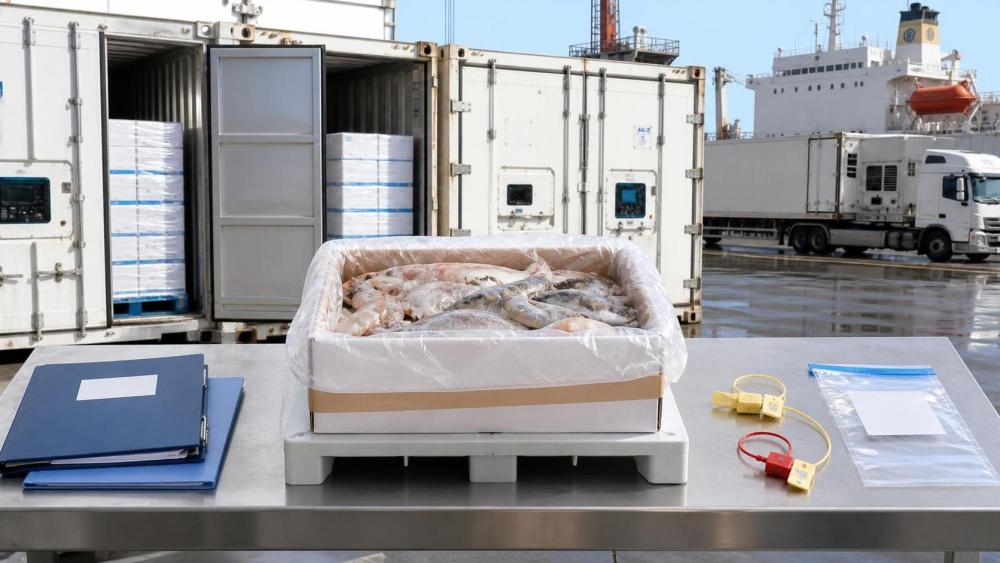
Before loading, compare the final label, carton mark, invoice, packing list, health certificate, bill of lading instructions, and any catch or origin documents line by line. Confirm the cold-chain plan, not only the booked temperature. This includes pre-cooling, loading duration, contingency contacts, seal management, and access to temperature records. For live or high-risk aquatic products, obtain written confirmation of the current import conditions from the relevant authority or importer before production commitments are irreversible.
For businesses following seafood trade developments, AgriTrade at www.zsiron.com provides a useful place to monitor the wider context around fishery markets: policy updates, disease developments, logistics constraints, cold-chain issues, processing trends, and export conditions. That context matters because border compliance rarely changes in isolation. A disease event, a revised control measure, or pressure on shipping capacity can alter the risk of a shipment even when the product itself has not changed.
The strictest fishery product quarantine rules in 2026 are found less in one definitive list than in the overlap between sensitive products and high-control markets. The EU, Australia, New Zealand, Japan, and the United States deserve early compliance planning, while China, South Korea, Canada, and other major destinations require equally careful verification of current product-specific conditions. The safest commercial decision is to confirm eligibility, documentation, and inspection exposure before the purchase order becomes a production schedule.
Related News
- 00
0000-00
Fishery Machinery Manufacturing Market: Demand Drivers and Supply Chain Risks - 00
0000-00
Selecting Marine Fishery Equipment for Offshore Vessels: Capacity, Corrosion, and Safety - 00
0000-00
How to Evaluate a Fishing Equipment Manufacturer for Quality, Capacity, and Compliance - 00
0000-00
How Can Buyers Assess a New Fishery Supplier’s Export Capacity? - 00
0000-00
Which Countries Have the Strictest Fishery Product Quarantine Rules in 2026?
Fishery News Editorial Team
Weekly Insights
Stay ahead with our curated technology reports delivered every Monday.