Professional Agri-Forestry Industry Insights | Global Intelligence Leader

Starting a Poultry Farm in Nigeria: How Housing and Feeding Systems Change the Budget





For a poultry buyer in Nigeria, the starting budget is rarely defined by chicks alone. The bigger cost swing usually comes from two design choices made very early: what type of house will be built, and how feed will be stored, delivered, and managed inside that house. A farm planned for 1,000 broilers can look affordable on paper, then become difficult to operate if housing ventilation is weak, feeder layout is inefficient, or feed losses are ignored in the original estimate.
That is why budgeting for a poultry project should not begin with a single number. It should begin with a production model. Open-sided housing, semi-automated feeding, and fully enclosed systems can all produce broilers, but they create very different capital needs, labor profiles, mortality risks, and operating costs. For decision-makers comparing options, the right question is not only how much the farm costs to start, but which setup protects cash flow under local power, climate, and feed price conditions.
Why housing and feeding decisions dominate the startup budget
In many small and mid-scale broiler projects, poultry houses and feeding systems shape both the first investment and the recurring cost base. Housing affects land use, ventilation, flooring, litter management, temperature stability, and disease pressure. Feeding systems influence daily labor, feed wastage, bird uniformity, and the speed of reaching market weight. Since feed often becomes the largest running expense in broiler production, even a modest design mistake in feeder choice or placement can keep hurting margins every cycle.
For buyers trying to estimate how much to start a poultry farm in nigeria, housing and feeding should be treated as linked decisions rather than separate line items. A lower-cost building may require more manual labor and tighter daily supervision. A more mechanized house may demand a larger initial budget, but could reduce spillage, improve feed access, and support more stable flock performance when managed correctly.
That is also why two farms with the same target capacity may have noticeably different startup budgets. One may include only a simple structure, drinkers, feeders, and brooding equipment. Another may include feed bins, automatic pans, ventilation components, backup power arrangements, and a more durable building frame. Both are poultry farms, but they carry different assumptions about labor, climate control, and operational risk.
Open housing, deep litter, and the cost logic behind basic broiler setups
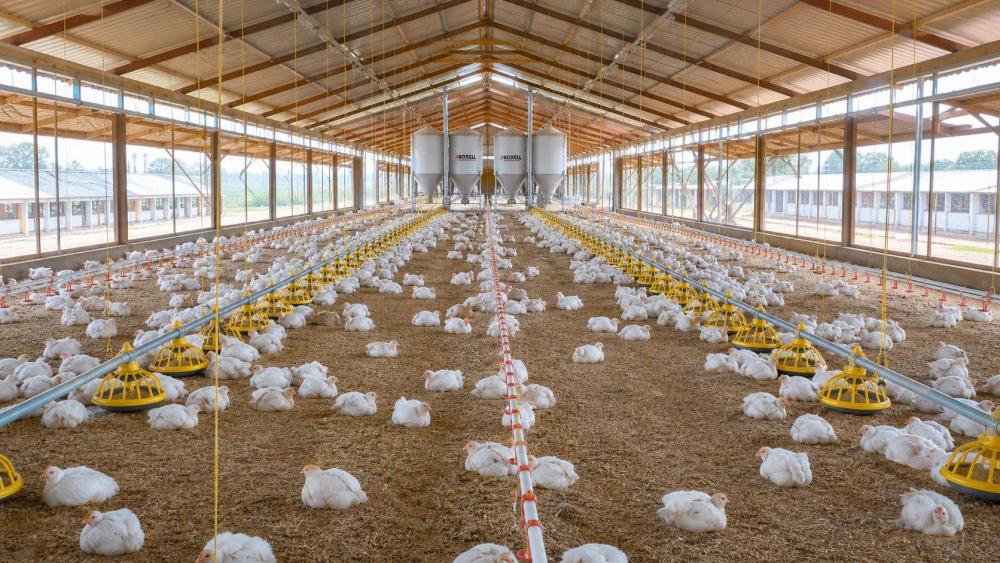
A common entry model in Nigeria is an open-sided deep litter house. It remains attractive because construction is relatively straightforward, equipment needs are moderate, and operators can start with simpler feeding and watering systems. For a buyer focused on controlling capital exposure, this setup often looks like the most practical starting point.
Yet the lower upfront cost comes with conditions. Open-sided housing depends heavily on orientation, airflow, roofing material, side curtain quality, drainage, and daily management discipline. If heat builds up during hot periods or litter becomes wet in the rainy season, birds may eat less, gain weight unevenly, and become more vulnerable to stress-related losses. In that situation, the farm did not really save money; it only shifted cost from construction into performance risk.
Feeding in these houses is often manual or semi-manual. Manual feeders reduce equipment spending but increase labor and usually make feed control less precise. Overfilling feeders, uneven feeder distribution, and poor storage practices can lead to wastage, contamination, and rodent issues. For 1,000 broilers, these losses may look small day by day, yet across multiple cycles they materially change profitability.
Buyers evaluating a basic setup should pay attention to:
- Roof height and heat dissipation capability
- Floor quality and drainage around the building
- Distance between feeders and drinkers to reduce crowding
- Feed storage protection against moisture and pests
- Ease of cleaning between batches
These details are often omitted from rough startup estimates, but they directly affect whether the house remains usable through several production cycles without frequent corrective spending.
When semi-automated feeding changes the economics
Not every farm needs a fully automated system, but many buyers underestimate the value of moving one step beyond fully manual feeding. Semi-automated feeding can mean different things in practice: improved feeder lines, hopper-fed distribution, more consistent pan feeders, or a storage and transfer arrangement that reduces repeated handling. The capital increase is noticeable, but the reason buyers consider it is not convenience alone.
Better feed distribution can help maintain more uniform access for birds across the house. Uniformity matters because poor access leads to uneven growth, and uneven growth complicates market timing. When one section of the flock reaches sale weight earlier than another, the producer may face difficult choices about delayed marketing, additional feed use, or partial sales that disrupt the flock.
Semi-automated arrangements may also reduce hidden labor costs. A business owner sometimes budgets for construction and equipment but treats labor as a flexible expense. In reality, repeated manual carrying, filling, and adjustment consume time every day. If the project depends on low-skilled labor without strong supervision, feed management accuracy can deteriorate quickly. The equipment decision then becomes partly a management decision: how much should the farm rely on daily labor consistency?
For enterprise buyers, this is where the budget discussion becomes more strategic. A moderately higher startup cost may be justified if it helps stabilize feed use, reduce wastage, and simplify supervision. That does not guarantee a better outcome, but it changes the operating model in a way that many spreadsheets fail to capture.
Closed houses and automation: higher capital, different risk profile
At the other end of the range are environmentally controlled houses with more automated feeding and ventilation. These systems are usually considered when the operator wants tighter control over climate, bird density, and production consistency. They are capital-intensive and less forgiving of technical failures, especially where power supply is unstable.
The budgeting issue here is not just equipment price. A closed house can require fans, cooling arrangements, control systems, reliable drinker lines, feed delivery components, backup power, and stronger maintenance capability. If one critical system fails, the loss can be severe and very fast, particularly during hot weather.
For that reason, a decision-maker should avoid evaluating enclosed systems only on output potential. The better question is whether the farm can support the entire operating environment the system needs. That includes fuel or generator planning, spare parts access, technician availability, and staff response procedures. A high-spec system installed without dependable support can become more expensive than a simpler farm that is consistently well run.
Still, there are situations where the larger investment makes sense. Businesses targeting more standardized throughput, tighter scheduling, or expansion beyond one house may prefer a more controlled model from the beginning. In such cases, the startup budget is higher, but the design may align better with long-term scaling plans than a low-cost house that will need major retrofits later.
Feed system selection affects more than equipment cost
Feeders are often treated as accessories in startup planning, yet they shape one of the biggest cost drivers in broiler production. Poor feeder design or poor feeder layout tends to show up in three places: wasted feed on the floor, uneven bird growth, and extra labor. Each of those affects the real cost of production more than the purchase price of the feeder itself.
When comparing options, buyers should look beyond whether a feeder is manual, pan-based, or linked to a feed line. More useful questions include:
- How easy is feed level adjustment as birds grow?
- Can the system reduce scratching and spillage?
- Will replacement parts be difficult to source locally?
- Does the chosen layout fit the planned stocking density?
- Can staff clean and inspect the system without excessive downtime?
Feed storage deserves the same scrutiny. A farm may use acceptable feeders but lose money through poor bag storage, high humidity exposure, or weak stock rotation. If feed cakes, molds, or attracts pests, the issue is no longer only cost; it becomes a flock health concern. Start-up budgets that focus only on the house and birds often fail to reserve enough for dry, secure, and practical feed storage.
What decision-makers often miss in a 1,000-bird budget
Budget discussions around broiler farms frequently center on visible items: land, building, chicks, and feed. The less visible items are usually where cost overruns begin. Even a smaller commercial unit benefits from a more complete checklist.
Another missed factor is sequence. Some buyers purchase equipment before confirming house dimensions, ventilation direction, or feeder spacing. That can create installation inefficiencies or force compromises later. The budget problem then is not overspending on one item, but spending in the wrong order.
How to compare startup options without reducing everything to the cheapest quote
For an enterprise buyer, a useful comparison framework balances four things: initial build cost, operating discipline required, risk exposure, and expansion compatibility. A cheaper setup may still be the right choice if management is strong, labor is available, and the local climate can be handled with practical open-house methods. A more advanced setup may be justified where labor control is difficult, output consistency matters more, or future expansion is already planned.
One practical approach is to compare options using scenario-based questions:
- If feed prices rise, which setup gives better control over wastage?
- If labor becomes less reliable, which setup remains manageable?
- If power interruptions are frequent, which housing model carries less catastrophic risk?
- If the farm expands from 1,000 birds to multiple houses, which system can be replicated with fewer redesigns?
This kind of comparison gives more value than asking for a single universal answer to how much to start a poultry farm in Nigeria. Costs differ because operating assumptions differ. The more clearly a buyer defines those assumptions, the more realistic the budget becomes.
A practical budgeting mindset for poultry buyers
The most dependable budgets are built around function, not just procurement lists. Housing should be selected for the local environment and management capability, not for appearance or minimum price. Feeding systems should be judged by their effect on feed control, labor, and bird uniformity, not only by the number of components included. In many projects, the decisive cost is not what was paid at installation, but what the design keeps costing after birds are placed.
For buyers working on broiler projects in Nigeria, the question is not simply whether a farm can be started at a low figure. It is whether the chosen housing and feeding model can keep the flock productive without creating recurring losses, avoidable labor pressure, or expensive retrofits. That is where a startup budget becomes a real business tool rather than a rough estimate.
Got questions about this industry topic or seeking best practices for your business? Drop us a line below, and let the expert team at AgriTrade help you out.
We respect your privacy. Your information is strictly confidential.
Related News
- 00
0000-00
Crop Protection in India: Common Pests and Ways to Manage Them - 00
0000-00
China Raises Corn Industrial Consumption Estimate in November CASDE Report - 00
0000-00
USDA Awards $1.8 Million for Four Alternative Crop Research Projects - 00
0000-00
November 5 Farm Wholesale Price Index Dips 0.02 Points; Pork Falls 1.3% - 00
0000-00
Agricultural Wholesale Price Index Rises to 111.44 on November 2
0000-00
Agriculture Industry Editorial Team
Weekly Insights
Stay ahead with our curated technology reports delivered every Monday.