





For buyers asking, “How to verify eco agriculture supplier sustainability claims?” the answer starts with evidence, not marketing language, and checks tied to actual purchases.
Claims about responsible farming, lower emissions, or sustainable sourcing should be checked against valid certifications, traceability records, independent audits, and measurable data from relevant farms.
Yet a certificate alone may not cover every product, production site, or environmental claim. Buyers must establish exactly what each document proves before relying on it.
This guide explains how to assess suppliers’ evidence, spot greenwashing warning signs, and build practical verification checks into procurement decisions that reduce sourcing and reputational risk.
What Evidence Should Buyers Request First?
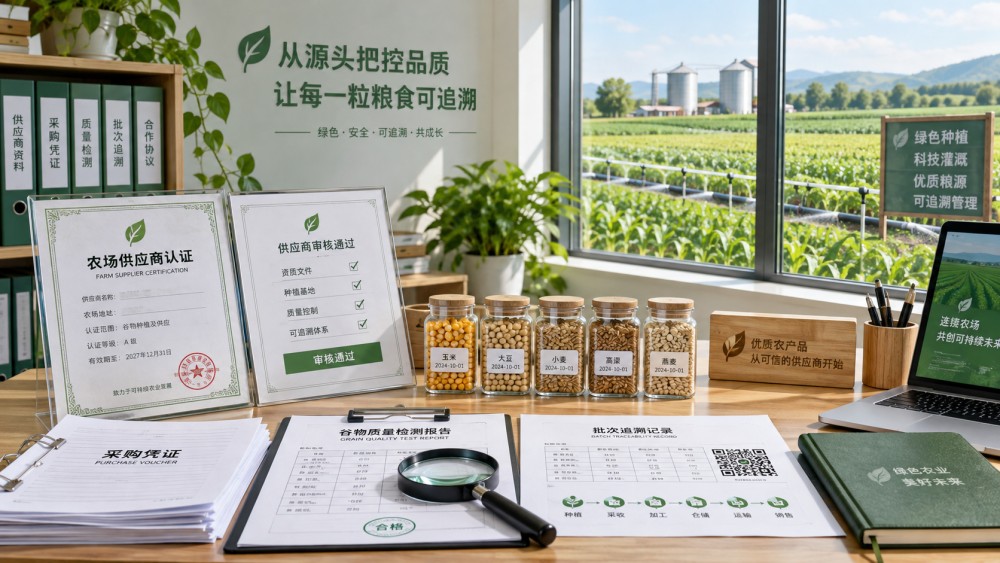
Start by converting the supplier’s promise into a specific, testable statement. “Sustainable agriculture” is too broad to approve without identifying the practices and outcomes being claimed.
Ask which product, farm, production period, and environmental issue the claim covers. Establish whether it applies to the entire shipment or only selected participating farms.
For an initial review, request the supplier’s legal identity, relevant certificates, farm or cooperative register, traceability documents, latest audit findings, and evidence supporting any numerical claims.
Include intermediaries in the request. A trading company may hold transaction records while producers hold operational evidence; neither document set necessarily establishes the complete sourcing chain.
Organize the material in a claim register linking each promise to supporting evidence, its coverage, expiry date, unresolved gaps, and the buyer responsible for approval.
Does the Certificate Cover Your Actual Purchase?
Verify certificates through the scheme owner’s official directory or the issuing certification body. Check the certificate number, legal entity, validity period, status, and approved activities.
Compare names and addresses with the contract, invoice, and production location. An unexplained mismatch deserves clarification, especially when several affiliated companies share similar trading names.
Read the scope carefully. Certification for processing or trading does not automatically establish that every supplying farm, commodity, or subcontracted facility meets the same requirements.
Recognized schemes address different issues. Organic certification concerns defined production and handling requirements; it does not automatically prove low emissions, fair wages, or deforestation-free sourcing.
Likewise, food safety certification can support operational confidence without substantiating environmental performance. Ask suppliers to identify the specific standard provisions relevant to their sustainability statements.
Useful starting points include official resources from Rainforest Alliance, GLOBALG.A.P., and the USDA Organic Integrity Database, depending on the product and claimed certification.
Can You Trace the Shipment Back to Its Source?
Traceability connects a sustainability claim to the goods being purchased. Ask suppliers to demonstrate the route from farm or producer group through aggregation, processing, and dispatch.
Review a sample transaction using purchase records, delivery notes, batch identifiers, processing records, and sales documents. Dates, quantities, and product descriptions should form a plausible sequence.
Check whether the sourcing model uses identity preservation, segregation, mass balance, or another accounting approach. These models provide different levels of connection to physical products.
Under mass balance, certified and conventional inputs may be mixed within scheme rules. Accounting supports allocated certified volumes, but does not necessarily identify each shipment’s physical origin.
Request a volume reconciliation where relevant: opening stock plus eligible purchases, minus processing losses and sales, should reasonably align with closing stock and claimed volumes.
Digital platforms can simplify record retrieval, but their credibility depends on reliable inputs and controls. A blockchain entry cannot establish whether incorrect farm data became truthful.
Do Environmental Numbers Demonstrate Real Improvement?
Numerical claims need a baseline, measurement period, calculation method, and clear boundaries. Without these details, a reported percentage reduction may be impossible to interpret or compare.
For emissions, identify included sources, such as fertilizer production, field emissions, energy, livestock methane, land-use change, and transport. Exclusions can materially change the reported result.
Request both absolute emissions and emissions per unit of product where practical. Greater efficiency can coexist with rising total emissions when production expands significantly overall.
Ask whether calculations use measured activity data, estimates, or default factors. Independent assurance adds value, but buyers should understand exactly which information the assurance covered.
For soil carbon claims, examine sampling depth, locations, timing, laboratory methods, and uncertainty. Modelled estimates should be identified clearly and supported by appropriate validation evidence.
For water claims, examine local scarcity alongside withdrawal volumes and efficiency. Saving water in an abundant region may have different implications from extraction within a stressed basin.
Separate operational reductions from carbon offsets. A supplier purchasing credits should explain that mechanism accurately instead of presenting purchased compensation as reduced emissions from farm operations.
What Should an Independent Audit Actually Tell You?
A useful audit establishes what was assessed, where, when, against which requirements, and with what findings. A pass logo alone provides little information for procurement decisions.
Request the audit summary and, where available, relevant findings and corrective-action evidence. Focus on unresolved issues that could undermine the particular claims attached to your purchase.
Review auditor competence and independence. Where the scheme requires accreditation or approval, confirm that the certification body has the appropriate authorization for that standard and scope.
Understand sampling limits in group certification. Inspecting selected farms can support assurance under a scheme, but does not mean every member received an individual site visit.
Check whether corrective actions were implemented and verified. A promised training session or revised procedure is weaker evidence than records showing the underlying problem was resolved.
Supplement audits selectively with site visits, worker interviews, satellite analysis, or laboratory testing. Match each method to a specific concern rather than collecting unrelated evidence indiscriminately.
Which Checks Matter Most for Different Agricultural Products?
Verification priorities should reflect the commodity and sourcing region. The same checklist will not capture the principal environmental risks of grain, livestock, aquaculture, and plantation crops.
For crops, assess fertilizer and pesticide management, soil protection, irrigation, and land conversion. Application records and field-level controls often reveal more than a general sustainability policy.
For livestock, consider feed sourcing, manure management, methane, land use, and animal welfare. Clarify which issues the supplier’s claim covers and which require separate assurance.
For aquaculture, investigate feed inputs, effluent management, chemical use, and habitat impacts. Where relevant, use species-specific and location-specific standards to structure evidence requests and follow-up.
For commodities exposed to land-conversion risk, request farm locations and sourcing histories. Satellite evidence can strengthen assessment, although ambiguous findings may require further investigation or field verification.
Check applicable destination-market requirements separately. Voluntary certification may support due diligence, but buyers should confirm whether additional documents, declarations, or sourcing assessments are legally required.
Which Warning Signs Suggest Greenwashing?
Broad labels such as “eco-friendly,” “natural,” or “planet positive” deserve clarification when they lack defined criteria. Ask what measurable practice or outcome supports each phrase.
Watch for expired certificates, missing scope pages, inconsistent company names, and documents covering unrelated products. These problems may reflect poor administration or more serious misrepresentation.
Another warning sign is selective reporting: highlighting recyclable packaging while withholding evidence about major farming impacts. Assess whether the claim addresses issues material to your purchase.
Unexplained improvement figures also deserve scrutiny. Changing the baseline, excluding high-impact suppliers, or switching calculation methods can create apparent progress without comparable environmental gains over time.
Treat supplier reluctance proportionately. Confidentiality may justify controlled access or redaction, but persistent refusal to provide essential evidence leaves the claim unverified and procurement risk unresolved.
How Much Verification Is Worth the Cost?
Use a tiered approach based on commodity risk, sourcing region, purchase value, supply-chain complexity, and the consequences of an inaccurate claim. Verification should support business decisions.
For lower-risk purchases, certificate validation, document review, and a sample traceability exercise may suffice. Record the reasoning so reviewers understand why those checks were considered adequate.
For higher-risk sourcing, consider deeper traceability testing, independent assessment, location analysis, or targeted site visits. Prioritize gaps that could change the supplier approval decision materially.
Smallholders may have limited reporting capacity without necessarily having poor practices. Cooperative records, proportionate sampling, and practical data support can improve verification while maintaining sourcing options.
Compare verification costs with potential shipment disruption, customer rejection, claim correction, and reputational damage. Avoid precise return-on-investment estimates unless reliable internal cost data supports them.
A workable approval process distinguishes verified claims, partially supported claims, and unsupported claims. Define procurement consequences for each category instead of forcing an oversimplified pass-or-fail judgment.
How Can Buyers Keep Claims Reliable After Approval?
Build evidence obligations into supplier agreements, including accurate claim descriptions, access to relevant records, notification of certification changes, and agreed procedures for addressing substantiated discrepancies.
Set review dates according to evidence validity and risk. Recheck sooner when farms, sourcing regions, ownership, production methods, or certification status change in ways affecting claims.
Use purchase orders and product specifications to state approved claim wording. Marketing teams should receive the same evidence boundaries so public statements remain consistent with procurement findings.
Maintain a record of reviewed documents, verification dates, findings, and decisions. This makes customer queries easier to answer and reduces repeated work across purchasing teams.
Use industry intelligence, including AgriTrade’s policy and supply-chain reporting, to identify emerging sourcing risks. Supplier-specific evidence remains essential when deciding whether an individual claim is substantiated.
What Is the Right Standard for a Purchasing Decision?
A credible sustainability claim links a clearly defined promise to the correct supplier, product, location, and period, supported by evidence appropriate to that specific promise.
Before approval, establish three things: whether the evidence is authentic, whether it covers your purchase, and whether its limitations allow the proposed claim to be used responsibly.
If a material gap remains, request corrective evidence, limit the approved wording, or defer approval. The goal is a defensible purchasing decision supported by verifiable facts.