Professional Agri-Forestry Industry Insights | Global Intelligence Leader

Evaluating a Poultry Farm Equipment Solution: What Belongs on a Complete Setup List





Procurement mistakes in poultry projects usually start with one assumption: that a “complete equipment list” is just a longer shopping list. In practice, a workable setup has to match bird type, housing style, climate, labor conditions, utilities, cleaning routines, and the farm’s expansion plan. A broiler house, a layer farm, and a pullet rearing unit may share some core systems, but they do not use equipment in the same way, and they do not fail for the same reasons. For buyers, the real task is not counting items. It is checking whether the package functions as one operating system from chick placement to daily management, manure handling, and turnover between flocks.
That distinction matters because poultry equipment is often bought in bundles. If one part is underspecified or incompatible, the cost shows up later in feed waste, uneven bird growth, water hygiene problems, ventilation imbalance, difficult cleaning, or higher maintenance demands. A complete setup list should therefore be read as an operational map: every line item needs a purpose, an interface with the next system, and a realistic installation and service plan.
Start with the production model, not the catalog
Before comparing quotations, buyers need to define the production model in plain operational terms. The first question is whether the farm is designed for broilers, layers, breeders, or pullets. The second is whether housing will be floor-based, cage-based, or some hybrid arrangement. The third is whether the site can support the utility load required by automated systems.
These choices shape the equipment list more than any supplier brochure does. Broiler farms often place more emphasis on fast feed distribution, drinker reliability, litter management, and ventilation response. Layer operations usually require closer evaluation of cage layout, egg collection lines, manure removal frequency, and lighting consistency. Breeder farms add another layer of complexity with nest systems, mating management, and stricter control over feed allocation.
A useful procurement file should include at least these baseline definitions:
- Bird category and target stocking density
- Number of houses and birds per house
- Open house or closed house design
- Local climate profile and seasonal extremes
- Power reliability and backup expectations
- Water source, pressure stability, and treatment needs
- Available labor skill level for operation and maintenance
- Cleaning method between cycles and target turnaround time
Without those inputs, a complete list can look impressive while still being poorly matched to farm conditions.
What belongs on a complete setup list
For procurement purposes, the most useful setup list groups equipment by function rather than by individual machine name. That makes it easier to check gaps, overlaps, and interface risks.
1. Housing structure and internal layout
The building itself is part of the equipment decision because dimensions, insulation level, roof profile, sidewall treatment, and floor quality affect how every downstream system performs. Buyers should confirm whether the quoted scope includes steel structure components, connection hardware, support frames, and installation references for the interior equipment.
Internal layout should also be reviewed early. A technically complete list can still create maintenance problems if service aisles are too narrow, if feed lines interfere with access, or if controller placement makes inspection difficult. In layer or breeder projects, row spacing and clearance for egg collection and manure removal deserve close attention.
2. Feeding system
The feeding system normally includes feed storage interface, conveying lines, hoppers, pans or troughs, drive units, and control components. Evaluation should go beyond “automatic” versus “manual.” Buyers need to ask how uniformly feed is delivered from the first to the last line, how easy it is to calibrate feed levels, and which wear parts will require periodic replacement.
Material selection matters here. Components exposed to dust, moisture, and feed acidity should be checked for corrosion resistance and cleaning tolerance. In many projects, feed wastage is not caused by poor feed quality but by pan design, line leveling errors, or unstable delivery speed. Those are procurement issues as much as management issues.
3. Drinking system
Drinking lines often look simple on paper, but they are one of the most sensitive systems in daily operation. A complete setup list should specify nipple lines or drinker type, regulators, filters, medicators if needed, flushing provisions, suspension hardware, and end-line components for pressure checking.
Buyers should verify whether the design accounts for local water quality. High mineral content, suspended solids, or biological contamination can shorten the useful life of regulators and nipples if filtration and cleaning procedures are not built into the plan. Access for flushing and disinfection should be considered part of the equipment solution, not an afterthought.
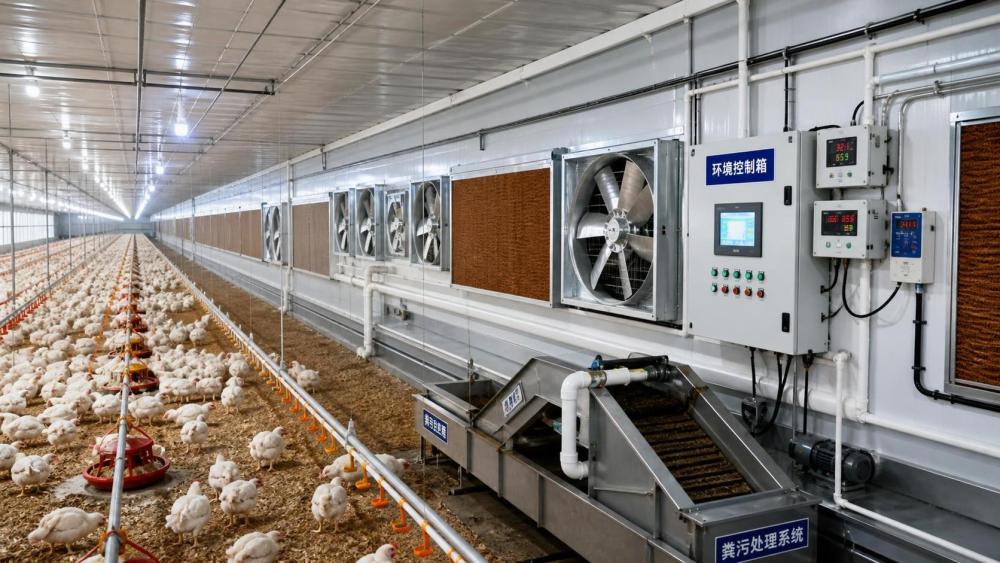
4. Ventilation and air movement
Ventilation equipment is often where the difference between a basic list and a complete list becomes obvious. A full review should cover fans, air inlets, cooling pads where applicable, circulation fans if required, shutters, actuators, and the control logic tying these parts together.
Buyers should assess ventilation as a system that has to work under minimum ventilation conditions as well as peak heat conditions. A package that performs well only during one season is incomplete for practical use. In hot regions, cooling effectiveness depends not just on pad area or fan count but also on house sealing, inlet control, and water distribution consistency. In cooler environments, poor minimum ventilation can create wet litter and ammonia issues long before temperature readings look alarming.
5. Environmental control and automation
Controllers, sensors, alarm systems, and power interface components deserve separate scrutiny. In many farms, the visible mechanical equipment receives most of the attention, while the control layer is accepted without enough technical review. That can be costly. A controller should be evaluated based on sensor inputs, backup behavior, manual override options, alarm routing, and ease of troubleshooting by local technicians.
When reviewing a poultry farm equipment solution, procurement teams should check whether automation depth fits the operating environment. Highly integrated control can reduce daily manual adjustments, but it also raises dependence on stable power supply, spare parts availability, and trained service support. In areas with frequent outages, even a strong automation package needs a practical fallback mode that staff can use without waiting for remote assistance.
6. Lighting system
Lighting is sometimes treated as a minor accessory, but bird behavior, feed intake timing, and layer production management are all influenced by light distribution and control stability. A complete list should identify fixture type, placement logic, protection level for dusty and humid conditions, and dimming compatibility where needed.
The key procurement issue is not whether lights turn on, but whether the system provides consistent intensity across the usable floor or cage area and whether maintenance access is realistic over the life of the house.
7. Egg handling, nesting, or collection systems where applicable
For layers and breeders, this category is central. Buyers should clarify whether the proposal includes egg belts, collection tables, transfer points, nest boxes, nesting pads, and associated supports. The review should also include the likely impact on egg cleanliness, crack risk, and labor needs during peak collection periods.
If the supplier’s list mentions egg handling but leaves transfer sections undefined, that gap can create awkward manual workarounds later. A complete list should make the physical path of eggs easy to understand from laying point to collection point.
8. Manure removal and waste handling
Manure systems are frequently undervalued during quotation review because they are less visible than feeding or ventilation equipment. Yet disposal frequency, belt or scraper arrangement, corrosion exposure, and cleaning access all influence labor demand, ammonia control, and long-term maintenance.
Procurement should confirm whether manure removal is continuous, periodic, or batch-based and whether the chosen method suits the housing style. In some environments, the more advanced-looking option is not the better one if maintenance discipline or spare parts logistics are weak.
9. Heating and brooding equipment
For chick placement and cold-season management, the heating package must match house volume, insulation quality, and fuel availability. A complete list should indicate heater type, fuel source, distribution pattern, safety controls, and interaction with ventilation settings.
Underpowered heating often causes hidden losses through uneven growth and poor early feed conversion, while oversized heating may create localized hot zones and unnecessary fuel use. The farm layout and climate profile should guide the decision, not only the nominal heater capacity.
How procurement teams should compare equipment packages
When two suppliers appear to offer similar scope, the real differences often sit in interfaces and after-installation realities. A disciplined comparison sheet should ask:
- Which components are included as standard and which are optional?
- Are fasteners, supports, suspension parts, and connectors clearly listed?
- What utility conditions are assumed for normal operation?
- Which wear parts will likely need replacement during the first year?
- Can key parts be serviced locally, or will they require imported replacements?
- Is the cleaning procedure compatible with the materials and assembly design?
- Does the layout leave enough access for inspection and repairs?
This method helps buyers avoid a common error: comparing headline prices while missing exclusions that later become urgent site purchases. A lower quote may leave out regulators, control accessories, backup provisions, or installation hardware that the farm cannot operate without.
Quality review should focus on failure points, not just specifications
Datasheets are useful, but practical quality assessment starts with expected stress points. On poultry farms, recurring trouble often appears at joints, moving parts, suspension points, drive units, seals, motors, and components exposed to water, ammonia, and wash-down routines.
Procurement teams should request clear identification of materials used in corrosion-prone areas, protection of electrical components in dusty or humid zones, and replacement procedures for consumable parts. If a line cannot be serviced without dismantling large sections of the house, maintenance cost may outweigh any initial savings.
Another overlooked factor is installation tolerance. Some systems only perform properly when line leveling, pressure setting, and alignment are done very precisely. That is not necessarily a reason to reject them, but it should influence supervision plans, acceptance criteria, and training requirements.
Documents that matter before delivery and at acceptance
A complete procurement package should include more than the bill of materials. Buyers usually benefit from checking the availability and clarity of these documents:
- General layout drawings for the house and equipment arrangement
- Utility requirement list for power and water
- Installation guidance and assembly sequence
- Operation and maintenance instructions
- Spare parts list for routine wear items
- Commissioning checklist and test points
- Packing list aligned with the bill of materials
At acceptance stage, inspection should confirm not only quantity but also function. Fans should be checked in operation, drinker lines should hold stable pressure, feed lines should run without abnormal vibration or binding, and control panels should be verified for alarm behavior and manual override response. Functional acceptance catches issues that piece-count inspection cannot.
Common gaps in “complete” poultry equipment lists
Many buyers only discover missing elements during installation. Typical gaps include transition connectors, hanging hardware, filters, end-line flushing provisions, sensor mounting parts, startup consumables, or clear definitions of what belongs to the electrical interface. These omissions are rarely dramatic on paper, but they can delay commissioning and complicate responsibility between installer, electrician, and equipment supplier.
Another gap appears in scaling plans. If the farm may expand later, today’s equipment decisions should be checked for modularity. Controller capacity, feed storage routing, water treatment sizing, and spare part standardization can either support future houses or force a fragmented system landscape.
What a complete setup plan should achieve
The best equipment list is not the longest one. It is the one that makes the farm operable under real site conditions with predictable maintenance and manageable risk. For procurement teams, that means evaluating the poultry house as an integrated process: birds, building, equipment, utilities, labor, cleaning, and future expansion all have to align.
A complete setup plan should leave few unanswered questions about scope, interfaces, utility assumptions, maintenance access, and acceptance standards. If those areas are defined early, buyers are in a better position to judge whether a quoted system is genuinely complete or only looks complete on paper.
Related News
- 00
0000-00
How to Select Smart Irrigation Systems for Vineyards by Block and Soil Type - 00
0000-00
Planning a Poultry House Setup: Equipment Layout and Utility Needs - 00
0000-00
Avoiding Overcrowding Risks Through Practical Cage Capacity Planning - 00
0000-00
How to Select Crop Protection Biologicals for Integrated Pest Management Programs - 00
0000-00
Choosing Horticulture Tools in the UK: Soil, Crop Type and Ergonomic Needs
Agriculture Industry Editorial Team
Weekly Insights
Stay ahead with our curated technology reports delivered every Monday.