Professional Agri-Forestry Industry Insights | Global Intelligence Leader

Building a Farm-to-Market Cold Chain for Fresh Fruit and Vegetables





A reliable farm-to-market cold chain starts by removing field heat promptly, then protecting the required product conditions through storage, loading, transport, and delivery. Installing refrigerated rooms and trucks leaves gaps if warm produce waits outside, packaging blocks airflow, or responsibility becomes unclear during a handoff. The practical starting point is a commodity-specific operating specification that connects harvest schedules, cooling capacity, dispatch timing, and receiving arrangements.
Fresh fruit and vegetables remain biologically active after harvest. Respiration releases heat, moisture loss reduces saleable weight, and unsuitable temperatures accelerate deterioration or cause chilling injury. A workable cold chain agriculture project therefore needs to control both product temperature and elapsed time, while preserving humidity, ventilation, and hygiene appropriate to each crop.
Define the product conditions before selecting equipment
“Fresh produce” is too broad to serve as a refrigeration specification. Leafy vegetables, berries, mature-green tomatoes, and tropical fruit have different temperature tolerances, moisture requirements, and responses to handling. Even within one commodity, cultivar, maturity, intended storage duration, and destination requirements affect the operating limits.
Create a handling profile for each crop or compatible product group. Record the acceptable product-temperature range, sensitivity to freezing or chilling, humidity requirements, ethylene behavior, packaging format, and maximum planned journey time. Establish these values from commodity-specific postharvest guidance and the receiving specification. A refrigerated-air setpoint alone does not define acceptable product condition.
Compatibility deserves particular attention in mixed loads. Some fruit releases ethylene that accelerates yellowing or deterioration in sensitive vegetables. Products with conflicting temperature requirements also need separate routes or compartments. Where segregation is impractical, shorten the journey and validate the proposed compromise against actual arrival quality before adopting it.
The specification must also define where temperature is measured. Surface readings respond quickly to surrounding air, while the center of a densely packed carton cools more slowly. Acceptance criteria should identify the measurement method, sampling locations, and permitted variation across a lot so that dispatch and receiving teams evaluate the same condition.
Size pre-cooling around the harvest peak
Field heat creates a concentrated refrigeration demand immediately after harvest. Moving warm produce into a storage room designed mainly to maintain temperature can overload the system and warm stock already inside. Pre-cooling capacity should reflect the warmest expected incoming product, peak arrival rate, packaging resistance, and time available before dispatch.
Start with the harvest-to-cooling timeline. Include collection in the field, movement to shade, grading, packing, and any queue before cooling. A short cooling cycle cannot recover quality already lost during a prolonged warm delay. Shaded staging limits additional solar heating, but it does not remove accumulated field heat.
Calculate product heat removal from incoming mass, commodity-specific heat capacity, and the required temperature reduction. Add respiration, packaging, fans, infiltration, and other relevant loads separately. Available cooling time converts the heat-removal requirement into a capacity requirement. Equipment selection must then account for performance at the actual ambient and operating conditions.
Daily tonnage hides short bottlenecks. A facility that handles its average daily volume comfortably can still develop a warm queue when several harvest crews arrive together. Model arrivals by time interval and include loading, unloading, cleaning, and defrost downtime. Extra storage space offers little protection when the constrained resource is the pre-cooling cycle.
Make packaging part of the airflow design
A cooling system and its cartons function together. Vent openings must remain aligned through cartons and pallet stacks. Liners, pads, labels, and stretch wrap can obstruct an otherwise adequate design. Increasing fan power without correcting these obstructions raises energy use without necessarily improving temperatures in the slowest-cooling cartons.
Packaging also has to retain stacking strength under humid conditions. Cartons that soften or collapse can damage produce and close airflow passages. Evaluate the loaded package under expected moisture exposure and stacking duration, including condensation during transfers.
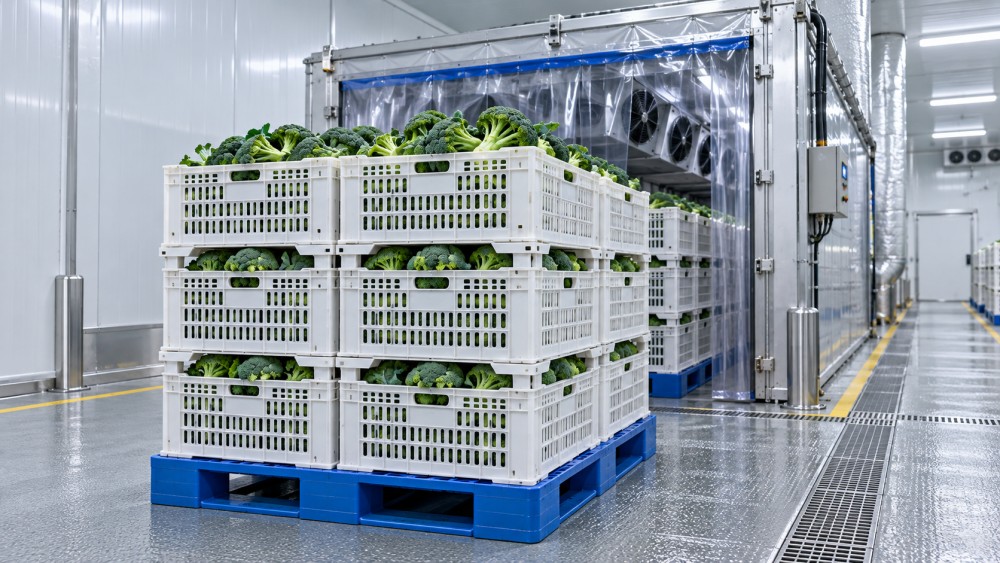
For forced-air systems, use a defined pressure path that draws air through the produce. Gaps around pallets and uncovered openings offer easier routes for air to escape. Smoke visualization or airflow measurements can reveal bypass paths, while temperature probes inside representative cartons establish whether the arrangement actually cools the product uniformly.
Humidity management involves a tradeoff. Dry air and excessive exposure promote water loss, but persistent surface moisture and condensation can encourage decay. Match humidity control, airflow, and packaging moisture barriers to the commodity. Where liners retain moisture, assess their effect on cooling speed and gas exchange as well.
Protect the loading and receiving handoffs
The transition between a cold room and a vehicle often becomes the weakest point because both facilities appear adequate when assessed separately. A cold pallet can warm during staging, and humid outside air can condense on cold surfaces. Schedule loading around vehicle readiness and keep exposed dwell time within the validated handling limits.
Before loading, confirm that the vehicle is clean, serviceable, and conditioned according to its equipment requirements and the loading arrangement. Transport refrigeration is generally designed to maintain suitably cooled cargo; relying on it to remove substantial field heat creates uneven temperatures and extends pull-down time.
Load geometry must preserve the vehicle’s supply and return airflow. Cargo pressed against air outlets, stacked beyond the load line, or positioned across return paths can leave distant cartons warm while the refrigeration controller displays an acceptable reading. Pallet restraints and loading instructions should preserve these clearances throughout the journey.
Responsibility should transfer at an identifiable event, supported by a concise record:
- At dispatch, record lot identity, representative product temperatures, loading time, vehicle setpoint, and logger placement.
- The carrier receives written instructions for refrigeration operating mode, permitted door openings, and escalation contacts. Mode selection must suit the commodity and equipment because continuous airflow requirements vary.
- Receiving arrangements include an unloading slot and suitable storage space. A temperature exception needs a named disposition authority so that the load does not remain on an uncontrolled dock while acceptance is debated.
For routes with several drops, evaluate how each door opening affects the remaining load. Delivery order, partitions, and access to individual pallets influence exposure. A route proven for one full-load delivery does not automatically remain suitable when converted into multiple small deliveries.
Monitor product condition, then interpret excursions
Air-temperature monitoring shows how the refrigeration environment behaves, but it does not establish the temperature of every carton. Supply air, return air, doorway air, and product pulp each answer different questions. Use vehicle or room sensors to assess equipment operation, and representative product measurements to assess cooling progress and shipment condition.
During commissioning, map temperatures across likely warm and cold locations under representative loads. Include positions near doors, within dense pallet centers, and along restricted airflow paths. Use the findings to choose routine logger locations. Convenient placement beside an accessible doorway rarely represents the entire shipment.
Set recording intervals and alarms to capture meaningful events without overwhelming the response process. A short air-temperature rise during defrost has a different implication from sustained product warming after refrigeration failure. Alarm rules should consider duration, sensor location, commodity tolerance, and whether the product itself is changing temperature.
Every alarm needs an action path. Define who investigates, which measurements confirm the event, and what temporary arrangements are available. When equipment fails, moving cargo to another vehicle or cold room requires verified capacity and compatible conditions. An alarm that reaches nobody able to intervene adds a record without protecting the shipment.
Sensor accuracy also needs management. Verify instruments against an appropriate reference on a documented schedule and after suspected damage. Keep probe cleaning procedures separate from calibration records: a clean instrument can still read incorrectly, while an accurate probe can transfer contamination between samples if handled poorly.
Commission the entire route under realistic load
An empty cold room reaching its setpoint demonstrates only part of the required performance. Acceptance trials should include representative incoming temperatures, pallet configurations, door activity, and peak ambient conditions. Where the most demanding seasonal conditions cannot be reproduced, document the remaining uncertainty and schedule follow-up verification.
Measure cooling time at the slowest-cooling product locations, not just beside the evaporator. Confirm that pre-cooling reaches its release criterion before transfer to holding storage. Then follow the same lots through loading, transport, unloading, and destination storage to identify where temperature control or handling quality deteriorates.
Arrival assessment should include visible damage, wilting, condensation, decay, and relevant commodity quality measures. Temperature records alone will not reveal bruising from rough handling or water loss caused by unsuitable humidity. Inspect quality after an appropriate observation period where chilling injury or other delayed symptoms are a concern.
Use trial results to distinguish equipment faults from process faults. Warm pallet centers with cold surrounding air suggest airflow or cooling-time problems. A room that warms whenever incoming loads arrive points toward excessive heat input, insufficient capacity, or poor scheduling. Product warming mainly during loading directs attention to staging time and dock arrangements.
Keep capacity and contingency plans operational
Maintenance access, drainage, washable surfaces, and evaporator condition affect daily performance. Blocked drains, iced coils, damaged door seals, and neglected condenser cleaning progressively reduce useful capacity. Provide access that allows maintenance without dismantling storage arrangements or exposing nearby produce to contamination.
Power-loss planning should reflect how quickly each product group warms under the site’s actual conditions. Establish arrangements for backup power or alternative refrigerated space, including transfer time and available capacity. Recovery procedures must prioritize product assessment; restoring the room setpoint does not establish whether exposed produce remains acceptable.
As operations expand, track harvest-to-cooling delay, cooling completion time, temperature exceptions, and arrival quality by commodity and route. Revalidate the process when carton designs, pallet patterns, harvest volumes, delivery stops, or product mixes change. These changes alter heat removal and exposure even when the refrigeration equipment stays the same.
Got questions about this industry topic or seeking best practices for your business? Drop us a line below, and let the expert team at AgriTrade help you out.
We respect your privacy. Your information is strictly confidential.
Related News
- 00
0000-00
Agricultural Production News: Weather and Input Costs Shape Crop Output - 00
0000-00
Farm Commodity Price Reports: How to Track Crop Price Trends - 00
0000-00
How Greenhouse Cultivation Technology Controls Climate and Irrigation - 00
0000-00
Crop Protection in India: Common Pests and Ways to Manage Them - 00
0000-00
China Raises Corn Industrial Consumption Estimate in November CASDE Report
0000-00
Agriculture Industry Editorial Team
Weekly Insights
Stay ahead with our curated technology reports delivered every Monday.