Professional Agri-Forestry Industry Insights | Global Intelligence Leader

Avoiding Overcrowding Risks Through Practical Cage Capacity Planning





Overcrowding in battery cage systems rarely begins with an obvious equipment failure. It often starts on paper: a capacity figure copied from an earlier project, a cage layout selected before the flock type is confirmed, or a purchasing specification that lists the number of cages but not the usable area per bird. By the time signs appear in the house—feather damage, uneven access to feed, recurring injuries, poor manure clearance, or difficult mortality checks—the underlying design decision may already be built into the installation.
For quality-control and safety teams, cage capacity planning is not simply an animal-density exercise. It affects the consistency of daily inspections, the ability of birds to reach feed and water, the load carried by flooring and supports, the working conditions for staff, and the chance that a minor management issue becomes a wider welfare, hygiene, or production problem. Practical planning starts by treating cage dimensions, bird size, equipment layout, and operating routine as one connected system.
Why nominal cage capacity can create real operating risks
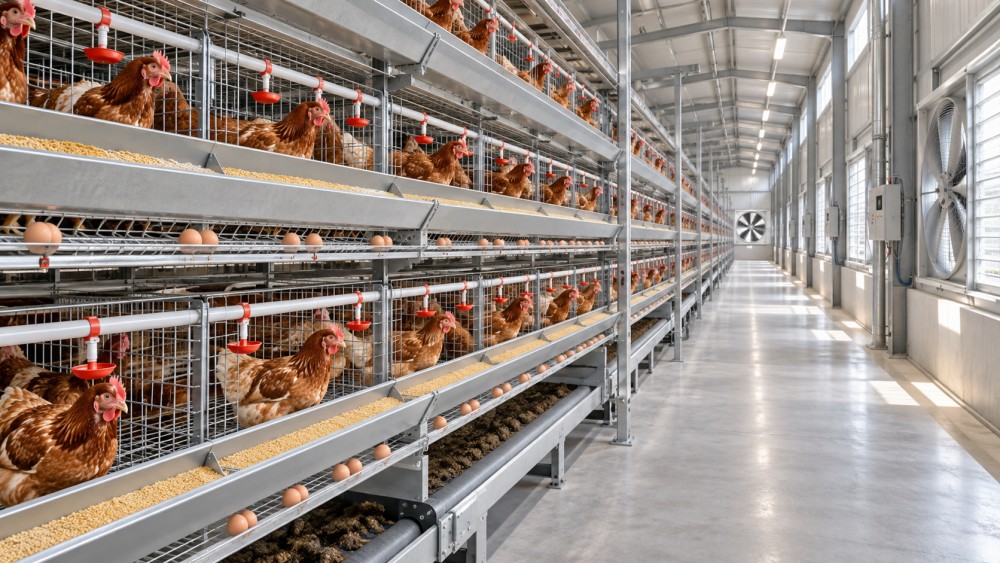
A stated capacity is usually a planning reference, not a universal operating limit. The same cage configuration can perform differently when used for lightweight layers, larger birds, birds at different production stages, or flocks with uneven body weight. Cage depth, width, internal height, floor slope, door opening, feeder position, nipple placement, and partition layout all influence whether the available space is genuinely usable.
Problems arise when capacity is calculated from gross floor area alone. Internal wires, feed trough geometry, drinker lines, dividers, egg belts, and access openings can reduce practical movement and feeding space. A cage may appear adequately sized in a layout drawing while creating competition at the feeder or difficulty reaching water in use. Where birds cannot reposition comfortably or access resources without repeated disturbance, the operational density is effectively higher than the drawing suggests.
Overstocking can also mask other weaknesses. A marginal ventilation pattern may become more difficult to manage when heat and moisture loads rise. A manure-removal schedule that works under normal stocking may leave more ammonia or fly pressure when the population increases. Small inconsistencies in water pressure, feed distribution, or lighting may affect a larger share of the flock because birds have fewer alternatives within the cage.
These interactions explain why quality teams should avoid treating “birds per cage” as the only acceptance criterion. A defensible capacity decision asks whether the complete housing system can support the intended population through the flock cycle, including warm periods, peak production, routine maintenance, and abnormal events such as delayed feed delivery or a temporary ventilation interruption.
Start with the bird, then verify the usable cage space
Capacity planning should begin with a clear flock definition. Procurement documents sometimes identify birds only as “layers” or “poultry,” leaving the supplier and site team to infer the intended size class. That creates avoidable ambiguity. The specification should identify the production purpose, expected mature body-weight range, flock age at placement, expected growth variation, and whether replacements or transfers may occur during operation.
Once the flock is defined, the cage assessment should distinguish between nominal dimensions and effective internal dimensions. Nominal measurements may describe the outside of a cage module, whereas effective dimensions reflect the floor area and resource access available inside the occupied compartment. Both are useful, but they answer different questions.
- Floor area: Confirm the internal length and depth at the floor level, not only the external module size.
- Space interruptions: Check whether dividers, structural wires, drinker fittings, or internal brackets limit movement or standing area.
- Feeding access: Assess usable feeder frontage per bird and whether the trough remains accessible when feed levels are low.
- Water access: Review nipple or cup placement, pressure stability, and whether dominant birds can block access points.
- Head and body clearance: Consider the cage profile, roof wires, front opening, and the birds’ ability to turn, stand, and use resources without repeated contact injuries.
A measurement taken from a catalogue should be verified against a production drawing and, where possible, against a sample cage or installed module. Variations can occur between tiers, end sections, and modules that accommodate drive units, supports, or service connections. If the system contains several compartment types, each type should be assessed separately rather than assigning one capacity number to the entire house.
Capacity is affected by the entire house, not only the compartment
A cage plan may be internally reasonable while the house-level plan remains weak. Stocking decisions change heat output, moisture generation, manure volume, water demand, feed consumption, egg collection flow, and the labor required to observe birds. The house must be able to absorb those loads without relying on ideal weather, flawless maintenance, or uninterrupted utilities.
Ventilation is a frequent point of failure in crowded systems. When birds are placed more densely than the ventilation design can comfortably support, air movement may become uneven across tiers or along the length of the building. Staff may observe birds that appear normal near inlets while conditions deteriorate in less well-served zones. A capacity review should therefore compare intended bird numbers with fan capacity, inlet control, air distribution, backup power arrangements, and the site’s likely temperature and humidity conditions.
Manure management deserves the same attention. Higher occupancy increases the load on belts, scrapers, pits, drying arrangements, and removal schedules. If manure stays wet or accumulates beyond the intended cycle, it can affect air quality and create more difficult cleaning and inspection conditions. This is not solved merely by adding birds to empty compartments; the downstream handling system must be capable of managing the resulting waste load.
Resource systems should be reviewed under peak demand rather than average demand. Water lines need stable supply and appropriate pressure across the full run. Feed delivery must reach all rows consistently, including the far end of long houses. Emergency access matters as well: if a row needs inspection, treatment, or bird removal, staff must have safe working space and practical access to the relevant tier.
A field method for identifying overcrowding before it becomes chronic
Inspection should combine measurements with observation. A site can meet its written bird count while still showing evidence that occupancy is too high for actual operating conditions. Quality and safety personnel can use a simple sequence during commissioning and routine audits.
- Confirm the placed population. Compare the actual count by house, row, tier, and compartment with the approved layout. Do not assume that an overall house total reveals local overstocking.
- Check the physical configuration. Verify compartment dimensions, number of partitions, floor condition, door alignment, feeder location, drinker count, and any modifications made during installation.
- Observe bird distribution. Look at whether birds cluster around water points, crowd the feeder at particular times, remain compressed at one end, or repeatedly displace one another.
- Review environmental variation. Walk the house at different times and levels. Temperature, air movement, light distribution, and moisture conditions may differ substantially between tiers or zones.
- Examine records for indirect warnings. Repeated wet litter beneath a row, unexplained variation in water use, elevated cull activity, frequent cage-door damage, or recurring egg collection issues may point to a capacity mismatch.
The most useful inspection records connect observations to a specific location. A note such as “crowding observed in house three” is difficult to act on. A record that identifies the row, tier, compartment type, time of day, ventilation condition, and affected resource point gives maintenance and farm management a clearer route to correction.
Equipment specifications should be written as verification requirements
Purchasing teams often receive cage quotations that are easy to compare on tier count, module length, material description, and total bird capacity. Those items matter, but a safety-focused specification needs more detail. The purpose is not to prescribe one cage design; it is to make the offered design verifiable against the intended flock and operating conditions.
For example, procurement documents can require dimensioned drawings showing internal compartment measurements, floor configuration, feeder and drinker positions, and the relationship between cage rows and service aisles. They can request a breakdown of nominal capacity by compartment type rather than a single house total. Installation acceptance can include checks for sharp wire ends, unstable doors, misaligned feed troughs, uneven floors, damaged coatings, and drinker leaks, all of which become more consequential when the cage is near its planned occupancy.
Reference material on standard battery cage dimensions can help teams frame those questions. The Taiyu(HK) poultry farm equipment guide is relevant when a buyer needs to compare cage dimensions and stated capacity as part of a broader planning review. It should be used alongside the site’s flock profile, housing layout, and operating constraints rather than as a substitute for those assessments.
Material and construction choices also affect the reliability of a capacity plan. Corrosion resistance, wire finish, weld quality, floor stiffness, and support alignment influence how well compartments retain their intended shape over time. A bowed floor, damaged divider, or loose feeder can reduce usable space and increase injury or contamination risks even where initial dimensions were acceptable. Incoming inspection should include a practical check that the delivered components match approved drawings and that replacement parts can be identified and controlled.
Common planning errors and safer corrections
When capacity changes after installation
Capacity plans should not be treated as fixed forever. Changes in flock source, target body weight, replacement policy, climate control performance, or farm workflow can alter the risk profile without any change to the cage frame. A site may also find that its original plan leaves too little margin during hot weather, periods of high humidity, or maintenance downtime.
When occupancy needs to be adjusted, a controlled change process is safer than an informal increase in placement numbers. The review should document the proposed bird count, affected compartments, expected water and feed demand, ventilation checks, manure-removal implications, and inspection responsibilities. It should also define what observations would trigger a reversal, such as repeated crowding at resource points, worsening air conditions, equipment strain, or rising injury indicators.
The practical objective is not to fill every apparent space. It is to maintain a cage environment that can be inspected, cleaned, supplied, and managed reliably under normal variation. When capacity is based on effective space, flock characteristics, and house-level limits, quality-control and safety teams gain a clearer basis for approving equipment, identifying deviations, and preventing overcrowding from becoming an embedded operating risk.
Related News
- 00
0000-00
How to Select Smart Irrigation Systems for Vineyards by Block and Soil Type - 00
0000-00
Planning a Poultry House Setup: Equipment Layout and Utility Needs - 00
0000-00
Avoiding Overcrowding Risks Through Practical Cage Capacity Planning - 00
0000-00
How to Select Crop Protection Biologicals for Integrated Pest Management Programs - 00
0000-00
Choosing Horticulture Tools in the UK: Soil, Crop Type and Ergonomic Needs
Agriculture Industry Editorial Team
Weekly Insights
Stay ahead with our curated technology reports delivered every Monday.