Professional Agri-Forestry Industry Insights | Global Intelligence Leader

Poultry Farm Equipment Quotes: Comparing the Full Project Scope





A low poultry equipment quote can become an expensive project when it excludes the electrical work, water preparation, controls, installation, or commissioning needed to operate the house. The purchasing problem is not simply identifying the lowest equipment price. It is establishing whether competing suppliers have priced the same operating requirement and accepted comparable responsibilities.
A useful comparison separates three figures: the equipment purchase price, the cost of bringing the system into service, and the expected cost of operating and maintaining it. These should remain visible throughout evaluation. Combining them too early can hide exclusions; comparing only the first can reward an incomplete proposal.
Define the production requirement before requesting prices
Start with a written design basis shared with every bidder. A broiler house, a pullet-rearing facility, and a commercial layer house require different equipment arrangements. Even within one production type, housing layout, bird age, climate, management practices, and available utilities affect the proposed solution.
The design basis should identify the intended production system, building dimensions, usable internal space, planned bird capacity, and production stages. Include site elevation, seasonal design conditions, water supply characteristics, electricity supply, and any existing equipment that must remain in service. Distinguish confirmed information from assumptions requiring verification.
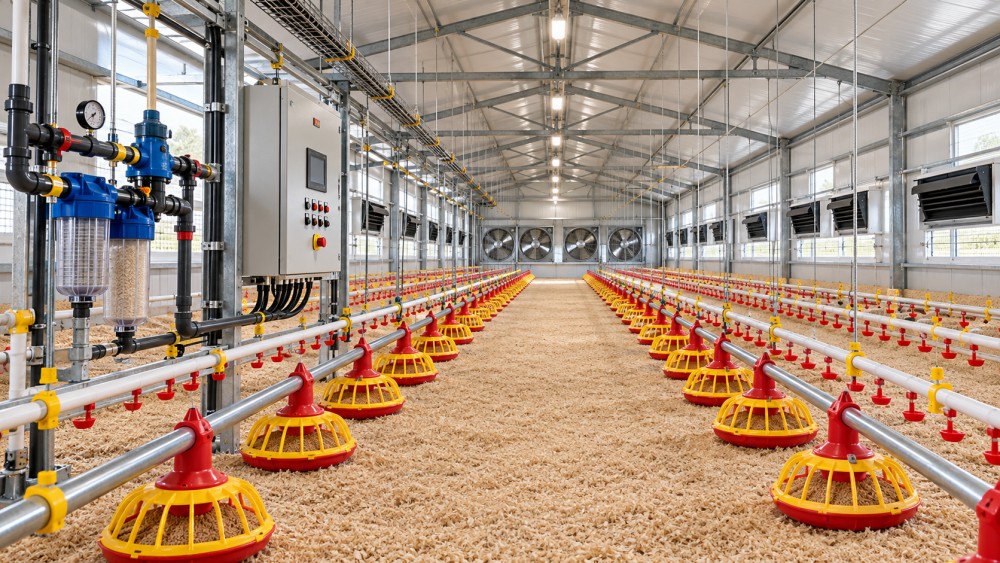
For broiler projects, feeding, drinking, heating, ventilation, and environmental monitoring should be considered together rather than purchased as unrelated packages. Aviagen’s Ross Broiler Management Handbook (2018) discusses these systems as connected elements of house management. It is a management reference, however, not proof that a particular supplier’s design is suitable for a particular site.
For layer projects, procurement may also need to cover nest or cage arrangements, egg collection, manure handling, and transfers between equipment sections. Ask bidders to state what happens at each connection. An egg conveyor ending at the house wall is a different scope from a system delivering eggs to the specified collection point.
Convert each quotation into the same scope schedule
Supplier quotations often use different package names and levels of detail. One may describe a “complete feeding system,” while another lists individual drives, hoppers, feed lines, sensors, and suspension components. Neither format establishes completeness on its own.
Build a comparison schedule based on functions and delivery boundaries, then require suppliers to mark each item as included, excluded, optional, or subject to confirmation. A poultry farm equipment guide focused on price comparison and cost-saving considerations can provide context for this exercise, but the purchasing decision still needs a project-specific schedule supported by written supplier responses.
Do not treat a blank cell as an inclusion. Record unresolved items separately, with an owner and a deadline for clarification. Where the buyer must procure missing work locally, obtain a supporting quotation or identify the allowance as provisional. An unsupported estimate should not carry the same confidence as a firm contractual price.
Compare performance at the proposed operating conditions
Matching quantities is necessary, but it does not establish equivalent performance. Two quotations can contain the same number of fans or drinker lines while relying on different operating assumptions.
For ventilation, request fan performance information at the proposed operating static pressure, together with the assumptions used to select inlets and cooling arrangements. Ask which shutters, guards, or other accessories are represented in the performance information. The engineering question is whether the proposed components can deliver the intended airflow as an installed system, not merely whether the fan diameter matches.
For drinking systems, request the required inlet pressure, water-quality limits, regulator arrangement, flushing method, and provisions for checking delivery along the line. For feeding systems, compare the proposed distribution layout, adjustment arrangements, drive protection, and access for cleaning and maintenance. The Ross handbook provides management guidance on ventilation, feed access, and drinking systems; bidders should supply the equipment-specific evidence needed to translate those requirements into a design.
Material descriptions also need precision. “Galvanized steel” or “stainless steel” alone may leave important questions unanswered. Ask for the material grade or coating specification where relevant, the components covered by that description, and restrictions associated with cleaning chemicals. Request drawings showing maintenance access and replacement clearances rather than assuming that equipment will remain accessible after installation.
Automation deserves a separate review. Establish which functions are controlled, which alarms are generated, how settings are backed up, and what remains operable if the main controller or communications connection fails. Ask whether software licenses, remote access, subscriptions, and configuration tools are included. A controller’s feature list is less useful than a clear description of how the proposed house will be operated and supported.
Price the interfaces between equipment, building, and utilities
Interfaces are a common place for responsibility to become unclear. The equipment supplier may assume that the building contractor provides openings and supports. The contractor may assume that equipment installation includes them. Resolve these boundaries before issuing the purchase order.
Use a responsibility matrix covering foundations, equipment loads, roof suspension points, wall penetrations, drainage, water connections, electrical connections, and control interfaces. Each task should have one named responsible party, even where several companies contribute.
A useful tender clarification is: “Describe the condition in which the site and utilities must be handed over to your installation team.” Require a corresponding statement of what that team will leave behind. Together, these statements define the installation boundary more clearly than the word “turnkey.”
Power interruption planning also belongs in the scope review. Ask the project designer to identify essential loads, backup arrangements, alarm power, transfer responsibilities, and the required response to equipment failure. Do not assume that a generator quotation includes transfer equipment, connection work, fuel arrangements, or testing with the proposed loads.
Animal-welfare requirements must be checked for the actual jurisdiction and production system. The World Organisation for Animal Health’s Terrestrial Animal Health Code, Chapter 7.10, “Animal welfare and broiler chicken production systems,” addresses relevant environmental management and contingency planning for broilers. It is an international reference, not a substitute for checking applicable local obligations or buyer assurance schemes.
Separate delivered cost from installed cost
Commercial terms can change the apparent ranking of otherwise similar offers. Record the quotation currency, validity period, payment milestones, delivery term, named place, packaging basis, and shipment assumptions alongside the equipment scope.
If Incoterms rules are used, specify the chosen rule, the precise named place or port, and the edition. The International Chamber of Commerce’s Incoterms® 2020 rules allocate defined delivery obligations, costs, and risks between buyer and seller. They do not replace the rest of the purchase contract. Installation, payment, acceptance, and warranty obligations still need explicit wording.
Check freight allowances against the proposed shipping configuration. Identify who pays for unloading, lifting equipment, temporary storage, customs clearance, duties, taxes, and inland transport. Ask who bears additional costs if the site is not ready when the equipment arrives.
For installation, distinguish a supplier’s supervisor from a complete installation crew. Clarify responsibility for local labor, tools, lifting platforms, accommodation, travel, interpreters, and repeat visits. A supervision fee may look competitive while leaving substantial work for the buyer to organize.
The resulting comparison should show an evaluated installed cost for each offer, with recoverable taxes and uncertain allowances displayed separately. Keep the assumptions visible so that a change in freight, exchange rates, or site readiness can be assessed without rebuilding the comparison.
Test operating-cost claims without inventing precision
A lower purchase price may be reasonable for a simple facility with capable local maintenance. A more automated system may suit a site where staffing, monitoring, or production requirements justify the additional complexity. Neither approach is inherently the better purchase.
Evaluate operating costs using a common set of assumptions. Ask suppliers for connected loads, expected operating patterns, consumables, maintenance tasks, and recommended spare parts. Distinguish rated electrical power from estimated energy consumption: operating hours and control settings must be stated before an energy-cost comparison becomes meaningful.
For equipment with variable operating conditions, compare more than one scenario. Ventilation and heating assumptions, for example, should reflect the intended climate and production schedule rather than a single favorable operating point. Any supplier savings claim should identify its baseline, calculation method, and exclusions.
Maintenance costs need similar discipline. Ask which parts require routine replacement, what work can be performed locally, and whether specialist tools or authorized technicians are necessary. Check spare-parts lead times and interchangeability by part number, not by a general promise of availability.
Keep uncertain production outcomes outside the core cost comparison unless there is credible, relevant evidence supporting them. Equipment alone does not establish future flock performance. A transparent range of operating-cost scenarios is more useful than a precise payback figure built on unsupported assumptions.
Make acceptance and payment follow verifiable deliverables
The contract should describe how delivery, installation completion, commissioning, and final acceptance differ. Equipment arriving on site does not demonstrate that the assembled system operates as specified.
Agree an inspection and test plan before manufacture or shipment. Depending on the scope, it may include document review, component checks, installation inspections, control-function tests, alarm demonstrations, and checks of feed and water distribution. Define the test conditions, instruments, records, and acceptance criteria rather than leaving “satisfactory operation” undefined.
Some functions can be checked without birds; others require agreed operating conditions. State which checks occur at each stage and how unresolved items will be managed. Include responsibility for corrective work, retesting, and any necessary return visits.
Handover should include the agreed drawings, wiring diagrams, operating instructions, maintenance schedules, spare-parts lists, and training records. Where conformity documents or local approvals are required, identify the exact documents and responsible parties. A general claim that equipment is “certified” should not replace evidence relevant to the supplied configuration and destination.
Warranty terms deserve the same scrutiny as price. Clarify the start date, covered components, exclusions, labor and travel charges, notification procedure, and remedy. An extended parts warranty may offer limited practical protection if diagnosis and replacement require costly external support.
Before award, prepare one comparison sheet showing scope completeness, evaluated installed cost, operating assumptions, delivery commitments, acceptance requirements, and unresolved risks. The preferred quotation should remain defensible after its omissions and dependencies are made visible. A competitive purchase is a clearly bounded project at an acceptable cost—not simply the smallest number on the supplier’s first page.
Got questions about this industry topic or seeking best practices for your business? Drop us a line below, and let the expert team at AgriTrade help you out.
We respect your privacy. Your information is strictly confidential.
Related News
- 00
0000-00
Evaluating Broiler Cage Equipment for House Space and Access - 00
0000-00
Comparing Cage Layouts for a 1,000-Layer Poultry House - 00
0000-00
Harvesting Equipment Export Market: Where Is Demand Growing? - 00
0000-00
Poultry Farm Equipment Quotes: Comparing the Full Project Scope - 00
0000-00
2026 China International Agricultural Machinery Exhibition Opens in Tianjin
0000-00
Agri-Machinery Editorial Team
Weekly Insights
Stay ahead with our curated technology reports delivered every Monday.