Professional Agri-Forestry Industry Insights | Global Intelligence Leader

Where precooling fits into fresh horticultural product logistics





A pallet of freshly harvested produce can look ready for dispatch while still carrying enough field heat to undermine the journey ahead. The cartons are sound, the truck is refrigerated, and the paperwork is complete—but inside the load, warm produce continues to respire and lose moisture. By the time deterioration becomes visible, part of its marketable life has already been spent.
In horticulture products logistics, precooling connects harvest handling with temperature-controlled storage and transport. Its job is to remove field heat promptly, using a method suited to the crop, packaging, and operating conditions. For operators, the practical challenge is not simply getting produce into a cold space. It is cooling the product itself, confirming the result, and preventing that work from being undone before dispatch.
Where precooling belongs in the handling sequence
Precooling should normally take place as soon after harvest as the commodity and handling process allow. The exact position varies: some crops are cooled in their shipping cartons, while others pass through cooling before final packing. Washing, sorting, curing, and treatment requirements may also change the sequence.
A common route for suitable fresh produce is:
Harvest → shaded collection → rapid transfer → receiving and preparation → precooling → temperature-controlled holding → refrigerated loading and transport.
This is a planning framework, not a universal process. Produce requiring curing may need a controlled curing stage before storage cooling. Some products are hydrocooled before packing; others need packaging designed for forced-air cooling. The correct arrangement protects crop quality without creating a queue of warm produce between operations.
One distinction matters throughout: precooling removes the initial heat load; refrigerated storage and transport maintain the required conditions afterward. A conventional cold room may cool warm produce slowly, especially in tightly stacked loads. A refrigerated truck should generally receive produce already within its agreed loading-temperature range rather than be expected to pull down a hot load.
Set the crop requirements before choosing the equipment
“Make it as cold as possible” is not a safe instruction. Horticultural commodities differ in chilling sensitivity, water tolerance, respiration rate, and susceptibility to moisture loss. Many temperate vegetables benefit from temperatures close to freezing, while chilling-sensitive crops can suffer injury at temperatures well above their freezing point.
Before a batch reaches the cooling area, operators need a crop-specific specification covering:
- Target product temperature: including acceptable loading limits and any chilling or freezing restrictions.
- Cooling urgency: based on perishability, harvest temperature, and the expected distribution period.
- Water-contact suitability: including food safety controls and whether packaging tolerates wet handling.
- Humidity needs: balancing moisture-loss prevention against free water and condensation risks.
- Packaging and pallet configuration: including ventilation, liners, stacking patterns, and load stability.
Use validated commodity guidance, buyer specifications, and applicable food safety requirements rather than a single temperature setting for every shipment. Mixed loads need particular care: a temperature suitable for one crop may injure another, and ethylene compatibility can create additional restrictions.
Match the cooling method to the product and the workflow
The most useful precooling method is one that reaches the required product temperature within the available time without introducing unacceptable quality or hygiene risks. Equipment capacity matters, but so do carton design, water management, staffing, and the pattern of daily arrivals.
Forced-air systems illustrate why installation alone does not guarantee performance. A fan may move plenty of air while little passes through the cartons. Gaps around a pallet, blocked vents, or poorly placed covers let air take an easier route around the product. The room feels cold, but the center of the load remains warm.
Hydrocooling brings a different responsibility. Shared water can spread contamination if controls fail. Water quality, treatment where applicable, monitoring, and corrective actions must be part of the food safety program. Cooling does not sanitize produce, and hydrocooling should not be treated as a pathogen-elimination step.
Vacuum cooling can suit leafy crops particularly well, but evaporative water loss must be managed. The operating cycle and any water application need validation for the product rather than adjustment by habit.
Build the cooling operation around product flow
On a busy harvest afternoon, the weak point is often the waiting area rather than the cooling machine. Several field deliveries arrive together, a packing line stops, or cooled pallets have nowhere to go. Warm produce accumulates while operators try to recover the schedule.
Shade and prompt transfer help limit additional heat gain and moisture loss, but they do not replace precooling. Record arrival times and temperatures so cooling priorities reflect product condition and perishability, not merely which vehicle reached the gate first.
Capacity planning should account for peak arrival rates, incoming temperatures, loading and unloading time, cleaning, defrost cycles, and available holding space. Daily throughput alone can hide an afternoon bottleneck. If precooling finishes faster than dispatch or cold storage can accept pallets, the process simply moves the queue downstream.
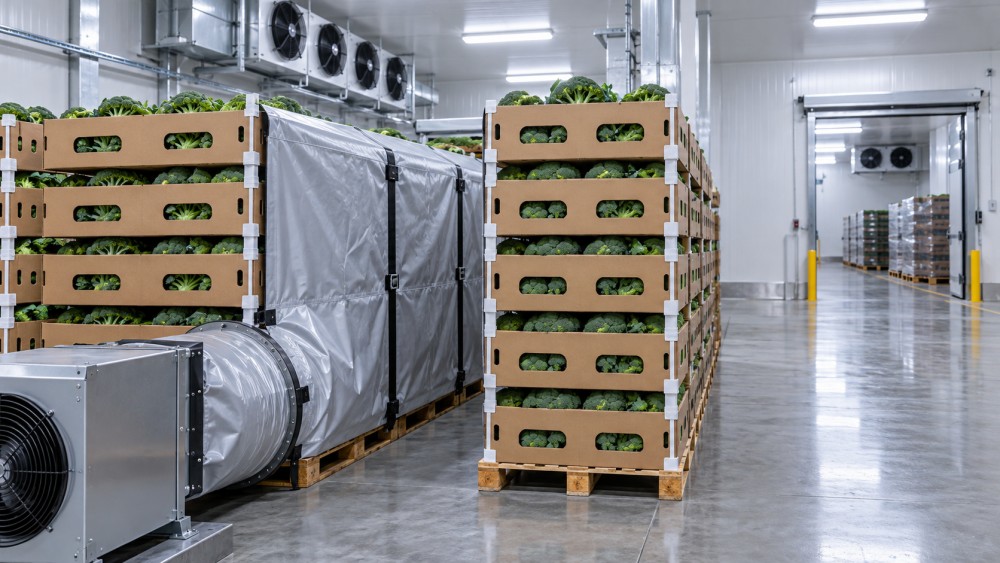
A practical layout separates incoming warm produce from cooled stock and minimizes travel through ambient areas. Where physical separation is limited, clear pallet identification and scheduled movement can reduce mix-ups. Operators should be able to see which batches are waiting, cooling, released, or held for investigation.
Packaging is part of the cooling system
Cooling performance depends on the entire route between the cooling medium and the produce. Carton vents that work individually may become blocked when boxes are stacked. Plastic liners can restrict airflow, and stretch film can cover the openings the system relies on.
Before changing a carton, liner, tray, or pallet pattern, check its effect on cooling. Assess the full pallet under realistic loading conditions, including the warmest expected incoming product. A packaging change that improves presentation or load security may require a different cooling cycle.
Release the batch on product temperature—not elapsed time
A display reading the target air temperature does not prove that the produce has reached it. Air can cool quickly while product cores lag behind. Surface readings are also insufficient for thick or densely packed commodities.
Use calibrated instruments and an appropriate product-temperature measurement method. Where probes penetrate produce, follow hygiene procedures and manage sampled units appropriately. Sample locations should include likely slow-cooling positions, not just accessible cartons near the outside of a pallet.
A workable release check combines:
- Incoming product temperature and the time cooling began.
- Representative product temperatures during and at the end of cooling.
- Cooling-air or cooling-water conditions, as applicable.
- Confirmation that the batch meets its commodity-specific release limits.
- Identification of the destination holding area or transport unit.
Seven-eighths cooling time is one useful performance measure. It describes the time needed to remove seven-eighths of the initial temperature difference between the produce and the cooling medium. For example, produce starting at 30°C in a constant 2°C cooling environment reaches seven-eighths cooling at 5.5°C. This is a way to compare cooling performance—not an automatic dispatch temperature. The actual release limit remains crop- and shipment-specific.
Once a process has been validated, routine records can reveal changes. If the same crop and pack format begin taking longer to cool, inspect airflow, refrigeration performance, load configuration, incoming temperatures, and equipment condition before simply extending every cycle.
Protect the result between cooler and truck
Precooling loses value when pallets wait on an exposed loading apron or enter an unsuitable vehicle. Dispatch should be coordinated with cooling completion so the product moves into temperature-controlled holding or transport without unnecessary delay.
Before loading, confirm that the vehicle is clean, suitable for the commodity, operating correctly, and prepared to the agreed conditions. Inspect door seals, air-delivery paths, return-air clearance, and loading configuration. Follow the vehicle or transport operator’s procedures for refrigeration operation during door-open loading; running the unit with open doors can draw in warm, humid air.
Do not pack cartons so tightly that they obstruct the transport unit’s designed circulation. Equally, avoid assuming that more empty space always improves cooling: the load needs the airflow arrangement specified for that equipment.
Temperature transitions also create condensation risks. Cold produce exposed to warm, humid air may collect surface moisture, potentially affecting decay development, labels, and packaging strength. Reducing exposure and controlling dock conditions is usually more effective than trying to correct wet cartons afterward.
When performance slips, trace the heat before changing the schedule
Recurring problems become easier to solve when operators distinguish cooling failure from later warming. A shipment arriving warm does not, by itself, establish where temperature control was lost.
- Outer cartons are cold but central cartons remain warm: investigate airflow bypass, vent alignment, liners, and pallet configuration.
- Every batch takes longer than expected: check actual heat load, refrigeration capacity, cooling-medium conditions, and maintenance.
- Produce meets release limits but is warm at loading: review staging times, transfer routes, and holding-room conditions.
- Wilting increases despite acceptable temperatures: examine cooling duration, humidity, airflow exposure, and crop-specific moisture loss.
- Decay rises after wet cooling: investigate incoming condition, handling damage, water controls, drainage, and subsequent temperature history.
Keep batch records that connect harvest, cooling, holding, and dispatch. Record exceptions as well as normal readings: a delayed field collection, damaged cover, failed water-control check, or prolonged loading period may explain more than a daily average.
For horticulture products logistics, the strongest precooling operation is not necessarily the one with the shortest cycle. It is the one that consistently brings the right product to the right temperature, verifies that result, and hands it over without avoidable warming. That makes precooling a controlled link in the supply chain—not merely a cold stop between the field and the truck.
Got questions about this industry topic or seeking best practices for your business? Drop us a line below, and let the expert team at AgriTrade help you out.
We respect your privacy. Your information is strictly confidential.
Related News
- 00
0000-00
Southeast Asia’s Plywood Industry: Key Producers and Export Markets - 00
0000-00
Vietnam Faces $3.9 Billion in Annual Agricultural and Food Losses - 00
0000-00
Cold Chain Logistics Updates: Shipment Tracking Technologies to Watch - 00
0000-00
Should You Buy Imported Wheat on FOB or CIF Terms? - 00
0000-00
Is Reefer Shipping Cheaper Than Air for Berries After Spoilage Losses?
0000-00
Supply Chain Research Editorial Team
Weekly Insights
Stay ahead with our curated technology reports delivered every Monday.