Professional Agri-Forestry Industry Insights | Global Intelligence Leader

When is sea freight viable for exporting fresh horticultural products?





Sea freight is viable for fresh horticultural exports when the product reaches its destination with enough saleable life to complete distribution and meet the agreed retail or processing window. That requires a suitable commodity, consistent harvest quality, a reliable cold chain, and a route whose delays fit within the product’s remaining life. Lower ocean freight charges improve the economics only when the value of usable produce delivered outweighs the extra time, handling, and inventory costs.
The decision therefore starts with arrival condition. A shipment that survives the voyage but requires immediate discounting has a different commercial outcome from one that supports normal distribution. Sea freight becomes a credible option when that difference can be measured and controlled.
Start with the saleable-life budget
Published storage-life figures provide a starting point, but they rarely represent the exact life available to an export consignment. Variety, maturity, field conditions, mechanical injury, disease pressure, and time before cooling all affect deterioration. A storage estimate established under controlled conditions should not be treated as a guaranteed transport allowance.
A useful screening relationship is:
Validated saleable life at loading > expected time to commercial release + required destination selling window + disruption allowance.
Each term must use the same starting point and a defined storage regime. “Commercial release” means the produce is available for its intended distribution channel after discharge, inspections, clearance, and any required handling. The selling window includes onward distribution and the usable life required by the receiving customer.
Calendar days alone do not capture deterioration. Warm exposure can consume quality faster than time at the intended storage temperature, while chilling injury can develop when sensitive produce is held too cold. The relationship is therefore a screening tool supported by product trials and temperature records, rather than a universal shelf-life calculator.
A positive margin under the advertised vessel schedule is insufficient. The route also needs enough room for a credible missed connection, inspection delay, or late container collection. If a routine disruption removes the entire destination selling window, the service is commercially fragile.
Commodity suitability depends on the actual export specification
Relatively durable produce offers a wider starting margin for ocean transport. Apples, certain citrus varieties, and properly cured onions are established candidates when their storage requirements are met. Grapes, kiwifruit, avocados, and other products also move by sea, but their suitability depends on variety, maturity, treatment, packaging, and destination handling. A commodity name alone cannot establish feasibility.
Highly perishable berries, tender herbs, and delicate leafy vegetables warrant closer scrutiny because visual quality and texture can deteriorate quickly. Specialized handling can extend the reach of selected products, but a successful shipment under unusually favorable conditions does not establish a repeatable service.
Harvesting earlier is also an incomplete answer. Some fruit develops acceptable eating quality after harvest only when picked at sufficient physiological maturity. Extending firmness at the expense of flavor, ripening performance, or customer acceptance transfers the problem to the destination.
Measure the route beyond port-to-port transit
The relevant journey begins before vessel departure. Harvest-to-packhouse time, cooling, inland haulage, terminal cutoffs, and waiting for loading all consume the available quality margin. At destination, discharge does not immediately make cargo available: inspection, clearance, container collection, inland delivery, and receiving appointments add further time.
A shorter advertised sailing can produce a longer commercial lead time if it requires transshipment or operates infrequently. Missing a weekly departure has a different consequence from missing a service with another suitable sailing shortly afterward. Schedule frequency and connection reliability deserve the same attention as nominal transit duration.
Route assessment should use observed performance where available: departure variability, connection failures, destination dwell, and seasonal congestion. An average transit time conceals the late arrivals that cause the greatest losses. The assessment needs a realistic delayed-arrival scenario as well as the expected journey.
Timing also affects revenue independently of physical condition. Produce arriving after a promotion, seasonal demand peak, or agreed delivery slot can lose value while remaining edible. A technically sound cold chain cannot recover a missed market window.
Cold-chain control must begin before container loading
A refrigerated container is primarily designed to maintain appropriately prepared cargo at its transport temperature. It should not be relied upon to remove substantial field heat from a tightly packed load. Slow cooling leaves the interior of cartons warm while external air readings appear acceptable, accelerating respiration and decay before the voyage is fully underway.
The appropriate cooling method depends on the product and packaging. Forced-air cooling relies on air passing through aligned vents; hydrocooling requires suitable produce, water management, and packaging. Cooling performance should be confirmed through representative pulp-temperature measurements, including positions likely to cool slowly.
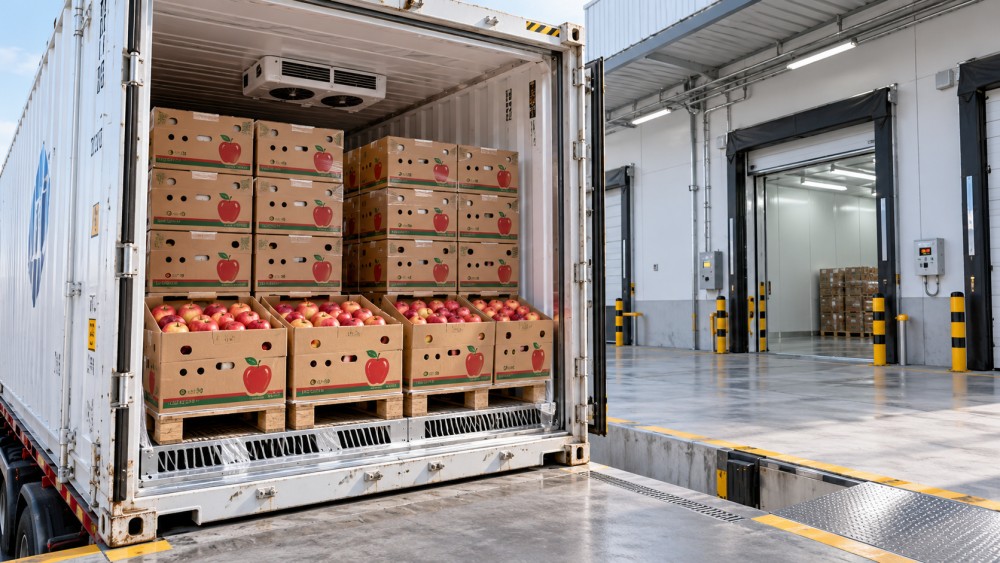
Loading then has to preserve airflow. Blocked carton vents, unsuitable pallet arrangements, cargo above the container’s loading limit, and obstructed floor channels can create uneven conditions. A correct controller setpoint cannot compensate for air that fails to move through the load.
Temperature settings must reflect the commodity’s tolerance. Lowering the setpoint to compensate for expected delays risks chilling injury or freezing damage. Mixed loads are especially difficult when products require different temperatures, humidity conditions, ventilation, or ethylene management. Compatibility must cover the entire journey, including any ripening activity within the container.
Monitoring should distinguish equipment operation from product exposure. Supply-air and return-air records describe refrigeration conditions; independent loggers placed at representative cargo positions help reveal uneven temperatures. Neither replaces arrival inspection, because firmness, decay, dehydration, and internal disorders provide evidence that temperature records alone cannot supply.
Atmosphere control adds capability within defined limits
Controlled-atmosphere transport and modified-atmosphere packaging can slow respiration or quality loss in suitable commodities. Their value depends on the product’s response, package permeability, temperature, and the ability to maintain the intended gas composition.
Excessively low oxygen or unsuitable carbon dioxide levels can cause injury, fermentation, or off-flavors. Packaging selected for one temperature regime may behave differently during warm handling because respiration changes. Atmosphere technology therefore needs validation with the actual product and pack; it cannot restore quality lost through poor maturity selection, delayed cooling, or infection.
Destination requirements can change the transport decision
Market access must be established before transport economics are finalized. Commodity eligibility, origin restrictions, phytosanitary documentation, food safety requirements, and any mandated treatment can determine whether the proposed shipment is feasible. Requirements must be verified for the specific origin–commodity–destination combination.
Where an authorized cold-treatment protocol applies, its temperature, duration, monitoring, and documentation requirements become part of the operating plan. A storage regime that protects appearance may still conflict with a treatment requirement, or the required treatment may increase the risk of quality damage in a sensitive variety.
Inspection arrangements also affect the quality budget. Cargo awaiting examination needs suitable temperature-controlled holding, and a container selected for inspection may face additional handling. The destination plan should establish where that happens, how refrigeration is maintained, and how quickly released cargo reaches the receiving facility.
Compare cost per saleable unit
Ocean freight should be compared with air freight using equivalent delivered quality and commercial terms. Freight per gross kilogram overlooks rejected cartons, weight loss, downgraded produce, and shortened selling time.
Cost per saleable kilogram = total shipment cost ÷ kilograms accepted for the intended sale.
The numerator includes product, preparation, packaging, inland transport, freight, applicable terminal charges, clearance, monitoring, financing, and destination handling. Additional storage or ripening belongs in the calculation where required. Rejected product reduces the denominator; downgraded product also needs a separate revenue adjustment because it may remain saleable at a lower price.
Longer transit ties up working capital and exposes the shipment to market-price changes. These costs matter even when physical losses are low. Container utilization also changes the result: waiting to assemble a full load can consume shelf life, while shipping a partial load can raise unit costs or complicate temperature compatibility.
A practical comparison uses an expected outcome and a plausible adverse outcome. The adverse scenario should combine realistic delay, quality loss, and destination charges rather than assume every variable remains favorable. Insurance recovery should enter the model only where the policy actually covers the relevant loss and conditions.
Sea freight is attractive when its margin remains acceptable under that adverse scenario. A small saving that disappears with modest downgrading offers little protection against normal variation.
Validate the lane before increasing shipment volume
A trial should reproduce the intended commercial arrangement: origin, variety, maturity, packhouse process, packaging, loading pattern, route, season, and destination handling. Changing several of these after the trial weakens the evidence supporting the decision.
Arrival assessment needs to cover the remaining selling period, not just unloading condition. Produce can appear sound on opening and then soften, decay, or develop internal symptoms during distribution. Relevant acceptance measures include firmness, external condition, internal quality where applicable, decay, weight loss, and the ability to complete any planned ripening stage.
Written acceptance criteria make the results usable. They should connect measurements to the intended market specification and record how much product remains suitable for its original grade. Temperature data, handling timestamps, and inspection findings then help distinguish a product limitation from a correctable process failure.
Expansion is justified when representative shipments demonstrate sufficient arrival quality, remaining selling life, and margin across the route’s expected variation. If the quality budget remains too narrow, a shorter sea route, a different harvest window, or air freight for time-sensitive consignments offers a more defensible transport choice.
Got questions about this industry topic or seeking best practices for your business? Drop us a line below, and let the expert team at AgriTrade help you out.
We respect your privacy. Your information is strictly confidential.
Related News
- 00
0000-00
Southeast Asia’s Plywood Industry: Key Producers and Export Markets - 00
0000-00
Vietnam Faces $3.9 Billion in Annual Agricultural and Food Losses - 00
0000-00
Cold Chain Logistics Updates: Shipment Tracking Technologies to Watch - 00
0000-00
Should You Buy Imported Wheat on FOB or CIF Terms? - 00
0000-00
Is Reefer Shipping Cheaper Than Air for Berries After Spoilage Losses?
0000-00
Supply Chain Research Editorial Team
Weekly Insights
Stay ahead with our curated technology reports delivered every Monday.