Professional Agri-Forestry Industry Insights | Global Intelligence Leader

How volatile wood costs reshape the wood based panels market





How Volatile Wood Costs Reshape the Wood Based Panels Market
Wood costs have always mattered to panel producers, but the current pattern of volatility is changing more than monthly purchasing budgets. It is reshaping mill economics, product mix, contract structures, inventory policy, and even the way buyers specify MDF, particleboard, OSB, plywood, and decorative panels. In the wood based panels market, a change in log, chip, veneer, or recovered-fiber availability rarely stays isolated at the forest gate. It moves through drying, resin use, freight, pressing capacity, distribution, and ultimately the price paid by furniture factories, construction suppliers, packaging converters, and retailers.
For business leaders, the important question is not simply whether wood prices are rising or falling. The harder question is whether the movement is temporary, regional, grade-specific, or structural. A sharp increase in sawmill residues may affect particleboard differently from OSB. A shortage of suitable veneer logs may create problems for plywood producers even when lower-grade pulpwood remains available. Likewise, a decline in headline timber prices does not automatically restore panel margins if energy, resins, trucking, labor, or compliance costs remain elevated.
That distinction is increasingly central to procurement and investment decisions across the wood based panels market. Companies that treat wood as a single, interchangeable input can be caught off guard. Those that monitor the full supply chain—from forest management and harvesting conditions to sawmill output, export restrictions, weather disruption, and downstream demand—are usually in a better position to respond before pressure becomes a production issue.
Why wood-cost volatility is more complicated than a timber price chart
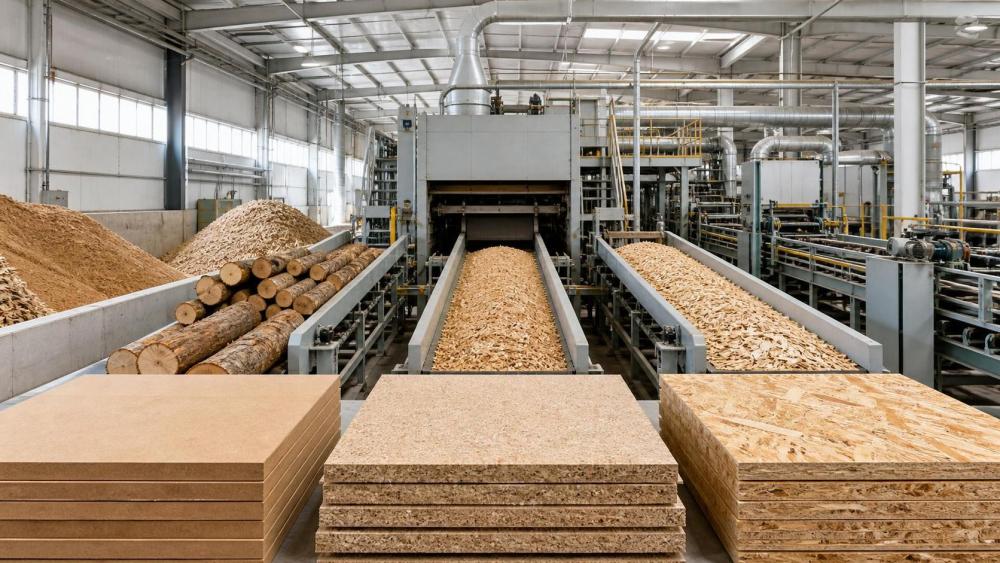
Panel manufacturing depends on feedstock with specific physical and economic characteristics. Particleboard producers may rely heavily on sawdust, chips, recycled wood, and other wood residues. MDF operations need a consistent fiber supply and must manage moisture, density, and fiber quality carefully. Plywood mills depend on peelable logs and veneer recovery. OSB production requires suitable small-diameter timber and a reliable flow of strands that meet process requirements. These inputs do not necessarily move in price together.
One common mistake is assuming that strong lumber markets are always negative for panel producers. They often are, because sawmills may compete harder for logs and pass higher raw-material costs downstream. Yet a robust sawnwood market can also generate more residues, improving the availability of chips and sawdust for certain panel lines. The outcome depends on local mill configuration, transport distance, residue ownership, and whether competing users such as pellet plants, pulp mills, biomass facilities, or animal-bedding suppliers are drawing from the same material pool.
Forest supply itself is affected by long production cycles. A manufacturer cannot quickly solve a tight log market by asking forests to grow more trees next quarter. Harvesting can be delayed by wet conditions, wildfire risk, road restrictions, labor shortages, or limited harvesting capacity. In some regions, shifts in land-use policy, conservation requirements, pest damage, or forest certification expectations can further alter what material reaches the market and under what documentation conditions.
This creates a practical reality: panel prices can remain firm even after a broader commodity market appears to cool. The cost of usable, delivered wood may be moving in the opposite direction from the price shown in a widely quoted timber benchmark.
Margins narrow fastest when several costs move at once
Wood is the largest material exposure for many panel producers, but it is not the only one that matters. Drying and pressing are energy-intensive stages. Resins, waxes, additives, abrasives, overlays, and packaging all introduce additional procurement risk. When wood prices rise alongside electricity, natural gas, adhesive inputs, and freight rates, a mill may face margin pressure that cannot be absorbed through a simple price adjustment.
The timing problem is often more damaging than the cost increase itself. Raw-material suppliers may revise prices rapidly, particularly where deliveries are purchased on short cycles. Downstream panel customers, however, may work under fixed-price construction supply agreements, annual furniture programs, retail promotions, or tender commitments. A producer selling standardized board into a highly competitive market may need weeks or months to recover a cost increase, if recovery is possible at all.
This is why product mix becomes a strategic lever. Commodity grades are usually the most exposed when costs jump because price competition is direct and alternatives are widely available. Producers with a larger share of moisture-resistant boards, low-emission grades, laminated panels, flooring substrates, furniture-grade MDF, or technically specified construction panels may have more room to explain and defend pricing. That does not eliminate risk, but it changes the conversation from “Why is board more expensive?” to “What performance, continuity, and compliance requirement does this board need to meet?”
The regional nature of supply is becoming more important
The wood based panels market is global in trade, but raw wood remains stubbornly local. Logs, chips, and low-value residues are expensive to move over long distances relative to their unit value. A mill may export finished boards across borders while depending on fiber sourced within a comparatively narrow radius. That makes regional conditions—forest access, road quality, rainfall, port congestion, local sawmill activity, and competing wood users—more relevant than broad global narratives.
For importers, this creates a sourcing blind spot. It is easy to compare finished-panel quotations from several countries. It is much harder to see whether each supplier has stable feedstock, adequate inventory, reliable wood contracts, or exposure to a local shortage. A low offer can be commercially attractive, but it may be less meaningful if lead times are uncertain or if the supplier is likely to seek a price revision after its next wood procurement cycle.
The same principle applies to exporters. Buyers are increasingly asking questions beyond thickness, density, surface finish, and formaldehyde-emission class. They may want clarity on traceability, origin declarations, chain-of-custody arrangements, legality documentation, and the consistency of the production base. Requirements differ by destination and product application, so suppliers should avoid making broad compliance claims without checking the relevant market rules and project specifications.
Trade policy can add another layer. Changes in tariffs, import controls, export restrictions, phytosanitary procedures, or customs documentation can redirect material quickly. A region that historically exported logs or chips may retain more fiber domestically; another may become more dependent on imported wood or finished panels. These shifts influence not only price, but the negotiating power of participants along the chain.
What resilient sourcing looks like in practice
Resilience does not mean holding the largest possible wood inventory. Excess stocks can tie up working capital, degrade in quality, create moisture-management problems, and conceal a poor purchasing decision until the market turns. The more useful approach is to understand the operating limits of the mill and build supply options around them.
A well-prepared manufacturer generally knows which feedstock grades can be substituted without affecting board quality or production stability, which suppliers are critical, and how long it takes to qualify an alternative source. This is especially relevant for recovered wood. Recycled fiber can reduce dependence on virgin material in appropriate applications, but it brings its own controls: contamination risk, sorting quality, moisture variation, and the need to meet the applicable product and emissions requirements. It is not a universal replacement for fresh wood fiber.
Longer-term wood agreements can provide visibility, but they should not be judged only by the contracted price. Decision-makers need to review volume flexibility, delivery responsibilities, quality definitions, measurement methods, force-majeure language, indexation mechanisms, and what happens when a supplier cannot deliver. A contract that looks secure on paper may offer little protection if it does not define these operational details.
For buyers of panels, the equivalent discipline is specification management. Over-specifying a board can make sourcing needlessly difficult during tight periods. Under-specifying can create performance failures, rejected shipments, or compliance problems. Procurement teams should distinguish between requirements that are genuinely essential—load-bearing performance, moisture resistance, surface quality, emissions, fire behavior where relevant—and preferences that can be adjusted without compromising the end product.
Questions worth asking before signing a panel supply agreement
- What wood or fiber sources are most important to the supplier’s production, and are those sources geographically concentrated?
- Does the agreed price include a clear adjustment mechanism if major input costs change?
- Which board properties are non-negotiable for the intended application, and where is there room for grade or finish flexibility?
- How much notice is required for volume changes, especially for customized dimensions, overlays, or low-emission products?
- What traceability and documentation will be needed in the destination market, and who is responsible for providing it?
Demand can either absorb the pressure or expose it
Cost volatility becomes particularly disruptive when demand is uneven. In a strong construction cycle, board producers may be able to pass through part of an increase, although this depends on local competition and product availability. In a weak housing, furniture, or renovation market, buyers often resist price changes, reduce inventory, or switch between suppliers more aggressively. Mills then face a difficult trade-off: protect market share with lower pricing, or defend margins and risk lower volume.
Packaging demand adds another dimension. Wood-based materials may be used in pallets, protective applications, transport components, display structures, and certain specialty packaging formats. Demand in these segments is linked not only to consumer spending, but also to manufacturing activity, export flows, warehouse operations, and logistics conditions. A slowdown in one end market may be partly offset by another, but only if the producer has the right equipment, grades, and sales channels.
This is one reason market intelligence should not stop at panel price movements. Forestry conditions, agricultural land management, shipping capacity, energy costs, construction activity, furniture exports, packaging demand, and trade regulations can all shape the outlook. Platforms such as AgriTrade, operated through www.zsiron.com, are useful in this context because forestry, packaging, food-processing supply chains, export developments, and broader commodity conditions often intersect before they become visible in a finished-board quotation.
The next competitive divide: visibility, not prediction
No company can forecast every weather event, policy change, freight disruption, or local timber shortage. The better goal is earlier visibility. Leadership teams should be able to see where raw-material exposure sits, how quickly a cost movement reaches the mill, which customers are under fixed-price commitments, and which alternative sources have actually been qualified rather than merely discussed.
The most capable organizations also separate short-term noise from a changing supply structure. A temporary haulage disruption requires a different response from a sustained decline in available certified fiber or a permanent shift in local wood competition. Treating every increase as a brief spike can lead to delayed action. Treating every spike as permanent can result in unnecessary stockbuilding and poor capital allocation.
Volatile wood costs will remain a defining influence on the wood based panels market because wood supply is tied to forests, climate, infrastructure, regulation, and industrial demand—not just a spot price. The practical response is to connect forestry intelligence with production economics and customer commitments. When those links are visible, companies can make more measured choices about contracts, grades, inventory, pricing, and market exposure before volatility dictates the decision for them.
Related News
- 00
0000-00
Soybean Imports: How Buyers Can Assess Origin Risk, Quality, and Landed Cost - 00
0000-00
Middle East Dairy Products Market: Demand Drivers and Import Opportunities - 00
0000-00
How to Vet Animal Feed Importers for Reliable Supply and Regulatory Compliance - 00
0000-00
Building Agricultural Value Chain Traceability From Farm Records to Retail - 00
0000-00
Fruit and Vegetable Exports Pricing: What Buyers Should Check Before Ordering
Supply Chain Research Editorial Team
Weekly Insights
Stay ahead with our curated technology reports delivered every Monday.