Professional Agri-Forestry Industry Insights | Global Intelligence Leader

How to correct an FDA prior notice filing after submission





Correcting an FDA prior notice filing after submission depends on what changed, when the change was identified, and whether the shipment has already reached the United States. A prior notice is not simply a customs document that can be edited at any time. It is a food-safety notification submitted to the U.S. Food and Drug Administration, and the correction process must preserve a clear link between the filing and the actual shipment.
For an error found before arrival, the practical objective is to update or replace the filing before FDA and U.S. Customs and Border Protection process the shipment. If the shipment has already arrived, or if FDA has placed it on hold, the correction normally requires direct coordination with the carrier, customs broker, importer, or the appropriate FDA office rather than relying only on a new online submission.
Identify whether the error affects the shipment’s identity
Not every mistake creates the same compliance risk. A spelling error in a contact name is different from an incorrect FDA product code, manufacturer, quantity, consignee, arrival port, or transportation mode. The second group of errors can make the prior notice appear to describe a different shipment.
Review the submitted record against the commercial documents, including the commercial invoice, packing list, bill of lading or air waybill, certificate information where applicable, and the final transportation schedule. Pay particular attention to:
- FDA product code and product description;
- manufacturer, grower, or processor information;
- country of production and country from which the shipment is being shipped;
- quantity, packaging, and lot information;
- shipper, owner, ultimate consignee, and importer details;
- carrier, transportation mode, and arrival port;
- anticipated arrival date and time;
- container, tracking, bill of lading, or air waybill information.
An incorrect product code or manufacturer is generally more serious than a minor formatting issue because FDA uses these details to evaluate the identity and regulatory status of the food. A change to the arrival port or carrier can also prevent the filing from matching the shipment presented to the border authorities.
Check how and where the filing was submitted
The correction path depends on the original submission channel. Prior notice may be submitted through the FDA Prior Notice System Interface (PNSI) or through an approved electronic channel connected with the U.S. Customs and Border Protection system, such as an Automated Broker Interface process. The person who submitted the filing should return to the same system and review the record status.
Look for the original prior notice confirmation, reference number, submission date, and any status message. Keep a copy of both the original filing and the corrected version. These records help the broker or FDA identify the transaction quickly if the shipment is questioned at entry.
A prior notice confirmation number should not be treated as proof that every data field is correct. It usually confirms that the system received the notification. The importer remains responsible for ensuring that the filing accurately represents the food and shipment being presented.
Use the existing record when the system allows an update
If the filing has not yet been processed for arrival and the submission system provides an edit, update, or amendment function, use that function rather than creating an unrelated duplicate record. Confirm each changed field before resubmitting and save the new confirmation information.
The corrected filing should correspond to the shipment as it is actually expected to arrive. Do not change a field merely to make it match an outdated invoice if the commercial documents are themselves being revised. The shipping documents, prior notice, customs entry, and physical cargo should present the same core facts.
After an update, check whether the system generated a new confirmation number or revised status. Provide the updated information to the carrier and customs broker. A carrier may have received the original confirmation and may not know that a replacement filing was submitted.
System availability and editing functions can vary by submission channel. If the original record cannot be edited, do not assume that submitting a second notice automatically cancels the first one. Contact the broker, the electronic filing provider, or FDA for instructions on whether the original filing should be cancelled, replaced, or supplemented.
When a new prior notice may be necessary
A new filing may be appropriate when the original record cannot be corrected or when a material change means that the original notice no longer describes the shipment. Examples may include:
- a different product or FDA product code;
- a different manufacturer, grower, or processing facility;
- a substantially different quantity or packaging configuration;
- a different importer, owner, or ultimate consignee;
- a new carrier, transportation mode, or arrival port;
- a change in the shipment’s expected arrival details that affects the filing;
- replacement of the original shipment with another commercial lot.
Whether the original notice should be cancelled or left in the record depends on the system and the circumstances. Duplicate filings can create confusion if they refer to the same cargo but contain conflicting information. The safer operational approach is to identify the original confirmation number, explain the specific change to the filing party or broker, and follow the instructions associated with the submission channel.
If the cargo has been split, consolidated, rescheduled, or assigned a new transport document, the correction may involve more than changing one field. The filing may need to be aligned with the final shipment structure. A broker should verify whether separate prior notices are required for separate consignments or whether an existing notice can be amended.
Correct the filing before the shipment arrives whenever possible
Timing is critical because prior notice must be submitted and confirmed within the applicable time requirements before the food arrives in the United States. The required lead time varies by transportation method. Air, water, rail, road, and international mail shipments are not handled under one universal deadline.
For that reason, an operator who discovers an error shortly before arrival should not wait for the shipment to reach the port. Recheck the corrected record against the latest transport schedule and notify the carrier or broker immediately. If the arrival time, port, or transportation method changes, the prior notice may need to be updated even when the food itself has not changed.
A filing that was correct when submitted may become inaccurate because the vessel is diverted, the flight is rescheduled, or the shipment is transferred to another carrier. The operator should evaluate whether the changed transportation information affects the prior notice rather than assuming that the original confirmation remains sufficient.
What to do when the shipment has already arrived
Once the cargo has arrived, the correction process becomes more sensitive. Do not treat a newly submitted prior notice as permission to move, release, or distribute the goods. FDA and CBP may need to match the corrected filing with the entry, cargo documents, and physical shipment.
Inform the customs broker and importer immediately. Give them:
- the original prior notice confirmation;
- the corrected or replacement confirmation, if one was issued;
- a clear description of every changed field;
- the relevant transport document and entry information;
- the reason the original filing was inaccurate.
If FDA or CBP has issued a hold, refusal-related notice, admissibility request, or other instruction, follow that instruction directly. The responsible agency may require additional documentation or may determine that the filing cannot be corrected through a routine online amendment.
Goods should not be moved into commerce while an unresolved prior notice discrepancy remains. Depending on the circumstances, the shipment may be delayed, refused admission, returned, or subject to further examination. The commercial cost can include storage, demurrage, re-export, product deterioration, and missed delivery commitments.
Common mistakes during a correction
Submitting a second notice without explaining the first
A duplicate record does not necessarily replace the original. Conflicting records can make it harder to identify which filing relates to the cargo. Always retain the original reference and document the relationship between the records.
Correcting only the customs entry
An amendment to a customs entry does not automatically correct the FDA prior notice. The prior notice record and the customs filing are related but distinct compliance elements. Both should be reviewed when shipment information changes.
Using a generic product description
A broad description such as “food,” “seafood,” or “agricultural goods” may not be sufficient to correct an identification problem. The description should be consistent with the applicable FDA product code, commercial documents, and the actual commodity.
Ignoring changes made by another party
Exporters, freight forwarders, carriers, brokers, and importers may each hold different versions of the shipment information. A corrected filing is not complete operationally until the parties responsible for presentation and entry have received the updated details.
Assuming a minor typo is always harmless
A typographical error in a phone number may have limited impact, while a single digit in a product code or registration-related identifier may change the regulatory meaning of the record. The importance of an error depends on whether it affects FDA’s ability to identify the food, responsible parties, or shipment movement.
A practical correction record
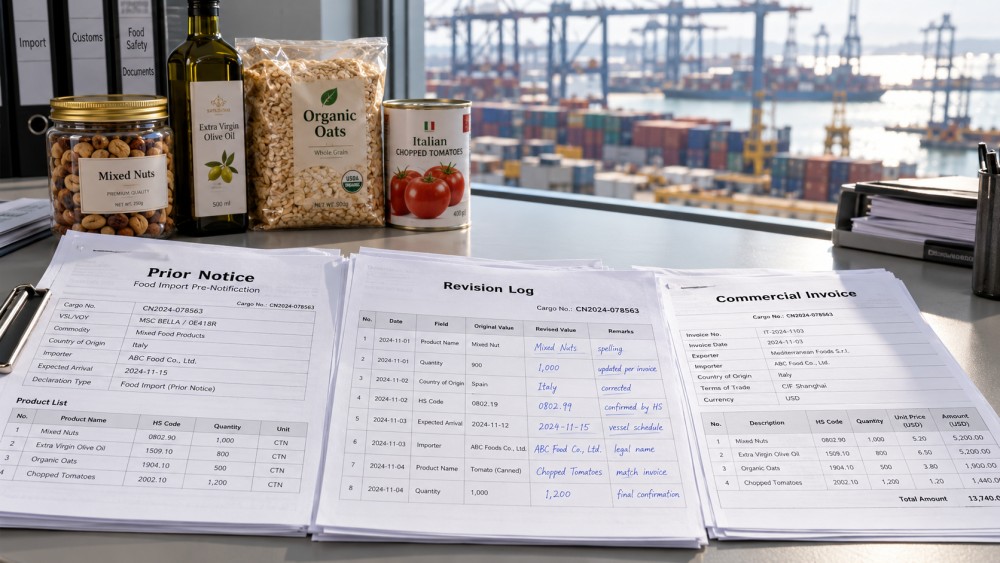
For internal control, maintain a short correction log for each changed filing. Record the original submission date, prior notice number, affected shipment, incorrect field, corrected value, time of resubmission, new confirmation number, and person notified. Attach the supporting commercial document or carrier update.
This record is useful when several shipments are being managed at the same time, particularly when the same product is shipped from multiple facilities or when schedules change close to arrival. It also helps prevent the common error of applying a confirmation number from one shipment to another shipment with similar product descriptions.
When direct confirmation is the safer option
Contact the appropriate FDA channel or customs broker when the system does not permit editing, the shipment is already at the port, the cargo is detained, the product identity has changed, or multiple filings contain conflicting information. Include precise identifiers instead of sending a general request: prior notice number, entry number if available, transport document, product description, arrival location, and the exact correction required.
The key distinction is between fixing a data-entry problem and changing the identity or movement of the shipment. A simple correction may be handled through the original filing system before arrival. A material change, an arrived shipment, or an agency hold requires coordinated action so that the prior notice, customs entry, transport documents, and physical cargo all tell the same story.
Got questions about this industry topic or seeking best practices for your business? Drop us a line below, and let the expert team at AgriTrade help you out.
We respect your privacy. Your information is strictly confidential.
Related News
- 00
0000-00
Southeast Asia’s Plywood Industry: Key Producers and Export Markets - 00
0000-00
Vietnam Faces $3.9 Billion in Annual Agricultural and Food Losses - 00
0000-00
Cold Chain Logistics Updates: Shipment Tracking Technologies to Watch - 00
0000-00
Should You Buy Imported Wheat on FOB or CIF Terms? - 00
0000-00
Is Reefer Shipping Cheaper Than Air for Berries After Spoilage Losses?
0000-00
Supply Chain Research Editorial Team
Weekly Insights
Stay ahead with our curated technology reports delivered every Monday.