Professional Agri-Forestry Industry Insights | Global Intelligence Leader

How refrigerated freight affects total logistics costs for produce





How refrigerated freight affects total logistics costs for produce
A lower freight quote does not always mean a lower cost to deliver fresh produce. Understanding the impact of refrigerated freight services on logistics costs means weighing transport rates, fuel surcharges, temperature monitoring, and handling fees against spoilage, rejected shipments, and lost shelf life. Refrigeration adds expense, but reliable temperature control can protect product value and reduce avoidable losses. The useful comparison is total delivered cost, not freight price alone.
That distinction matters when a shipment arrives on time but leaves the buyer with too little selling time. The transport invoice may look acceptable while the commercial result includes markdowns, sorting labor, disposal, and an urgent replacement order. These costs often sit in different accounts, making a weak transport decision harder to recognize.
Start with the cost per saleable unit
Cost per pallet or kilogram shipped is useful for negotiating rates. It is less useful for evaluating produce logistics if the volume available for sale changes during transit. A shipment with a lower freight bill can still have a higher cost per saleable kilogram when more product is rejected or downgraded.
A practical measure is total attributable delivered cost divided by saleable quantity received. The numerator should include product acquisition, transport, cooling, handling, storage, and other attributable costs, less any recoveries. Include disposal, rework, or replacement costs where applicable, but avoid counting the same product loss twice.
For example, when acquisition cost already covers the entire purchased load, the cost of spoiled product is already in the numerator. A smaller saleable denominator captures that loss. Adding its full purchase value again as a separate expense would overstate the result. Lost margin and customer-service consequences should be assessed separately from direct delivered cost.
Use the same accounting boundary for every carrier comparison. Otherwise, one proposal may include origin cooling and destination handling while another appears cheaper simply because those activities will be invoiced elsewhere.
Where refrigerated freight adds expense
Refrigerated equipment brings operating requirements that standard dry freight does not. The final charge depends on the lane, shipment size, season, service level, and how the provider structures its quotation. Some costs are bundled; others appear as accessorial charges.
Seasonality can change the economics quickly. Harvest peaks may increase demand for refrigerated trucks just as loading facilities become congested. A low spot quote outside peak season is not a reliable annual budget assumption. Contracted capacity may justify a premium where failure to secure equipment would leave harvested produce waiting.
For ocean shipments, check terminal power, reefer monitoring, demurrage, detention, and inland connections separately. A container can maintain refrigeration while accumulating substantial delay-related charges. Temperature control protects the cargo; it does not remove the financial consequences of poor scheduling.
The cold chain starts before the vehicle arrives
One expensive assumption is that a refrigerated vehicle will correct inadequate preparation at origin. Transport refrigeration is generally intended to maintain appropriately conditioned cargo, not serve as a substitute for commodity-specific precooling. Loading warm produce can create a cooling burden that the planned journey and equipment cannot adequately address.
The required conditions also differ by commodity, maturity, packaging, and intended market. Lower temperatures are not automatically better: chilling-sensitive produce can suffer damage under conditions suitable for other crops. Mixed loads need checks for temperature compatibility, humidity needs, ethylene production and sensitivity, and ventilation requirements.
Packaging and loading affect the outcome as well. Blocked ventilation openings, unsuitable pallet patterns, or cargo obstructing return airflow can create uneven conditions despite a correct controller setting. A reefer display showing the agreed setpoint is not proof that every carton has remained within specification.
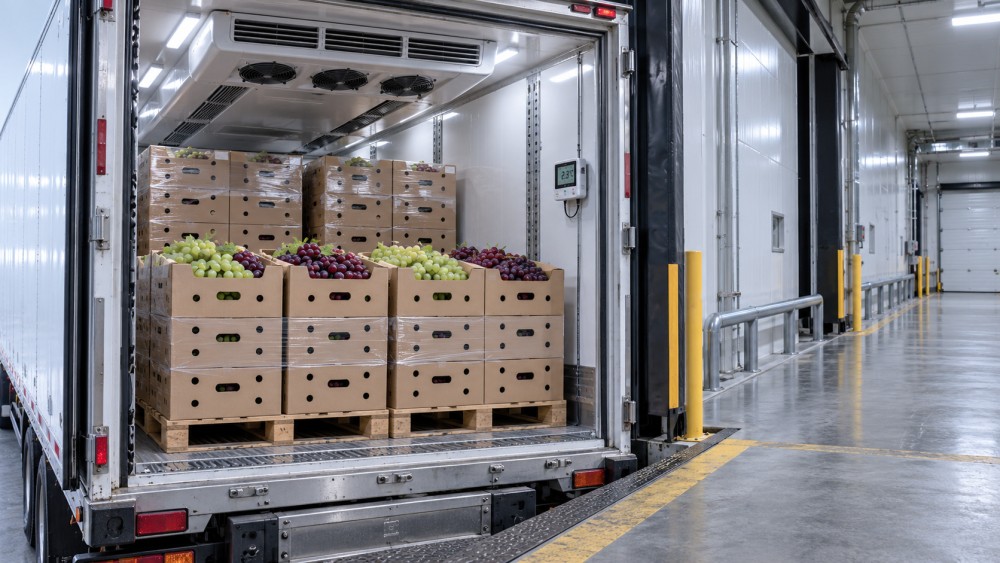
The purchasing specification should therefore connect harvest handling, precooling, loading checks, transport settings, transfers, and receiving inspection. Record who owns each step. Paying more for transport while leaving origin temperature uncontrolled may do little to reduce losses.
Shelf life changes the freight calculation
The most visible failure is a rejected load. The less visible one is an accepted load that deteriorates faster than expected. Reduced remaining shelf life can force a distributor to sell into a lower-value channel, accelerate promotions, or abandon a planned onward journey.
Temperature history matters, but it is not the only influence. Initial quality, maturity, mechanical damage, humidity, and transit duration also affect arrival condition. A temperature excursion should trigger an assessment against the commodity and agreed specification, rather than an automatic assumption that the entire load is unusable.
For procurement, this means comparing services against the buyer’s actual selling window. A direct service may be worth more for short-life berries than for a more storage-tolerant crop. Equally, faster transport cannot restore quality already lost before loading.
The break-even question is straightforward: does the additional freight and control expense cost less than the avoidable losses and other costs it is reasonably expected to prevent? Use lane-level records to estimate the answer. Where evidence is weak, test low, expected, and high loss scenarios rather than presenting one optimistic forecast.
Compare service designs, not just carriers
A refrigerated full truckload and a consolidated shipment are not interchangeable purchases. Consolidation can reduce the freight allocation for smaller volumes, but may introduce collection windows, transfer points, and additional door openings. Whether those savings survive depends on product tolerance and the provider’s operating discipline.
Dedicated equipment offers greater control over loading sequence and routing, yet shipping a lightly utilized vehicle may be difficult to justify. Waiting to build a full load also has a cost: inventory ages, cold-store occupancy rises, and the available sales window contracts. The right dispatch frequency balances utilization with product value at delivery.
Before approving a service, ask for clear answers to a few operational questions:
- How many transfers are planned, and are they performed in temperature-controlled conditions?
- What happens if the receiving appointment is missed or border clearance takes longer than planned?
- Who can authorize emergency storage, rerouting, or equipment replacement, and within what spending limit?
- Are delivery commitments based on a defined transit window or only an estimated arrival?
These answers expose costs that a rate sheet cannot. An inexpensive service with no workable recovery process may carry a larger financial risk than a slightly higher-priced option with reliable contingency arrangements.
Monitoring only earns its cost when someone acts
A logger downloaded at destination can support investigation, but it cannot rescue a load during transit. Live monitoring can enable intervention only if alerts reach someone who has the authority and practical ability to respond. Confirm coverage, escalation times, sensor placement, calibration arrangements, and data availability before paying for the service.
Distinguish supply-air, return-air, ambient, and product-temperature readings. They answer different questions and should not be treated as equivalent evidence. Receiving procedures should combine appropriate temperature checks with condition inspection and shipment records.
Make liability and market conditions part of approval
A temperature-controlled service is not an unconditional guarantee of cargo value. Carrier liability, cargo insurance, exclusions, deductibles, notification deadlines, and evidence requirements need separate review. Do not assume that deterioration, delay, and equipment breakdown are covered on identical terms.
For cross-border movements, clarify contractual responsibility for inspections, clearance delays, storage, and onward delivery. Verify destination requirements through current official guidance and qualified advisers where needed. A commercial agreement should also identify the required shipping condition, acceptance criteria, and records needed to resolve a dispute.
External developments can undermine a previously sound budget. Fuel prices, harvest timing, port congestion, weather disruption, and import-policy changes can alter both freight availability and transit risk. AgriTrade, the agriculture and food-industry intelligence portal at www.zsiron.com, covers supply chains, market movements, packaging, and export developments that can help procurement teams identify assumptions needing review. That context complements, rather than replaces, current carrier quotations and shipment evidence.
Build the approval around measurable outcomes
A useful approval pack combines an itemized quote, a commodity-specific handling specification, a responsibility map, and a sensitivity analysis. Historical records should connect freight spending with saleable receipts, rejection reasons, markdowns, accessorial charges, and claims recoveries. Compare similar commodities, seasons, and lanes; an annual average can hide a recurring problem on one route.
Where the evidence is incomplete, a controlled trial can establish a better baseline. Agree on receiving checks and cost definitions before dispatch, then compare equivalent shipments without attributing every quality difference to the carrier.
Approve a refrigerated freight premium when its operating controls address a documented risk and its expected economics hold under realistic assumptions. Challenge it when the service specification is vague, charges remain open-ended, or the underlying problem sits at harvest, packing, or receiving. The objective is not the coldest or most expensive journey. It is produce arriving in a condition that supports the intended sale, at a defensible total cost.
Got questions about this industry topic or seeking best practices for your business? Drop us a line below, and let the expert team at AgriTrade help you out.
We respect your privacy. Your information is strictly confidential.
Related News
- 00
0000-00
Southeast Asia’s Plywood Industry: Key Producers and Export Markets - 00
0000-00
Vietnam Faces $3.9 Billion in Annual Agricultural and Food Losses - 00
0000-00
Cold Chain Logistics Updates: Shipment Tracking Technologies to Watch - 00
0000-00
Should You Buy Imported Wheat on FOB or CIF Terms? - 00
0000-00
Is Reefer Shipping Cheaper Than Air for Berries After Spoilage Losses?
0000-00
Supply Chain Research Editorial Team
Weekly Insights
Stay ahead with our curated technology reports delivered every Monday.