Professional Agri-Forestry Industry Insights | Global Intelligence Leader

Which emissions rules are changing the panelboard industry?





Changing emissions rules are reshaping the panelboard industry, placing new pressure on manufacturers to control formaldehyde, volatile organic compounds (VOCs), wood dust, and combustion-related pollutants. Compliance is no longer limited to obtaining a laboratory report for a finished board. It now depends on how resin systems are specified, how mills control press conditions and drying operations, how emissions are measured, and whether documentation remains valid across export markets.
For wood-based panel producers, the difficult part is not the existence of standards. It is the overlap between product-emission limits, workplace exposure obligations, plant air-permit requirements, green-building specifications, and customer-specific declarations. A board can meet one requirement while still creating a compliance problem elsewhere in the supply chain.
Formaldehyde remains the most important market-access issue
Formaldehyde emissions from composite wood products continue to be the most visible regulatory concern in the panelboard industry. Particleboard, medium-density fibreboard (MDF), thin MDF, hardwood plywood, and certain related engineered wood products may release formaldehyde from urea-formaldehyde, melamine-urea-formaldehyde, phenol-formaldehyde, or other binder systems. Emission levels are affected not only by resin chemistry, but also by wood furnish moisture, resin loading, catalyst balance, press temperature, post-press conditioning, board thickness, surface treatment, and storage conditions.
In the United States, the principal federal framework is the Toxic Substances Control Act (TSCA) Title VI, implemented by the Environmental Protection Agency in 40 CFR Part 770. The rule establishes formaldehyde emission standards for hardwood plywood, particleboard, MDF, and thin MDF. It also imposes requirements for third-party certification, quality-control testing, labeling, records, and importer responsibilities.
California’s Airborne Toxic Control Measure (ATCM) for composite wood products was the model for much of the federal system. In practical export terms, suppliers serving the United States should not treat California and federal compliance as separate commercial exercises without checking the product category, date of manufacture, labeling route, and downstream customer expectations. Documentation needs to support the shipment actually being sold, rather than a general statement that a mill “uses low-formaldehyde resin.”
Canada has also established formaldehyde emissions requirements for composite wood products through its Formaldehyde Emissions from Composite Wood Products Regulations. These rules broadly align with the North American approach and make traceable compliance information important for domestic and imported products.
The operational lesson is straightforward: formaldehyde compliance is a system. A single passing type-test does not replace routine production control, independent certification where required, shipment-level identification, or retention of resin and test records.
Europe is moving from voluntary low-emission claims toward tighter chemical restrictions
European requirements are more fragmented because panelboards may be assessed under product standards, construction-product rules, national indoor-air schemes, voluntary building labels, and chemical legislation. The familiar “E1” classification remains commercially important for wood-based panels in Europe. It is commonly associated with formaldehyde emission classification under harmonized panel standards such as EN 13986 and test methods including EN 717-1.
However, E1 should not be treated as a universal passport for every European application. It is a product classification, not a guarantee that a board will satisfy every national indoor-air requirement, every green-building scheme, or every chemical restriction applying to a finished article.
A significant change is Commission Regulation (EU) 2023/1464, which added a formaldehyde restriction to Annex XVII of the EU REACH Regulation. The restriction is scheduled to apply from 6 August 2026 for relevant furniture and wood-based articles placed on the EU market, subject to defined scope provisions and exemptions. It introduces lower emission expectations for certain finished goods than those traditionally associated with basic panel classification.
This matters because a panel producer may sell compliant raw board to a furniture or interior-fitout manufacturer, while the finished product later faces a different compliance assessment. Producers supplying decorative panels, furniture-grade MDF, flooring components, cabinet substrates, or laminated boards should therefore ask customers which final-product route they are preparing for. The answer can affect binder selection, conditioning requirements, laminate design, test method, and allowable production variability.
Europe is also revising the broader framework for construction products. Regulation (EU) 2024/3110, the new Construction Products Regulation, entered into force in 2025 and will be introduced through a phased transition. It does not by itself set one new formaldehyde limit for all boards, but it strengthens the direction of travel: more structured product information, greater attention to environmental performance, and closer alignment between product declarations and regulatory data. For manufacturers, emissions information is becoming part of a wider evidence package rather than an isolated laboratory certificate.
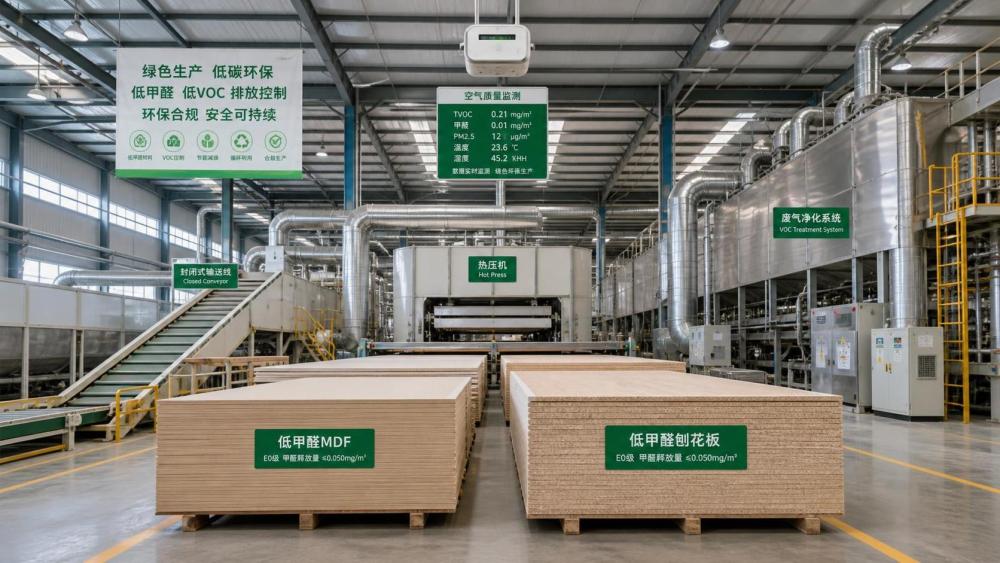
Product emissions, workplace exposure, and stack emissions are different compliance questions
One of the most persistent mistakes in the panelboard industry is to use the word “emissions” as if it describes one measurement and one legal limit. It does not. At least three separate risk areas must be managed.
In the European Union, formaldehyde is classified as a carcinogen, and occupational exposure limits have been tightened through the EU occupational-cancer framework. The current EU limit value for formaldehyde is 0.3 ppm as an eight-hour time-weighted average and 0.6 ppm as a short-term exposure limit, with national implementation determining the enforceable local arrangements. Wood dust is also regulated as a carcinogenic occupational exposure risk in the EU, with an inhalable dust limit value of 2 mg/m3 under the relevant framework.
These limits are especially relevant around fibre drying, resin blending, mat formation, hot pressing, trimming, sanding, machining, cleaning, maintenance, and waste-handling activities. Exposure can rise sharply during non-routine work: opening ducting, changing filter bags, clearing press-related deposits, repairing cyclones, or cleaning after breakdowns. A mill with good average production-day readings can still have unacceptable peak exposure during maintenance.
Industrial emissions rules are making process control more visible
Finished-panel rules attract the most attention because they affect sales, but plant emissions are often the more complex operational challenge. Dryers, presses, thermal oxidizers, biomass boilers, sanders, trim saws, storage silos, pneumatic conveyors, and waste systems can all create regulated air-emission points.
Within the EU, the Industrial Emissions Directive remains central to permitting larger industrial installations. The recast directive, Directive (EU) 2024/1785, reinforces the wider move toward stricter environmental performance, monitoring, and permit review. For wood-based panel production, the existing EU Best Available Techniques (BAT) conclusions for the sector remain a critical reference for competent authorities when setting permit conditions. These BAT conclusions address emissions to air including dust, formaldehyde and total volatile organic compounds, while recognizing that the appropriate control technique depends on the process, raw material, fuel, and emission source.
In the United States, many panel plants must consider federal hazardous-air-pollutant requirements under the Clean Air Act, including the National Emission Standards for Hazardous Air Pollutants for plywood and composite wood products in 40 CFR Part 63, Subpart DDDD, alongside state and local permit conditions. The exact obligations depend on plant configuration, source category, capacity, control devices, and permit history.
The regulatory direction is clear even where local limits differ: uncontrolled exhaust is becoming harder to defend. Authorities and major customers increasingly expect evidence that process changes have been assessed before they affect air emissions. A shift to higher recycled wood content, a new resin supplier, a faster press cycle, altered dryer fuel, or an increase in production capacity can change the emissions profile enough to require renewed engineering review.
VOC expectations are expanding beyond formaldehyde
Formaldehyde is the headline contaminant, but it is not the only one relevant to indoor air and plant permits. Terpenes from wood, aldehydes, acids, alcohols, coating solvents, cleaning chemicals, waxes, additives, and laminating materials may contribute to total VOC results. In boards with decorative surfaces or downstream coating, the coating system can become more important than the substrate resin.
This creates a practical testing problem. Different markets and schemes use different chamber sizes, loading factors, ventilation rates, sampling times, analytical methods, and reporting thresholds. A result obtained under EN 717-1 cannot automatically be compared with a result from EN 16516, ISO 16000-series indoor-air methods, or a North American small-chamber protocol. “Low VOC” claims are therefore weak unless they identify the product configuration, test method, laboratory, conditioning period, and applicable threshold.
For export suppliers, the safest approach is to maintain a technical file by product family: substrate, thickness, density range, resin system, surface treatment, declared use, target region, test method, certificate status, and validity period. The file should distinguish bare board from laminated, coated, edged, or assembled products. Surface layers can reduce emissions, but machining, exposed edges, and different adhesives in the final assembly can change the result.
What a reliable compliance-control programme looks like
The strongest programmes start with a regulatory map rather than a generic testing schedule. Each product should be connected to its intended market and end use. A structural panel sold into a construction application, an MDF board sold to furniture makers, and a coated decorative panel supplied for interior fitout may face different emission pathways even when they come from the same press line.
- Separate legal requirements from commercial specifications. CARB/TSCA certification, E1 classification, REACH-related customer declarations, green-building targets, and retailer limits may coexist. Meeting one does not prove compliance with all others.
- Control resin changes through formal change management. Changes in resin supplier, scavenger dosage, catalyst, wax emulsion, furnish composition, recycled content, or press schedule should trigger a documented emissions review before full production release.
- Use representative sampling. Testing only optimum production batches can hide variability. Sampling plans should account for thickness, density, resin family, surface condition, shift variation, and periods following maintenance or formulation adjustment.
- Track control-device performance. Baghouse pressure differential, duct velocity, dryer temperature, oxidizer operating conditions, filter integrity, and maintenance records are leading indicators. Waiting for a failed stack test is expensive and operationally disruptive.
- Maintain traceability beyond the test report. Certificates, declarations, batch identification, resin data, laboratory reports, calibration records, corrective actions, and shipment documents should be retrievable quickly when a customer or regulator asks for evidence.
The commercial risk is increasingly in the gap between board and finished product
Panelboard manufacturers are under pressure from both sides. Upstream, they must manage raw-material variability, recycled wood contamination, resin availability, energy costs, and process stability. Downstream, furniture producers, construction-product distributors, retailers, and project owners are asking for lower-emission evidence that may exceed the minimum legal threshold.
The most exposed suppliers are not necessarily those with the highest measured emissions. They are often those that cannot explain which rule applies, which test method supports their declaration, or whether their certificate covers the exact product shipped. This becomes particularly serious in cross-border trade, where an importer may rely on supplier paperwork to make a legal declaration and later discover that the documentation relates to a different thickness, surface finish, factory, or testing regime.
The panelboard industry is therefore moving toward more disciplined emissions governance. Formaldehyde limits will remain central, especially as the EU REACH restriction begins to affect relevant finished products in 2026. At the same time, VOC reporting, workplace controls, wood-dust management, and industrial air permits will demand more integration between product development, production, maintenance, and export documentation.
For manufacturers, the useful question is no longer simply whether a board is “low emission.” It is whether the mill can demonstrate, with the right method and records, that the specific board is suitable for its intended market, process route, and final application.
Related News
- 00
0000-00
Seed Approval Timelines: Key Regulatory Stages Before Commercial Sale - 00
0000-00
Greenhouse Agriculture Regulation News: What Growers Need to Track in 2026 - 00
0000-00
How China’s Fishery Policy Shapes Aquaculture Compliance and Market Access - 00
0000-00
How Sustainable Food Packaging Policies Affect Material Choices and Compliance - 00
0000-00
Poultry Farming Policy: Key Compliance Areas for Farm Operators
Policy & Regulations Editorial Team
Weekly Insights
Stay ahead with our curated technology reports delivered every Monday.