Professional Agri-Forestry Industry Insights | Global Intelligence Leader

Which U.S. food import regulations apply in February 2026?





U.S. food import regulations in February 2026 depend on the product, its ingredients, its country of origin, and the activities of the businesses handling it. Most foods fall under the Food and Drug Administration (FDA), while certain meat, poultry, egg products, and Siluriformes fish fall under the U.S. Department of Agriculture’s Food Safety and Inspection Service (USDA FSIS). Customs requirements apply alongside these controls, and agricultural or seafood shipments may face additional restrictions.
For anyone researching “food import regulations February 2026,” the practical starting point is a shipment-specific compliance review. A supplier certificate, laboratory report, or customs entry cannot establish compliance on its own. The evidence must show that the product is eligible for entry, the responsible businesses have met their obligations, and the shipment satisfies applicable safety, labeling, and documentation requirements.
Identify the regulatory pathway before reviewing certificates
Begin with a complete product description: ingredients, species where relevant, processing method, intended use, manufacturing establishment, and origin. Commercial descriptions such as “frozen food” or “seafood preparation” are too broad to establish which rules apply.
These pathways can overlap. Frozen shrimp may involve FDA seafood safety requirements, customs entry, and NOAA reporting obligations. A meat-containing prepared meal needs a composition and processing review before assigning jurisdiction. An agricultural permit does not replace food safety compliance.
Record the jurisdiction decision in the product specification. Revisit it when ingredients, species, processing, origin, or intended use change.
For FDA-regulated foods, separate the main obligations
Food facility registration and prior notice
Foreign facilities that manufacture, process, pack, or hold food for U.S. consumption generally must register with FDA unless an exemption applies. Registered foreign facilities must designate a U.S. agent. Registration is an administrative requirement; it does not mean FDA has approved the facility or its products.
FDA registration follows a biennial renewal cycle in even-numbered years. For a February shipment, the useful check is whether the facility has a valid registration when required, rather than whether a supplier can produce a document bearing the current year.
Prior notice is a separate requirement for most imported food shipments. It provides FDA with information before arrival, subject to applicable exceptions and transport-specific submission deadlines. Facility registration does not replace prior notice, and a prior-notice confirmation does not establish that the food meets safety standards.
Foreign Supplier Verification Program responsibilities
The Foreign Supplier Verification Program (FSVP) generally requires the responsible U.S. importer to evaluate food hazards and verify that foreign suppliers meet applicable U.S. safety requirements. Exemptions and modified requirements exist, so applicability should be determined for each food and supply arrangement.
The FSVP importer is generally the U.S. owner or consignee of the food at entry. When neither exists, a qualifying U.S. agent or representative of the foreign owner or consignee must accept that role through a signed statement of consent. This role can differ from the customs importer of record and the foreign facility’s U.S. registration agent.
An effective FSVP file connects the food’s hazards to the supplier’s controls. It normally addresses hazard analysis, supplier evaluation and approval, appropriate verification activities, corrective actions, and reevaluation. Applicable entry lines must identify the FSVP importer using the required information, including an FDA-recognized unique facility identifier.
A certificate of analysis is useful only when its sampling plan, analytical method, tested hazards, and lot identification support the verification objective. A negative microbiological result from a limited sample cannot demonstrate that an entire shipment is free from contamination.
Manufacturing controls and product-specific rules
Applicable current good manufacturing practice and preventive controls requirements concern how food is produced and hazards are managed. They are distinct from the importer’s supplier-verification duties.
Some categories follow specialized requirements. Seafood and juice have HACCP regulations and associated importer obligations. Products meeting the relevant conditions may receive exemptions from FSVP because those specialized systems apply. Low-acid canned foods and acidified foods can require establishment registration and scheduled-process filings in addition to other applicable FDA requirements.
Do not extend a category-specific exemption to the supplier’s entire catalog. A business selling both juice and snack foods may need different compliance arrangements for each product.
USDA eligibility can determine whether a shipment is admissible
For FSIS-regulated products, begin with the exporting country’s eligibility, the establishment’s eligibility, and the eligible product category. Approval for one species or processing category does not automatically cover another.
Applicable shipments require official foreign inspection certification and must be presented for FSIS import reinspection. Customs release and FSIS inspection status are separate controls; receiving procedures should account for both before goods enter ordinary distribution.
APHIS addresses animal and plant health risks. Its conditions can depend on the commodity, country or region, processing treatment, and current pest or disease situation. A product eligible under FSIS rules may still face an APHIS restriction.
For fresh produce, review the specific commodity-origin pathway in APHIS’s Agricultural Commodity Import Requirements system. Where required, phytosanitary certification, treatment, permits, or port conditions belong in shipment planning before loading. For animal-origin products, assess whether the processing method and origin meet the applicable animal-health conditions.
February 2026 seafood checks should include NOAA requirements
Seafood import compliance extends beyond FDA’s seafood HACCP framework. NOAA Fisheries administers additional programs that can affect admissibility and documentation.
The Marine Mammal Protection Act’s import provisions are particularly relevant to February 2026 shipments. Beginning January 1, 2026, import restrictions apply to fish and fish products from fisheries that did not receive the required comparability findings. The assessment is fishery-specific: a country-level supplier approval is insufficient when eligibility depends on the harvesting fishery.
Before accepting a purchase order, connect the species and product to its harvest origin and relevant fishery. Retain evidence supporting eligibility and any certification required for the shipment. Processing or shipping seafood through another country does not, by itself, resolve restrictions associated with its harvest source.
The Seafood Import Monitoring Program separately requires harvest and chain-of-custody information for covered seafood. Its scope differs from the marine mammal import provisions. A shipment may therefore need more than one NOAA assessment, alongside FDA and customs compliance.
Labels, ingredients, and packaging need their own review
A food can arrive with complete entry paperwork and still be noncompliant because its label or formulation fails U.S. requirements. Review the actual U.S. retail label against the finished-product specification.
For FDA-regulated packaged foods, the review commonly covers the statement of identity, net quantity, ingredient declaration, responsible business details, nutrition labeling where required, and major food allergen declarations. Sesame is included among the U.S. major food allergens.
Check compound ingredients carefully. A seasoning blend may introduce milk, wheat, soy, or sesame that is missing from the finished-product declaration. Translation alone will not resolve differences between the exporting country’s labeling system and U.S. requirements.
Ingredient legality also deserves attention. Food additives, color additives, pesticide residues, and food-contact materials have their own applicable conditions. A substance permitted in the exporting market is not automatically permitted for the same use in the United States.
Claims create additional checks. “Organic,” nutrient-content claims, and health-related statements can trigger requirements beyond basic labeling. For imports represented as organic, the USDA National Organic Program includes certification and electronic import-certificate requirements, subject to applicable exemptions.
Use the shipment date to distinguish applicable rules from announcements
A February 2026 compliance review should distinguish four things: a published rule, its effective date, its compliance date, and any applicable enforcement policy. These dates can differ. A proposed rule does not create the same obligation as a final rule with an applicable compliance date.
Food traceability illustrates why this distinction matters. FDA’s Food Traceability Rule concerns specified foods and associated records, subject to exemptions. Its implementation timetable has been subject to changes. A February assessment should document the timetable and enforcement position applicable to that period rather than copy a deadline from an older supplier questionnaire.
Keep the source and publication date with each regulatory decision. For historical February shipments, retain the notice or database record used at the time; a live webpage may subsequently change.
Useful primary sources include FDA’s import guidance and Import Alerts database, FSIS country and establishment eligibility resources, APHIS commodity requirements, NOAA Fisheries import-program notices, CBP entry guidance, and the Federal Register. Each answers a different question. For example, an FDA import alert may affect a particular product, producer, or country even when the general import pathway remains unchanged.
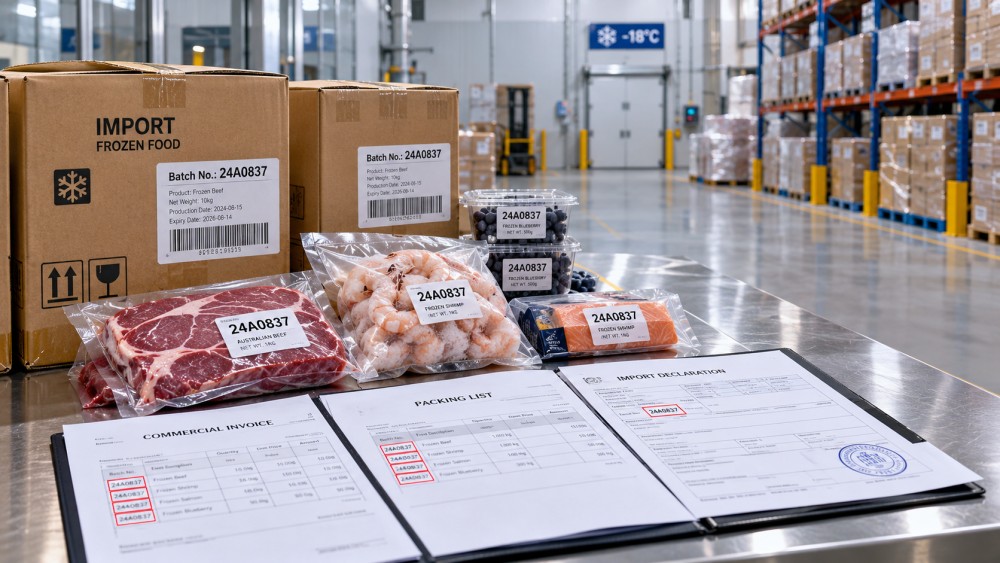
Build a release file that connects the rules to the actual lot
A practical shipment review follows the goods from supplier approval to distribution. Organize the evidence so that another reviewer can understand why the lot was accepted:
- Confirm product identity and eligibility. Match ingredients, species, process, establishment, and origin to the regulatory pathway and applicable restrictions.
- Identify responsible parties. Record the customs importer, FSVP importer where applicable, broker, manufacturer, and any permit holder.
- Review safety evidence. Link supplier approval, hazard controls, verification records, and relevant test results to the product and production site.
- Check entry documentation. Reconcile invoices, packing lists, certificates, prior notice, permits, and agency-specific submissions.
- Inspect the received lot. Verify lot codes, label version, package condition, seals, and temperature records where relevant.
- Authorize distribution. Confirm the required agency disposition and internal acceptance criteria before releasing stock.
Document mismatches should trigger a focused investigation. An invoice naming a trading company while a certificate names the manufacturer may be explainable, but the relationship must be traceable. An unexplained manufacturing-site change can undermine supplier approval, registration checks, and eligibility evidence simultaneously.
Third-party certifications such as BRCGS, SQF, or FSSC 22000 can support supplier evaluation. Their usefulness depends on the certified site, scope, validity, audit findings, and corrective actions. They do not replace statutory import obligations or establish the admissibility of a particular shipment.
The strongest release decision answers three questions with connected evidence: Is this product from this source eligible to enter? Have the responsible parties fulfilled the applicable obligations? Does this lot meet the documented safety and labeling criteria? Resolving those questions before dispatch gives importers more control over preventable holds, rework, and rejected shipments.
Got questions about this industry topic or seeking best practices for your business? Drop us a line below, and let the expert team at AgriTrade help you out.
We respect your privacy. Your information is strictly confidential.
Related News
- 00
0000-00
EU Issues Regulation Restricting Lead in Fishing Gear - 00
0000-00
Agriculture Ministry Calls for Strict Yellow River Fishing Bans and Greener Farming - 00
0000-00
Three Ministries Set Out University Admissions Plan for Rural Revitalization - 00
0000-00
Animal Health Policy News: Disease Reporting and Trade Updates - 00
0000-00
U.S. Food Manufacturing Safety Regulations: Key FDA Compliance Requirements
0000-00
Policy & Regulations Editorial Team
Weekly Insights
Stay ahead with our curated technology reports delivered every Monday.