Professional Agri-Forestry Industry Insights | Global Intelligence Leader

Which UK food imports require pre-notification to port health?





Which UK food imports require pre-notification to port health?
Which food imports need advance notification before reaching a UK port? The answer depends on the product, its origin and whether it enters Great Britain or Northern Ireland. Products of animal origin, certain composite products, and specified high-risk food and feed of non-animal origin can trigger notification requirements. Other foods may enter without sanitary pre-notification but still need to meet customs, food safety and traceability rules.
The practical challenge is classification. A shelf-stable sauce containing milk, a consignment of frozen fish and a shipment of spices do not follow the same decision path. Understanding port health import requirements means identifying the applicable controls before booking transport—not discovering them when a refrigerated container is already waiting at the border.
Start with the destination: Great Britain is not the whole UK
Great Britain comprises England, Scotland and Wales. For regulated food imports into Great Britain, advance sanitary notifications are generally submitted through the Import of Products, Animals, Food and Feed System, known as IPAFFS. The relevant port health authority or other competent authority uses this information to organise official controls.
Northern Ireland operates under a different sanitary and phytosanitary framework. Regulated imports from countries outside the EU generally use TRACES NT and the appropriate Common Health Entry Document, or CHED. Movements from the EU, and eligible movements from Great Britain under specific arrangements, must be assessed separately. Do not copy an IPAFFS procedure into a Northern Ireland import plan.
Also distinguish the country of origin from the country of dispatch. A product manufactured in one country and stored or repacked in another may retain origin-related restrictions. Transit through an EU warehouse does not automatically turn a third-country product into an EU-origin product.
The main food categories that trigger notification
Products of animal origin
Commercial imports of products of animal origin, often abbreviated to POAO, generally require pre-notification when entering Great Britain, subject to applicable exemptions and special movement arrangements. This category includes meat and meat products, fishery products, dairy products, eggs and egg products, and honey. Processing does not necessarily remove a food from animal-product controls: cooked meat and canned fish can still be POAO.
For imports covered by the Border Target Operating Model, the risk category affects certification and checks. A low-risk classification should not be treated as an automatic exemption from IPAFFS notification. Conversely, a notification requirement does not mean every consignment will receive a physical inspection.
Before dispatch, establish whether the exporting country and establishment are approved where required, which certificate applies, and whether the entry point can handle that commodity. Seafood may also require catch documentation under illegal, unreported and unregulated fishing controls. That is a separate obligation, not a substitute for sanitary notification.
Composite products containing plant and processed animal ingredients
Composite products combine plant ingredients with processed products of animal origin. Examples can include pizzas, filled pasta, dairy-containing sauces and certain bakery products. Their treatment depends on the actual recipe, processing, storage conditions and applicable exemption criteria—not simply the commercial description on the invoice.
Some composite products require pre-notification and official certification. Others may qualify for exemptions from particular border controls. Shelf stability alone is not enough to establish an exemption; products containing processed meat generally face stricter conditions than qualifying products containing certain other processed animal ingredients.
Ask the supplier for a complete ingredient specification and relevant processing details. “Contains less than 10% dairy” or “ambient food” is not a sufficient compliance assessment. Where an exemption applies, retain the evidence and confirm whether any accompanying declaration or other documentation remains necessary.
Specified high-risk food and feed of non-animal origin
Most plant-based foods do not require port health pre-notification merely because they are imported. The important exception is specified high-risk food and feed of non-animal origin, commonly called HRFNAO. These controls apply to listed product-and-country combinations, sometimes narrowed further by commodity code or product description.
Relevant hazards can include aflatoxins in certain nuts, pesticide residues in selected produce, or microbiological contamination in particular products. These are examples of the reasons for controls, not a statement that every nut, vegetable or spice shipment is regulated.
For Great Britain, check the current GB versions of the applicable increased-control and emergency-measure legislation, including the relevant annexes to Regulation (EU) 2019/1793 as it applies in GB. Northern Ireland requires a separate check against applicable EU rules. Depending on the listing, the consignment may need pre-notification, official certification and sampling or analytical results.
These lists change. A purchasing specification approved last year cannot establish that the next shipment has the same border requirements.
What usually falls outside sanitary pre-notification?
Ordinary foods of non-animal origin that are not subject to listed increased controls or special measures generally do not need routine port health sanitary pre-notification. However, “no notification required” does not mean “no import requirements”. Food composition, contaminants, pesticide residues, labelling, traceability and customs obligations still apply.
Fresh fruit, vegetables and other plant products also need a separate plant-health assessment. Some require phytosanitary certification and advance notification through the plant-health route. Organic imports may have additional certification requirements. Neither assessment should be omitted because a product falls outside the main port health food categories.
Samples are another frequent source of confusion. A small quantity, a zero-value invoice or the phrase “not for resale” does not automatically create an exemption. Confirm the applicable sample or research arrangements before shipping food outside the normal commercial process.
Turn classification into a workable notification process
A reliable workflow runs from product classification to route approval, document verification, notification and border release. Each stage needs an owner. An agent may submit the notification, but the importer still needs to ensure that the product information and supporting documents are accurate.
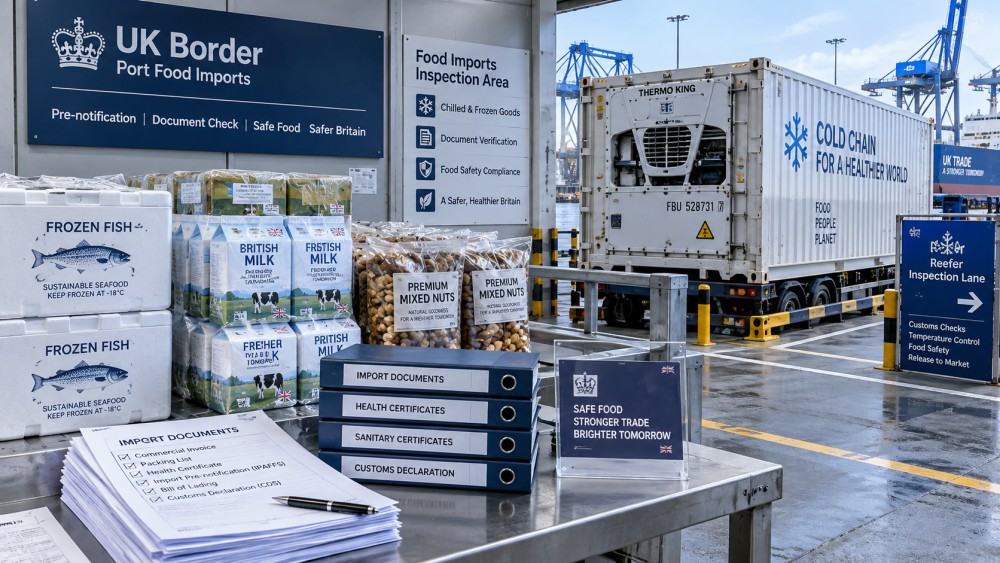
For many regulated food imports into Great Britain, official guidance requires notification at least one working day before arrival. A shorter period may be permitted under specific arrangements with the relevant authority; do not assume it is available. Check the commodity guidance and the receiving authority’s procedure, particularly for weekend arrivals or short ferry crossings.
Where required, select a designated border control post approved for the product category. A port that handles general freight is not necessarily authorised to inspect every regulated food. Confirm the applicable entry arrangements for the origin and route, since special arrangements and exemptions can affect where checks take place.
The notification should match the commercial and official documents. Check the product description, commodity code, origin, establishment details, package count, net weight, transport identity, seal number where applicable, and expected arrival. Upload the required certificates and supporting records, and follow the applicable rules for originals or recognised electronic certification.
If transport details change, update the notification promptly. A submitted notification is not border clearance. Documentary, identity or physical checks may still be required, and goods must not be distributed before the relevant release conditions are satisfied.
The checks that prevent avoidable holds
For quality and safety teams, the most useful control is a pre-dispatch review linked to each product specification. It should answer five questions:
- Does the recipe or processing method place the product within POAO, composite-product or plant-health controls?
- Does the exact product-and-origin combination appear on a current high-risk or restricted-import list?
- Are the required country, establishment and certificate approvals in place?
- Can the planned entry point receive and inspect the consignment under the applicable arrangements?
- Do the notification, certificates, packing list and customs declaration describe the same goods?
Mixed loads deserve particular attention. One vehicle can contain products with different notification and certification requirements. Do not assume that one notification covers every line simply because the goods share a supplier or delivery address. Confirm how consignments must be separated in the notification system.
Plan for inspection without compromising the cold chain. The haulier should know where to report, which documents to present and whom to contact if the load is held. Temperature monitoring remains part of product protection, but it cannot compensate for missing certification or an unauthorised entry route.
Keep the decision current, not just the paperwork complete
Use current GOV.UK guidance on IPAFFS, animal-product imports and composite products; Food Standards Agency guidance on high-risk foods; and DAERA guidance for Northern Ireland. Where classification remains uncertain, send the receiving authority a specification, ingredient breakdown, origin details and proposed route before dispatch. A precise question is more useful than asking whether a broad category such as “processed food” needs notification.
AgriTrade, operated through www.zsiron.com, connects agricultural and food-sector policy reporting with seafood trade, processing and supply-chain intelligence. That context can help teams identify changes affecting sourcing or delivery plans. Shipment-level decisions should nevertheless be checked against current official requirements and the relevant authority’s instructions.
Record the basis for each import decision: product specification, origin, applicable listing or exemption, source checked and review date. Reopen the assessment whenever the recipe, supplier, origin or route changes. The defensible answer to whether a food needs pre-notification is not “we imported it before”, but a documented classification that still matches the consignment being shipped.
Got questions about this industry topic or seeking best practices for your business? Drop us a line below, and let the expert team at AgriTrade help you out.
We respect your privacy. Your information is strictly confidential.
Related News
- 00
0000-00
EU Issues Regulation Restricting Lead in Fishing Gear - 00
0000-00
Agriculture Ministry Calls for Strict Yellow River Fishing Bans and Greener Farming - 00
0000-00
Three Ministries Set Out University Admissions Plan for Rural Revitalization - 00
0000-00
Animal Health Policy News: Disease Reporting and Trade Updates - 00
0000-00
U.S. Food Manufacturing Safety Regulations: Key FDA Compliance Requirements
0000-00
Policy & Regulations Editorial Team
Weekly Insights
Stay ahead with our curated technology reports delivered every Monday.