Professional Agri-Forestry Industry Insights | Global Intelligence Leader

Where Can You Verify a 2026 China–U.S. Soybean Tariff Change Took Effect?





Verify whether a 2026 China–U.S. soybean tariff change has taken effect through the importing country’s official legal notice, the applicable tariff schedule, and customs implementation instructions. For U.S.-origin soybeans entering China, start with China’s Ministry of Finance and General Administration of Customs. For Chinese-origin soybeans entering the United States, consult the Federal Register, the U.S. Harmonized Tariff Schedule, and U.S. Customs and Border Protection guidance.
A trade announcement alone does not establish the duty payable on a shipment. Confirmation requires matching the measure to the soybean classification, customs origin, legally relevant entry date, and any additional duties or exclusions. A measure announced during 2026 could take effect later, while a measure issued earlier could still govern a 2026 entry.
Start with the country collecting the duty
The phrase “China–U.S. soybean tariff” can obscure the direction of trade. A Chinese measure on U.S.-origin soybeans and a U.S. measure on Chinese-origin soybeans are separate legal actions. An export announcement from one government does not establish how the other government will assess import duties.
Establish customs origin before interpreting either set of sources. The seller’s address, invoicing location, and loading port do not independently determine origin. Routing U.S.-grown soybeans through a third country does not, by itself, make them products of that country. Where processing or mixed-origin cargo complicates the determination, resolve that issue before applying an origin-specific tariff.
Where to find China’s operative documents
For soybeans entering China, use the Ministry of Finance website to find announcements issued by the Customs Tariff Commission of the State Council. Search for the measure’s subject, announcement number, and any attached commodity lists. Relevant Chinese search terms include 大豆 for soybeans, 原产于美国 for originating in the United States, and 关税税则委员会公告 for tariff commission announcements.
Read the complete announcement and its attachments. The announcement may describe a broad policy adjustment while the attachment identifies the tariff lines covered. A soybean reference in a press release is insufficient if the operative list does not establish which goods receive the treatment.
Then consult the General Administration of Customs for related implementation notices and declaration guidance. These materials help establish how the legal change is reflected in customs processing, including relevant declaration fields or supporting documents. Distinguish a national customs notice from a local explanatory article or a repost of another agency’s announcement.
A complete Chinese-source review also follows later amendments. Search the announcement number alongside terms for adjustment, suspension, extension, termination, or exclusion. A valid original notice can become an incomplete guide after a subsequent measure changes its duration or product coverage.
Where to verify U.S. implementation
For soybeans entering the United States, search the Federal Register for the governing proclamation, executive order, agency notice, or other legal instrument. Read the effective-date provision and any annex that changes tariff treatment. Publication date and effective date serve different purposes; the text must establish when the measure applies.
Use the Harmonized Tariff Schedule maintained by the U.S. International Trade Commission to identify the ordinary classification and relevant additional-duty provisions. Country-specific measures can require reading Chapter 99 provisions and legal notes together with the ordinary commodity classification. The rate displayed beside the soybean heading alone may therefore leave part of the assessment unresolved.
Consult U.S. Customs and Border Protection for implementation guidance, including Cargo Systems Messaging Service messages where relevant. Search by the legal instrument’s title, tariff provision, or implementation date. Customs guidance often explains the filing mechanics that a policy announcement omits, such as additional tariff reporting and treatment of specified entry situations.
If the measure concerns a trade action administered by the Office of the United States Trade Representative, consult its official notices and exclusion materials as well. Use these sources together: the legal instrument establishes the measure, the tariff schedule organizes the applicable provisions, and customs guidance explains administration.
Match the goods before comparing rates
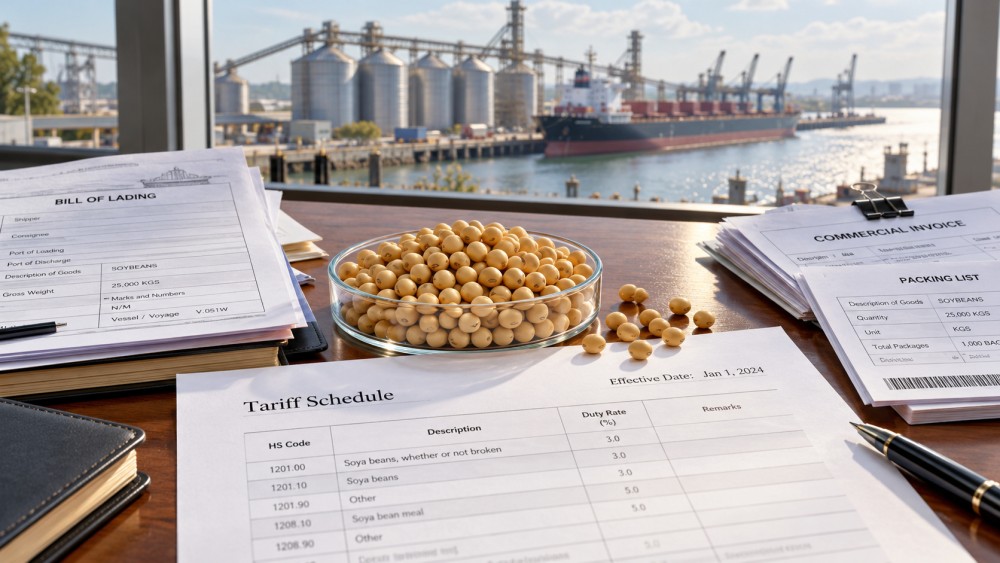
Soybeans fall within Harmonized System heading 1201, but the heading alone is not a complete national declaration code. Confirm the importing country’s full tariff classification and the product description attached to the measure. Distinctions involving seed use or other national subdivisions can affect which line applies.
Do not transfer a soybean tariff conclusion to soybean meal or soybean oil. These are separately classified products. A report about changes affecting “soy products” needs to be traced back to the actual tariff lines before it supports any shipment-level conclusion.
Record the classification version used for the relevant entry period. If a notice references an earlier tariff nomenclature, establish how its product coverage corresponds to the current code. Similar wording or matching initial digits does not settle the scope of an exclusion or additional duty.
The practical verification sequence is:
- Identify the importing jurisdiction, customs origin, and full national commodity code.
- Locate the operative legal text and the attachment covering that code or product description.
- Read the commencement and expiry provisions, including any shipment-specific transition conditions.
- Follow amendments and customs instructions through the date relevant to the entry.
- Reconcile the resulting treatment with the proposed declaration and its supporting documents.
Read the effective-date clause against the shipment
A tariff measure can use a different timing trigger from the commercial contract. Contract signature, payment, vessel departure, arrival, customs declaration, and release are distinct events. The relevant trigger is whichever event the governing measure and applicable customs rules specify.
For example, U.S. tariff instruments can refer to goods “entered for consumption” or “withdrawn from warehouse for consumption” on or after a stated time. Where that language appears, a vessel’s arrival date does not alone resolve applicability. In China, read the announcement alongside the rules governing the applicable duty date, including any provisions relevant to advance declarations or other special procedures.
Consider a hypothetical shipment loaded before a tariff change but declared after its effective date. Loading before the change creates no automatic entitlement to the earlier treatment. An in-transit exception must exist in the legal text, and the shipment must satisfy its conditions. Those conditions could require evidence of loading, departure, entry within a specified period, or a particular transport status.
Keep the evidence aligned with the stated condition. A booking confirmation does not prove vessel departure. An estimated arrival date does not prove entry. Bills of lading, transport records, declaration timestamps, and warehouse withdrawal records answer different timing questions.
Where the legal instrument specifies an exact hour or time zone, preserve that detail in the assessment. Reducing a precise commencement provision to a calendar date can produce the wrong result for entries close to the boundary.
Determine exactly which tariff component changed
A headline saying that a soybean tariff was “cut,” “removed,” or “suspended” does not identify the full duty calculation. Separate the ordinary customs duty from any additional country-specific duties and any applicable exclusion. Import taxes collected alongside customs duty should also remain separately identified in landed-cost calculations.
The operative wording should establish whether a measure replaces an earlier rate, adds a duty, suspends a particular additional duty, or grants relief for specified goods. Removing one component does not establish that every other component disappears. Likewise, a temporary suspension has an end date or continuation mechanism that must be traced.
Exclusions require especially careful reading. Determine whether relief applies automatically to covered goods or requires an application, authorization, designated reporting provision, or other condition. Match the exclusion’s product description as well as its tariff reference; some exclusions cover only part of a tariff line.
Separate prospective treatment from retrospective relief. A rule reducing duties on future entries does not automatically establish a refund entitlement for earlier entries. Any retrospective application, correction route, or claim deadline needs support in the governing text and relevant customs procedure.
Resolve conflicting reports through their underlying documents
When two sources give different answers, first compare the facts each assumes. One report may describe a negotiated commitment, while another describes an implemented measure. They may also concern different origins, product codes, entry dates, or duty components.
Use publication titles and dates to trace each claim to its source. A joint statement can establish that governments announced an agreement, but implementation still requires identifying the legal action that makes the relevant tariff treatment operative. An agency FAQ can explain administration, yet a summary that omits an exception cannot replace the complete governing provision.
An online tariff lookup also needs context. Its displayed rate may reflect the current schedule rather than the schedule applicable to an earlier entry. Save the revision or historical version used, and reconcile it with amendments effective on the relevant date.
If the legal notice and customs filing instructions appear inconsistent, identify the precise unresolved point: covered code, origin treatment, commencement time, additional-duty reporting, or exclusion eligibility. A focused query to the relevant customs authority or customs representative is more useful than asking whether “the soybean tariff changed.”
Keep a verification record tied to the entry
A defensible finding should be reproducible from saved official evidence. Retain the legal notice and attachments, relevant tariff provisions, customs implementation message, and any exclusion documentation. Record document numbers, publication dates, effective periods, source URLs, and the date each source was accessed.
The entry record should connect that evidence to the shipment’s classification, origin, applicable customs event, and claimed treatment. A useful internal statement reads: “The measure applies to this entry because the goods fall within the listed scope, the stated origin condition is met, and the relevant customs event falls within the effective period.” Support each part with the corresponding document.
If an effective date or covered tariff line remains unconfirmed, keep that specific point open in the cost calculation. Once the official text, amendments, and shipment facts align, the conclusion can identify exactly which tariff change took effect and why it applies to that entry.
Got questions about this industry topic or seeking best practices for your business? Drop us a line below, and let the expert team at AgriTrade help you out.
We respect your privacy. Your information is strictly confidential.
Related News
- 00
0000-00
EU Issues Regulation Restricting Lead in Fishing Gear - 00
0000-00
Agriculture Ministry Calls for Strict Yellow River Fishing Bans and Greener Farming - 00
0000-00
Three Ministries Set Out University Admissions Plan for Rural Revitalization - 00
0000-00
Animal Health Policy News: Disease Reporting and Trade Updates - 00
0000-00
U.S. Food Manufacturing Safety Regulations: Key FDA Compliance Requirements
0000-00
Policy & Regulations Editorial Team
Weekly Insights
Stay ahead with our curated technology reports delivered every Monday.