





For food arriving by sea, FDA must receive and confirm prior notice at least eight hours before the vessel reaches its first U.S. port.
Understanding “prior notice FDA” requirements helps operators coordinate food shipments, protect clearance schedules, and avoid preventable disruption to refrigerated, frozen, and other time-sensitive cargo.
This AgriTrade guide explains filing windows, submission channels, arrival calculations, and practical checks for importers, exporters, brokers, and logistics teams handling ocean shipments.
What is the FDA prior notice deadline for ocean shipments?
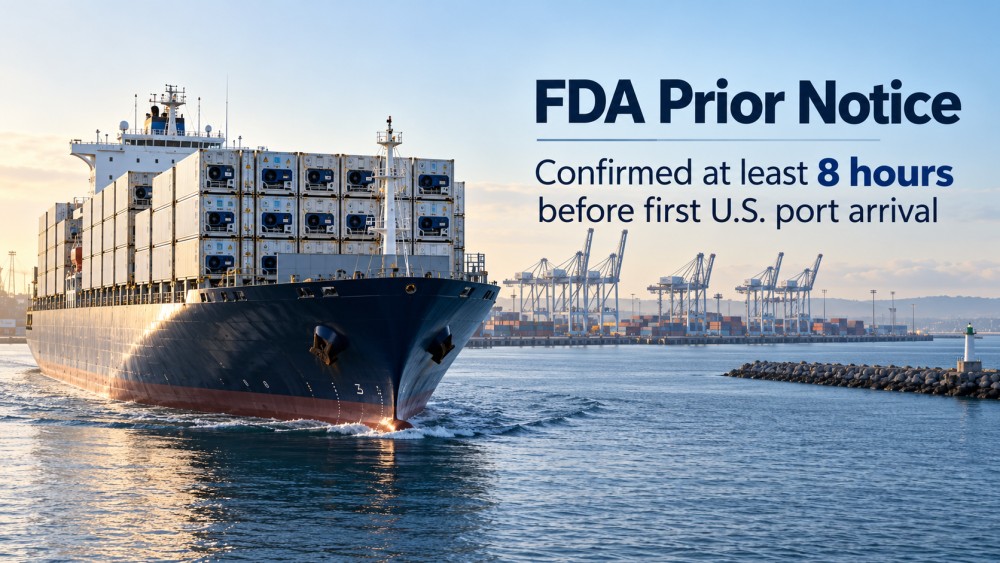
The minimum lead time for food arriving by water is eight hours. The controlling event is arrival at the first U.S. port, not cargo unloading.
Under 21 CFR 1.279, the notice must be submitted electronically, received by FDA, and confirmed for review within the applicable advance-notice window for that shipment.
Beginning a filing eight hours before arrival does not establish compliance. Operators need a successful submission and FDA confirmation before the minimum notice period begins.
For example, a vessel arriving Tuesday at 4:00 p.m. requires confirmed prior notice by Tuesday at 8:00 a.m., using the same time zone.
Treat that calculation as the legal boundary. Your operating deadline should allow additional time for data corrections, system responses, and changes in the vessel’s schedule.
Which arrival should you use when the vessel visits several U.S. ports?
Use the vessel’s first U.S. port of arrival, even when your container remains aboard and will discharge at a later U.S. port of call.
Suppose a vessel first calls at Los Angeles on Monday, then carries your food container onward to Oakland on Tuesday for its scheduled discharge.
The eight-hour calculation runs back from the Los Angeles arrival. Calculating from Oakland would create a later deadline and could leave the shipment noncompliant.
Ask the carrier or forwarder for the complete U.S. port rotation. A destination shown on a booking confirmation may not identify the first arrival.
Keep the first arrival port, expected arrival time, and discharge port clearly distinguished in shipment records so every participant works from the same timing assumptions.
How early can you submit prior notice?
FDA sets both a minimum notice period and an earliest submission limit. The earliest permitted filing date depends on the electronic system you use.
These windows allow operators to file before arrival without waiting until the final day, provided the required shipment details are available and sufficiently accurate.
A long ocean voyage does not mean you can always submit when the vessel departs. The departure date may fall outside the permitted filing window.
For lengthy routes, prepare the information in advance, then schedule submission once the shipment enters the applicable 30-day or 15-day window for your chosen channel.
Filing early is useful only when the information is dependable. Repeated changes to products, suppliers, or routing can create additional correction work for operators.
Which filing channel should your team use?
Customs brokers commonly submit prior notice through the Automated Broker Interface within the Automated Commercial Environment, often alongside information supporting the shipment’s customs entry.
FDA’s PNSI provides another electronic route. It can suit filers submitting prior notice directly or handling situations where the broker is not making that submission.
Choose the channel according to your shipment workflow, available access, and responsibility arrangements. Both routes still require accurate information and compliance with the sea-arrival deadline.
Confirm the filing arrangement before the shipment approaches the United States. A broker handling customs entry should not automatically be assumed to handle prior notice.
Assign one responsible filer and one operational contact who checks completion. This prevents missed submissions when exporters, importers, and forwarders each expect another party to act.
What information should operators collect before filing?
Build the filing from commercial documents, product specifications, facility information, and carrier records. Resolve inconsistencies before submission instead of copying conflicting descriptions into the notice.
Product information generally includes the FDA product code, common or usual name, quantity, packaging details, and relevant lot or production identifiers where those are required.
Party information includes the submitter and transmitter, plus applicable manufacturer, grower, shipper, importer, owner, and ultimate consignee details according to the food and transaction.
Shipment information includes the anticipated arrival location and time, transportation mode, carrier details, and applicable vessel, voyage, container, and entry identifiers for the shipment.
Facility registration information may also be required. Check applicable exemptions carefully; a missing registration number should be investigated rather than replaced with an unsupported assumption.
The filing also requires identification of any country that has refused entry to the article. Gather that history from the responsible supply chain parties.
Does one container need only one prior notice?
Prior notice applies to each article of food. A single ocean container can therefore require multiple notices when it carries different products or manufacturers.
Do not assume one bill of lading, one invoice, or one customs entry means one notice. Those documents organize shipments differently from FDA’s article-based requirements.
For example, a mixed container carrying canned vegetables, dried fruit, and seafood from different manufacturers should be reviewed for the notices each article requires.
Differences in product identity, manufacturer, or other required information may require separate notices. Review the actual product lines before deciding how many submissions are necessary.
Create a reconciliation sheet matching commercial invoice lines to prior notice records. This gives operators a practical way to identify products omitted from filing.
How should you manage arrival changes and time zones?
Base your internal deadline on the earliest credible arrival estimate. A vessel arriving ahead of schedule can eliminate the margin created by an earlier forecast.
Record the time zone beside every arrival estimate and filing deadline. Carrier portals, overseas offices, and U.S. brokers may display times using different conventions.
For a Wednesday 6:00 a.m. arrival, the eight-hour boundary is Tuesday at 10:00 p.m. in the same time zone, crossing into the previous day.
Account for daylight saving changes when relevant. Avoid converting times mentally during a busy shift; use a shared scheduling tool with explicit time-zone settings.
After a delay or diversion, review whether the submitted information remains acceptable. A schedule change does not automatically mean every existing notice must be replaced.
What if shipment details change after submission?
Compare the changed information with FDA’s rules for correcting prior notice. Some changes require cancellation and a new submission, while specified exceptions apply to others.
Under 21 CFR 1.282, changes involving estimated quantity, anticipated arrival information, and planned shipment information receive specific treatment. Avoid applying one blanket rule to every change.
Product identity or manufacturer changes deserve immediate attention because they can affect the notice’s validity. Ask the filer to assess the specific field that changed.
When a replacement notice is required, it must satisfy the applicable timing requirements. Submitting it close to arrival can therefore create a new compliance problem.
Keep the original confirmation, replacement confirmation, and reason for correction together. This helps the receiving team identify which notice supports the shipment being presented.
What does FDA confirmation actually tell you?
A prior notice confirmation establishes that FDA has received a submission for review. It does not mean the food has been approved for importation.
Confirmation also does not establish compliance with labeling, food safety, facility registration, or other import requirements that may apply to the specific food article.
Save the confirmation number and submission record where the importer, broker, and relevant logistics contacts can retrieve them promptly if questions arise during arrival processing.
Check every required article for confirmation. A successful response for one product does not establish that all other products in the container were covered.
If the system returns errors or an incomplete status, investigate immediately. A saved draft or attempted transmission does not substitute for confirmed prior notice.
What happens if you miss the eight-hour deadline?
Food imported or offered for import without adequate prior notice is subject to refusal of admission and may be held under the applicable regulatory procedures.
For operators, possible consequences include storage charges, demurrage, extra coordination, missed delivery appointments, and reduced shelf life while the shipment’s status is being resolved.
If a notice is missing or inadequate, contact the broker or responsible filer immediately. Submit accurate information and follow FDA and CBP instructions for resolution.
Do not assume filing after arrival automatically releases the shipment. FDA’s review and any required holding arrangements must still be addressed for that cargo.
Escalate temperature-sensitive shipments promptly so logistics teams can maintain appropriate storage conditions while compliance personnel resolve the notice issue and any related arrival requirements.
Which related requirements should you check separately?
FDA prior notice is separate from ocean Importer Security Filing requirements. Meeting an ISF deadline does not establish that FDA received the required food notice.
Likewise, completing customs entry or holding an FDA food facility registration does not replace prior notice. Each requirement serves a different purpose in import processing.
Prior notice generally covers imported human and animal food, including many ingredients, dietary supplements, and animal feed products, subject to the applicable scope and exemptions.
Some products regulated exclusively by USDA fall outside these requirements. Determine jurisdiction for the actual product instead of assuming all agricultural cargo follows identical rules.
For seafood, fresh produce, or animal feed, check additional product-specific obligations separately. An accurate prior notice addresses only one part of the shipment’s compliance requirements.
A practical release check before the vessel arrives
Before arrival, verify the first U.S. port, current ETA, applicable time zone, and eight-hour deadline. Then confirm that every required food article has coverage.
Check that the filing falls within the permitted advance window, required information matches shipment records, and FDA confirmation is available to the team managing arrival.
For the controlling requirements, consult 21 CFR Part 1, Subpart I. Use current FDA instructions when handling unusual routing, corrections, exemptions, or electronic system disruptions.
The operational rule is straightforward: secure FDA receipt and confirmation at least eight hours before the vessel’s first U.S. arrival, with time available to correct problems.
Reliable prior notice management depends on accurate product information, clear filing ownership, and active arrival monitoring. Together, these practices reduce avoidable disruption across food supply chains.