Professional Agri-Forestry Industry Insights | Global Intelligence Leader

When do food gifts sent to the US require FDA prior notice?





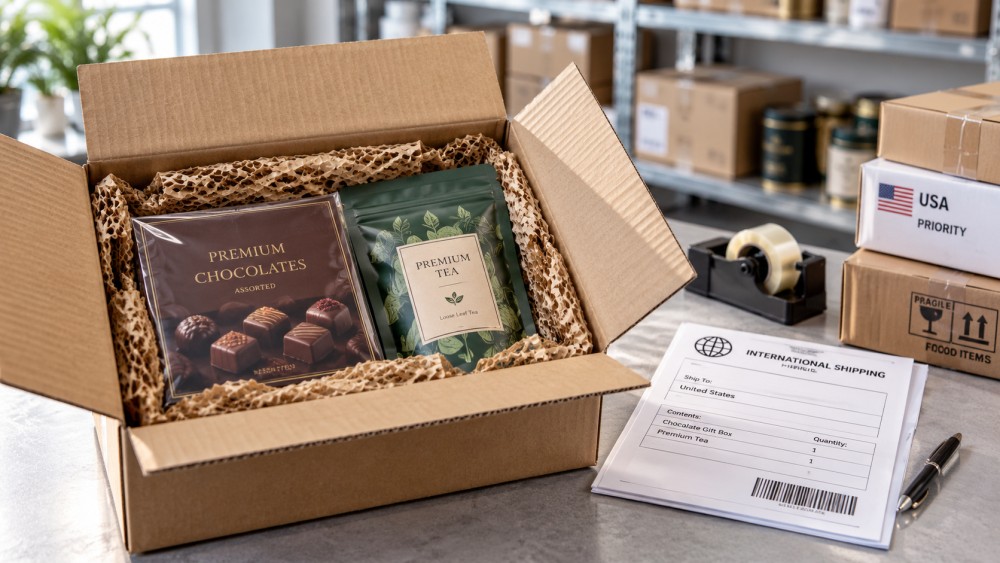
Sending chocolates, tea, or homemade cookies to someone in the United States? A gift label alone does not remove FDA prior notice requirements. Food made by an individual in their own home and sent by that individual as a personal gift to another individual in the US is exempt. Store-bought food is different: certain individual-to-individual shipments fall under FDA enforcement discretion, while food shipped directly by a retailer generally requires prior notice.
The practical question is not simply whether money changed hands. It is who made the food, who is actually sending it, and whether it travels as a parcel or accompanies a traveler. Getting that distinction wrong can lead to a refused shipment, delays, or spoiled food. Before booking delivery, place your gift into one of the categories below.
Which situation matches your food gift?
These categories address prior notice only. They do not establish that the food is allowed into the country. Meat products, fresh produce, seeds, and some animal-origin foods can face separate restrictions even when no FDA prior notice is required.
The homemade-gift exemption has specific boundaries
Under the FDA prior notice regulations in 21 CFR 1.277, an exemption covers food made by an individual in their personal residence and sent by that individual as a personal gift, for nonbusiness reasons, to another individual in the United States.
For example, cookies baked at home and mailed by the person who baked them to a relative can fit this exemption. The important facts are not the festive packaging or the customs description. They are that an individual made the food at home, that same individual sends it, and the recipient is another individual receiving a personal gift.
Moving commercially manufactured food into a homemade-looking container does not qualify. Neither does buying bakery goods and describing them as homemade. Food produced through a home-based business should not automatically be treated as exempt merely because the kitchen is inside a residence; the personal, nonbusiness nature of the shipment matters.
Keep the description straightforward: what the food is, who made it, and why it is being sent. Accurate information helps distinguish a genuine homemade gift from a commercial shipment. It does not override restrictions on ingredients or destination-country import requirements.
Store-bought gifts: exemption and enforcement discretion are different
A box of supermarket biscuits sent by one person to another does not meet the homemade-food exemption. However, FDA guidance explains that the agency generally intends to exercise enforcement discretion for prior notice violations involving food imported or offered for import for noncommercial purposes with a noncommercial shipper.
This can include food an individual purchases and personally sends to another individual as a gift. “Noncommercial shipper” refers to the person sending the food, not to whether the parcel travels through a paid postal service or express courier. Using a commercial carrier does not, by itself, turn a personal gift into a business shipment.
The distinction has a practical consequence: enforcement discretion is not a legal exemption. It describes FDA’s stated enforcement approach for qualifying circumstances, rather than removing the underlying requirement from the regulations. It is also not a guarantee that a carrier will accept a parcel without prior notice documentation.
Before relying on that policy, confirm these points:
- An individual, rather than a retailer or other business, is actually sending the food.
- The recipient is an individual receiving it for personal, noncommercial purposes.
- The parcel is not a sale, business sample, promotional shipment, or supply for resale.
- The carrier accepts the shipment under its own documentation rules.
Quantity can affect whether a shipment looks consistent with its stated purpose, but there is no general “small gift” threshold that automatically removes prior notice requirements. Low value and duty-free customs treatment are separate questions.
What changes when the shop ships it?
Ordering tea from an overseas shop and entering a friend’s US address normally leaves the shop as the commercial sender. The fact that you bought the tea as a birthday present does not make the shipment individual to individual.
Likewise, asking a retailer to wrap a purchase and send it “on your behalf” does not establish eligibility for the personal-shipment enforcement policy. For direct retailer deliveries, arrange prior notice unless a separate exemption applies. Ask who handles the filing before payment, especially when the seller advertises international delivery without explaining food-import paperwork.
Food in luggage follows a different route
Food accompanying an individual entering the United States can be exempt from prior notice when it is for that person’s personal use. This category can include food for family or friends, provided it is not for sale or other distribution.
A package sent separately by post is not accompanied baggage simply because the sender is also traveling to the US. Use the parcel rules for that package. Similarly, a shipment addressed to a hotel does not become accompanied food because the recipient plans to collect it after arrival.
Travelers must still declare food and agricultural products as required by US Customs and Border Protection. Prior notice exemption does not authorize undeclared fruit, prohibited meat, or other restricted items. Check admissibility before packing rather than treating airport inspection as the first opportunity to find out.
When prior notice is needed, arrange it before dispatch
US FDA prior notice gives the agency advance information about food entering the country. It is separate from a customs declaration, commercial invoice, carrier booking, or duty payment. Writing “gift” on the customs form does not submit a notice.
An individual with the required information can submit prior notice through FDA’s Prior Notice System Interface. A seller, broker, or carrier may also handle submission, depending on its service. FDA does not charge a fee for submitting prior notice itself, although a service provider may charge for assistance.
- Agree who will file. Get a clear answer from the seller or carrier. Do not assume that accepting the parcel means the carrier has submitted the notice.
- Gather the food details. Have accurate product descriptions, quantities, manufacturer information, country details, sender and recipient information, and transport details available. The system’s requirements depend on the shipment.
- Identify the separate food articles. A mixed hamper may require multiple prior notices rather than one generic entry for “food gift.” Different products or manufacturers should not be combined merely because they share a box.
- Submit within the applicable timeframe. The transport method determines the deadline.
- Pass on the confirmation. Keep the confirmation number and provide it wherever the carrier or shipment documentation requires it.
For food sent by international mail, prior notice must be submitted and confirmed before the food is sent. The prior notice confirmation number must accompany the food. Obtain the number before handing over the parcel, not after it has entered the postal network.
For other transport methods, FDA generally must receive and confirm prior notice at least two hours before arrival by road, four hours by air or rail, and eight hours by water. These are regulatory minimums, not recommended last-minute filing targets. Carrier cutoffs may be earlier, and some shipment details may need correction before acceptance.
A prior notice confirmation acknowledges the submission; it is not FDA approval of the food, its labeling, or its entry into the United States.
Check the contents, not just the paperwork
Some foods are unsuitable for a casual gift parcel even when the prior notice position is clear. Agricultural admissibility, food safety, and transport conditions can each stop a shipment independently.
- Meat, poultry, and certain egg products: USDA rules may control admissibility. Foods under USDA’s exclusive jurisdiction have a distinct
Got questions about this industry topic or seeking best practices for your business? Drop us a line below, and let the expert team at AgriTrade help you out.
We respect your privacy. Your information is strictly confidential.
Related News
- 00
0000-00
EU Issues Regulation Restricting Lead in Fishing Gear - 00
0000-00
Agriculture Ministry Calls for Strict Yellow River Fishing Bans and Greener Farming - 00
0000-00
Three Ministries Set Out University Admissions Plan for Rural Revitalization - 00
0000-00
Animal Health Policy News: Disease Reporting and Trade Updates - 00
0000-00
U.S. Food Manufacturing Safety Regulations: Key FDA Compliance Requirements
0000-00
Policy & Regulations Editorial Team
Weekly Insights
Stay ahead with our curated technology reports delivered every Monday.