Professional Agri-Forestry Industry Insights | Global Intelligence Leader

What Food Safety Violations Cause Shipment Rejection in 2026?





What Food Safety Violations Cause Shipment Rejection in 2026?
What food safety violations cause shipment rejection in 2026? For agricultural exporters, seafood suppliers, food processors, and importers, the main risks include excessive pesticide or veterinary drug residues, microbial contamination, undeclared allergens, unsafe contaminants, and failures in hygiene or temperature control. Missing health certificates, incorrect labels, and ineligible production facilities can also prevent clearance, even when the food appears sound.
There is no single worldwide rejection standard for 2026. The outcome depends on the product, destination, applicable rules, and evidence presented to the inspecting authority. Businesses should verify current requirements rather than assume that last year’s specifications remain sufficient. This AgriTrade guide explains where shipments become vulnerable and what to check before dispatch.
A border hold is not always a final rejection
A shipment may be held for document review, sampled for laboratory testing, refused entry, or rejected commercially by the buyer. These are different events. A detention can sometimes be resolved with acceptable evidence or an authorized correction; a confirmed safety failure may require re-export, destruction, or another disposition permitted by the authority.
Buyer specifications introduce another distinction. A retailer may require residue levels below legal limits or more remaining shelf life than import law demands. Failure to meet those terms can trigger contractual rejection without establishing a regulatory food safety violation. Purchase agreements should identify which requirements are legal conditions and which are additional buyer conditions.
Do not assume a missing document is harmless paperwork. For animal-origin products, an official certificate or approved-establishment status may be a condition of entry. Testing the food cannot replace that condition.
Residues and contaminants: testing against the wrong limit
Pesticide residues are a concern for fresh produce, grains, herbs, tea, and other plant products. Veterinary drug residues matter in meat, milk, eggs, and aquaculture products. A substance permitted in the producing country may have a different limit—or no permitted use for the relevant commodity—in the destination market.
The practical mistake is ordering a generic “export residue test” without defining the destination and commodity. A laboratory report is useful only when its analyte coverage, reporting limits, methods, and sample identity support the required assessment. A pass against one market’s specification does not establish compliance elsewhere.
Before commissioning testing, align three things: the farm or treatment history, the destination’s applicable maximum residue limits, and the buyer’s specification. For veterinary medicines, withdrawal-period records help explain how compliance was controlled upstream. Testing should verify that system, not substitute for it.
Other chemical hazards need separate attention. Mycotoxins can affect grains, nuts, and dried products; heavy metals may be relevant to seafood and crops; food-contact materials can introduce migration risks. The appropriate test panel depends on the commodity, origin, processing method, and packaging. A pesticide screen will not reveal every chemical hazard.
Microbial contamination and weak process control
Pathogens such as Salmonella and Listeria monocytogenes can lead to rejection where their presence or level breaches applicable requirements. Certain pathogenic E. coli strains are also relevant to particular foods. However, microbiological criteria are not interchangeable across products: ready-to-eat food and raw ingredients intended for further processing require different assessments.
For processors, the useful question is not simply, “Did the finished batch pass?” It is, “Which control prevents contamination, and can we show it worked?” That may involve water quality, sanitation, validated heat treatment, separation of raw and cooked areas, or protection against contamination after processing.
A negative result from a limited sample does not prove that every unit in a shipment is safe. Sampling design matters, especially when contamination is uneven. Buyers should review the relationship between production records, environmental monitoring where appropriate, and lot-release testing rather than rely on an isolated certificate of analysis.
Specific foods also carry specific hazards. Histamine formation is relevant to certain fish species, while inadequate controls in low-acid canned foods can present serious safety risks. A broad “microbiology passed” statement may not address either issue.
Cold-chain failures need more than a temperature snapshot
A refrigerated container set point is not proof that the product remained within its required temperature conditions. Loading warm product, blocked airflow, equipment failure, transshipment delays, and extended unloading can create exposure that the arrival reading misses.
The safety significance of an excursion depends on the food, actual temperature, duration, and relevant requirements. There is no universal excursion threshold that makes every chilled or frozen shipment unacceptable. Some deviations primarily affect quality; others can support pathogen growth or toxin formation and justify rejection.
A defensible assessment connects product temperatures at loading, logger placement, calibration records, transit data, and receiving observations. Surface readings alone may not represent the temperature inside the product. Where records conflict, keep the affected goods segregated while a qualified person assesses them.
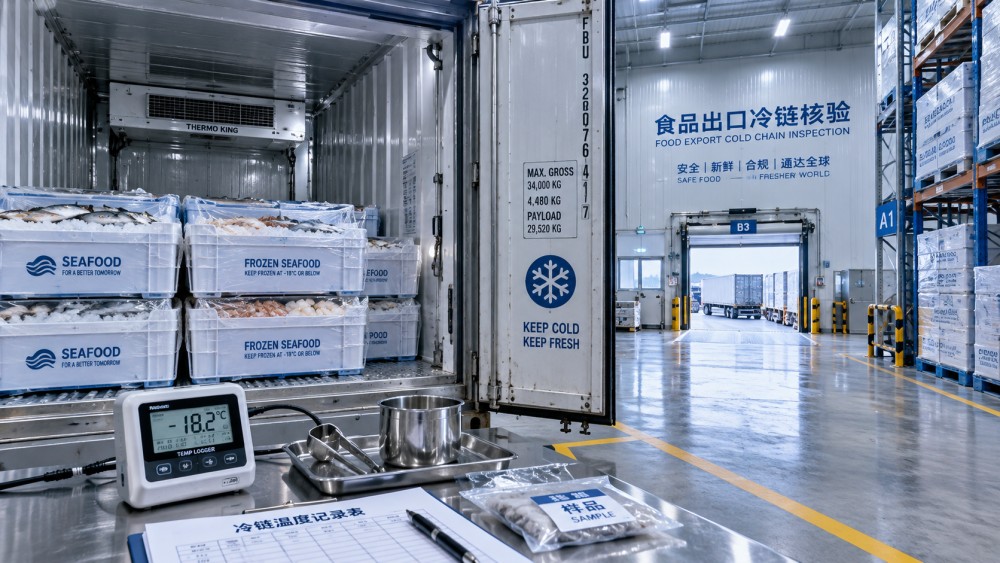
For seafood, chilling after a temperature-abuse event does not necessarily undo the hazard. Histamine already formed is not reliably removed by freezing or ordinary cooking. Prevention and a credible handling history matter more than presenting the consignment cold at inspection.
Allergens, labels, and packaging can stop an otherwise acceptable lot
An undeclared allergen is a safety issue, not merely a translation error. Ingredient substitutions, compound ingredients, rework, and packaging mix-ups can leave the actual formulation different from the approved label. The legally recognized allergen list and declaration format also vary by destination.
Check the finished artwork against the production formula, including ingredients within sauces, seasonings, and other components. Confirm required language, product identity, storage instructions, date marking, and importer details where applicable. Do not assume that a precautionary “may contain” statement resolves an undeclared ingredient or inadequate cross-contact control.
Packaging failures create a different route to rejection. Broken seals, compromised can seams, leaking pouches, pest contamination, or physical foreign material can raise safety concerns. Food-contact compliance must also match the actual use conditions; suitability for dry food does not automatically establish suitability for hot-filled, acidic, or fatty products.
Certificates and traceability must describe the shipment that arrived
Documents can look complete while referring to the wrong goods. A certificate may identify a different establishment, species, lot, weight, or processing category. The shipment may also originate from a country, region, or facility that is not eligible for that product under current import conditions.
Distinguish food safety controls from animal-health and plant-health restrictions. Disease-related import restrictions or phytosanitary failures can block agricultural consignments without a confirmed food contamination finding. They still belong in the pre-shipment compliance review because the commercial consequence can be the same.
Traceability becomes critical when inspectors need to connect results with a lot. The invoice, packing list, certificate, carton markings, and laboratory report should tell a consistent story. If a report covers a raw-material batch but the shipment contains several finished-product lots, document that relationship rather than expect the inspector to infer it.
Build the release decision around the destination
For U.S.-bound food, relevant checks may include FDA requirements, applicable USDA oversight, prior notice, registration obligations, and importer verification responsibilities, depending on the product. FDA import alerts and import refusal records can help identify enforcement concerns, but they do not replace the governing requirements.
For EU-bound consignments, businesses should verify applicable residue and contaminant limits, microbiological criteria, official certification requirements, and country or establishment eligibility where relevant. The European Commission’s food safety resources and RASFF notifications offer useful context. A notification is a warning signal to investigate, not proof that all similar goods are prohibited.
Other destinations have their own registration, labeling, inspection, and certification systems. Codex standards can provide a reference point, but they are not automatically the legal import standard in every jurisdiction. Check the version and effective date of the actual destination requirement.
A practical release review should answer these questions before the container is sealed:
- Is this exact product, origin, and establishment eligible for entry?
- Do test reports cover the shipped lots and destination-specific hazards?
- Do labels match the formula and approved market artwork?
- Are certificates valid, consistent, and issued through the required process?
- Can the planned route preserve required storage conditions and remaining shelf life?
- Who has authority to stop dispatch when evidence is incomplete?
If the shipment is held, identify the precise failure
Obtain the written grounds, affected lot details, test information, response deadlines, and permitted options. A document mismatch needs a different response from a confirmed contaminant exceedance. Do not assume that a private retest will override an official result, or that relabeling, reconditioning, and re-export are automatically allowed.
Maintain required storage conditions during the hold and preserve records. Agree with the importer who manages authority communications, laboratory review, storage costs, and buyer updates. Controlling the immediate loss matters, but the corrective action should also reach the source: farm treatment, processing, artwork approval, loading, or document preparation.
Agriculture, Livestock & Fisheries Industry News | AgriTrade, operated through www.zsiron.com, brings together policy updates, export developments, food-processing news, and supply-chain intelligence. That context can help businesses recognize changing risks early; shipment-release decisions still require current official rules and lot-specific evidence.
Before the next dispatch, select one shipment and reconcile its eligibility, test results, labels, certificates, and cold-chain plan. Any gap that cannot be explained clearly to the importer deserves resolution before loading—not after arrival.
Got questions about this industry topic or seeking best practices for your business? Drop us a line below, and let the expert team at AgriTrade help you out.
We respect your privacy. Your information is strictly confidential.
Related News
- 00
0000-00
EU Issues Regulation Restricting Lead in Fishing Gear - 00
0000-00
Agriculture Ministry Calls for Strict Yellow River Fishing Bans and Greener Farming - 00
0000-00
Three Ministries Set Out University Admissions Plan for Rural Revitalization - 00
0000-00
Animal Health Policy News: Disease Reporting and Trade Updates - 00
0000-00
U.S. Food Manufacturing Safety Regulations: Key FDA Compliance Requirements
0000-00
Policy & Regulations Editorial Team
Weekly Insights
Stay ahead with our curated technology reports delivered every Monday.