Professional Agri-Forestry Industry Insights | Global Intelligence Leader

Is FDA prior notice of imported foods required for trade samples?





For distributors, agents, and importers handling food trade samples, understanding the FDA prior notice of imported foods requirement is essential for avoiding customs delays and compliance risks. Even products sent for evaluation, testing, or business development may be subject to U.S. food import rules, depending on their nature, quantity, and intended use. A sample that has no commercial invoice value can still be considered food under U.S. law. The key question is not simply whether the shipment is sold, but how the product will enter the United States and whether a specific exemption applies.
This guide explains when prior notice may be required, what information should be prepared, and how businesses can manage sample shipments more efficiently across international agricultural and food supply chains.
Why trade samples can still require FDA prior notice
FDA prior notice is a notification requirement for food imported or offered for import into the United States. It allows the U.S. Food and Drug Administration to review information about an incoming food shipment before arrival. The rule generally covers food for humans and animals, including processed foods, beverages, dietary supplements, food additives, seafood, feed ingredients, and many agricultural products.
A trade sample may be sent without a sale, without a final purchase order, or without a commercial resale plan. However, it may still be introduced into U.S. commerce in the broad regulatory sense if it is brought into the country for evaluation, distribution, demonstration, product development, or possible future sale. For example, a distributor may receive sample cartons of dried fruit, a seafood product, a beverage concentrate, or an animal feed ingredient for internal review and customer demonstrations. The shipment is still connected with the U.S. food supply chain, so prior notice should not be dismissed merely because the goods are labeled “sample.”
The classification also depends on whether the product is genuinely food, whether it is intended for human or animal consumption, and whether another U.S. agency has primary jurisdiction over it. Products regulated exclusively by the U.S. Department of Agriculture, such as certain meat, poultry, and processed egg products, may follow different import procedures. Mixed shipments can be more complicated and should be reviewed item by item.
Is FDA prior notice always required for imported food samples?
Not always. Some shipments may fall within a regulatory exemption, while others may require prior notice even if they are small, free of charge, or marked for testing. The facts surrounding the shipment matter more than the word “sample” printed on the package.
Because exemptions are specific, an importer should not rely on a general assumption that “free samples are exempt.” If the product will be tasted, consumed, distributed to prospective customers, or used to support a future commercial transaction, prior notice may be the safer compliance path unless a qualified professional confirms that an exemption applies.
Information needed to submit prior notice
A prior notice filing normally requires shipment information that connects the product, the parties, and the arrival event. The exact data set can vary depending on the filing method and shipment details, but businesses should be ready to provide the following:
- The identity and contact details of the submitter.
- The name and address of the manufacturer or grower.
- The country where the food was produced.
- The product description and relevant FDA product code.
- The quantity, packaging format, and lot or batch information when available.
- The shipper, consignee, owner, ultimate consignee, and importer of record.
- The carrier, mode of transportation, and estimated arrival information.
- The port of arrival or other applicable entry details.
- Any facility registration information required for the product and facility.
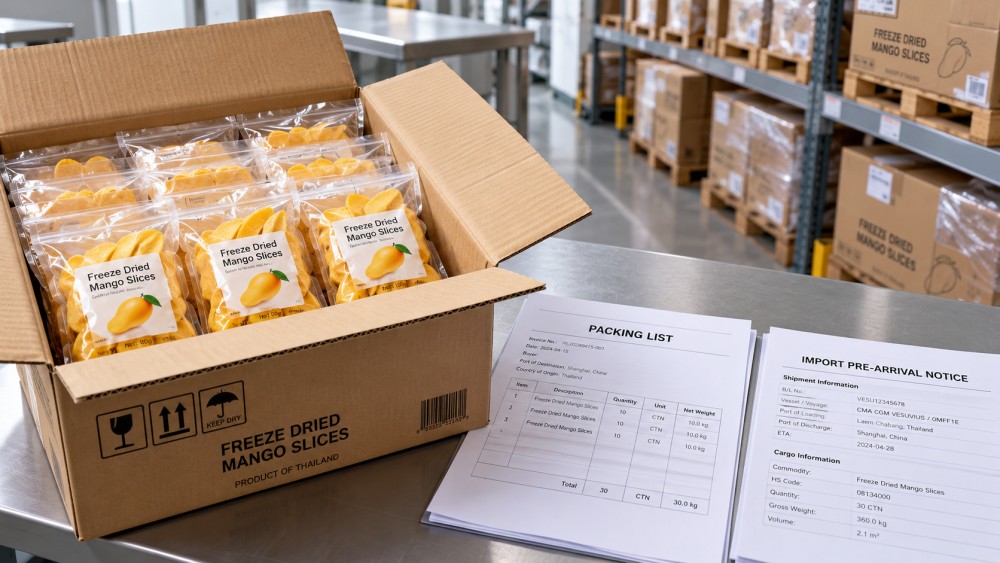
Product descriptions deserve special attention. “Food samples” is usually too vague to help customs and FDA understand the shipment. A description such as “freeze-dried mango slices for distributor evaluation” or “canned sardine samples for commercial product assessment” gives a clearer picture. The description should match the commercial documents, packing list, labels, and product code. Inconsistencies can lead to questions, holds, or requests for additional information.
When must prior notice be submitted?
Prior notice must generally be submitted before the food arrives in the United States. The deadline depends on the transportation method. Under the FDA framework, the common minimum periods are generally:
- At least two hours before arrival by land through a road vehicle.
- At least four hours before arrival by rail or air.
- At least eight hours before arrival by vessel.
- Before the food is mailed internationally, where applicable.
These are not shipment-planning targets. They are minimum regulatory timeframes, and practical operations usually require more lead time. A carrier may need the prior notice confirmation before accepting the shipment, and a late change in flight, vessel, port, or consignee may require an update.
For distributors, the most reliable approach is to collect the product and importer information before the goods leave the exporting country. Waiting until the parcel is already moving can be risky, particularly when the courier submits customs data quickly or when an airport shipment arrives outside normal business hours.
How to manage a sample shipment from preparation to arrival
A simple internal workflow can reduce uncertainty without creating unnecessary administrative work.
1. Classify the product before booking transport
Identify whether the item is a food, dietary supplement, beverage, food additive, animal feed, seed-related product, seafood product, or another regulated article. Check whether USDA or another agency may have jurisdiction. If the shipment contains several products, do not assume that one classification covers the entire parcel.
2. Define the intended use honestly
Record whether the sample is for tasting, laboratory analysis, formulation, quality testing, customer demonstration, or another purpose. “Not for sale” can be useful information, but it does not replace an accurate statement of intended use. If the sample may be consumed by people or animals, that fact should be reflected in the compliance review.
3. Confirm the U.S. parties
The overseas supplier, U.S. distributor, customs broker, courier, and importer of record should agree on who will submit prior notice and who will respond if FDA or Customs and Border Protection asks questions. A common problem is that each party assumes another party has filed. Written responsibility is better than verbal expectation.
4. Align every document
The invoice, packing list, airway bill or bill of lading, labels, prior notice record, and entry filing should describe the same goods. The invoice should state that the products are samples only when that is accurate, while still providing a realistic customs value for clearance purposes. “No commercial value” does not mean “no customs value.”
5. Keep the confirmation and supporting records
Save the prior notice confirmation, filing details, product specifications, labels, certificates, and correspondence with the carrier or broker. These records can help resolve a hold and make repeat shipments easier. They also provide a useful reference when the product later moves from sampling to commercial importation.
Common mistakes that create avoidable delays
Using “sample” as the entire product description. FDA and customs officials need to know what the product actually is. The description should identify the food, form, and intended evaluation purpose.
Assuming a low value removes the requirement. A small package or free-of-charge shipment may still be subject to prior notice. Value, quantity, and commercial status are only part of the analysis.
Declaring an exemption without checking the facts. A business shipment sent to a distributor is different from an individual carrying food for personal use. An exemption should be based on the applicable legal conditions, not on convenience.
Ignoring facility registration issues. Where applicable, a foreign facility that manufactures, processes, packs, or holds food for consumption in the United States may need FDA food facility registration. Trade samples do not automatically remove facility-related obligations.
Sending products with unclear labels. Labels should identify the product and, where appropriate, state “sample,” “not for resale,” or “for evaluation only.” These statements support transparency, but they should never be used to disguise the actual purpose or contents of a shipment.
Letting the courier make unverified assumptions. Express carriers often assist with customs data, but the exporter and U.S. recipient remain responsible for providing accurate information. A courier’s standard description may not be detailed enough for a food shipment.
What distributors and agents should ask suppliers before shipment
- What is the exact product name and ingredient composition?
- Is the item intended for human consumption, animal consumption, laboratory testing, or demonstration?
- Who manufactured or packed the product, and where?
- Is the facility subject to FDA registration or another agency’s approval?
- What is the product code and expected customs classification?
- Which party will submit FDA prior notice?
- What are the shipment terms, carrier details, and expected arrival time?
- Are the labels, invoice, packing list, and prior notice information consistent?
These questions are especially valuable when a distributor receives samples from several overseas suppliers. A consistent intake checklist helps prevent one supplier’s shipment from being treated casually simply because it contains only a few units.
Final compliance perspective
For food trade samples entering the United States, the safest question is not “Is this shipment free?” but “What is the product, why is it entering the country, and which rule applies to this exact movement?” FDA prior notice of imported foods may be required even when the shipment has no immediate sale attached to it. At the same time, specific exemptions may exist for qualifying situations, so businesses should avoid both extremes: filing blindly for every item or assuming that every sample is exempt.
AgriTrade provides practical coverage of food safety rules, agricultural trade procedures, packaging requirements, supply chain changes, and international market access. For distributors, agents, and importers, following these developments can make sample programs more predictable and support better decisions when a product moves from initial evaluation to regular U.S. distribution. Regulatory requirements can change, so shipment-specific questions should be confirmed with current FDA guidance, the carrier or customs broker, and qualified import counsel where necessary.
Got questions about this industry topic or seeking best practices for your business? Drop us a line below, and let the expert team at AgriTrade help you out.
We respect your privacy. Your information is strictly confidential.
Related News
- 00
0000-00
EU Issues Regulation Restricting Lead in Fishing Gear - 00
0000-00
Agriculture Ministry Calls for Strict Yellow River Fishing Bans and Greener Farming - 00
0000-00
Three Ministries Set Out University Admissions Plan for Rural Revitalization - 00
0000-00
Animal Health Policy News: Disease Reporting and Trade Updates - 00
0000-00
U.S. Food Manufacturing Safety Regulations: Key FDA Compliance Requirements
0000-00
Policy & Regulations Editorial Team
Weekly Insights
Stay ahead with our curated technology reports delivered every Monday.