Professional Agri-Forestry Industry Insights | Global Intelligence Leader

Is Certified Timber Enough to Meet EU Deforestation Requirements?





No. Certified timber alone is not enough to meet the EU Deforestation Regulation (EUDR). Certification can provide useful evidence about forest management and supply chain controls, but it does not automatically establish that a particular timber product meets the regulation’s requirements. Compliance also requires evidence of origin, assessment against the applicable deforestation and forest degradation criteria, legality verification, and completion of the relevant due diligence obligations.
The decisive question is whether the evidence supports the actual timber being placed on or exported from the EU market. A valid certificate can still leave gaps if the shipment cannot be linked to its production plots, if material from uncertain sources enters processing, or if the certification assessment does not cover a requirement imposed by the EUDR.
Separate the certification claim from the legal requirements
The EUDR requires covered products to be deforestation-free, produced in accordance with relevant legislation in the country of production, and covered by the required due diligence documentation. For wood, the deforestation-free conditions also address forest degradation as defined by the regulation. A general claim of sustainable harvesting does not establish all these elements.
Certification schemes have their own standards, audit methods, claim categories, and rules for mixing material. Their evidence can contribute to due diligence, but certification does not create an automatic exemption or transfer regulatory responsibility to the certification body.
A certificate should therefore be treated as one component of the evidence file. Its value increases when the certificate scope, transaction claim, production records, and physical material all align.
Establish whether the product is covered before collecting documents
Begin with the product’s customs classification and description. EUDR coverage follows the products listed in its annex; it does not extend automatically to everything made partly from wood. Logs, sawn timber, panels, pulp, paper, and certain furniture products require assessment against the relevant listed entries.
Packaging needs particular care. Wooden packaging sold as a product in its own right can receive different treatment from packaging used exclusively to support, protect, or carry another product. The presence of a timber component alone does not settle the scope question.
Record the classification decision and its basis before building the shipment file. Otherwise, substantial effort can go into collecting documents for the wrong product category while missing the obligations attached to the actual goods.
Application dates, transitional provisions, and duties attached to different supply chain roles should be verified against the current consolidated regulation and official guidance. A certificate’s validity period does not determine when EUDR obligations apply.
Build a traceable connection from the shipment to the forest
The practical starting point is a defined consignment: product description, quantity, wood species, supplier, production origin, and the records linking these details. For wood, species information includes the common name and full scientific name. Broad descriptions such as “mixed hardwood” are insufficient when they conceal the species actually supplied.
Next, establish the geolocation of all relevant production plots and the production date or time range required by the regulation. A sawmill address, export terminal, warehouse location, or country-of-origin declaration cannot substitute for the location where the trees were grown.
The geolocation format must follow the applicable requirements. Larger plots can require polygon boundaries rather than a single coordinate. Even correctly formatted data needs validation: a point in the wrong concession or a polygon covering an entire commercial estate without identifying the relevant production area can undermine the assessment.
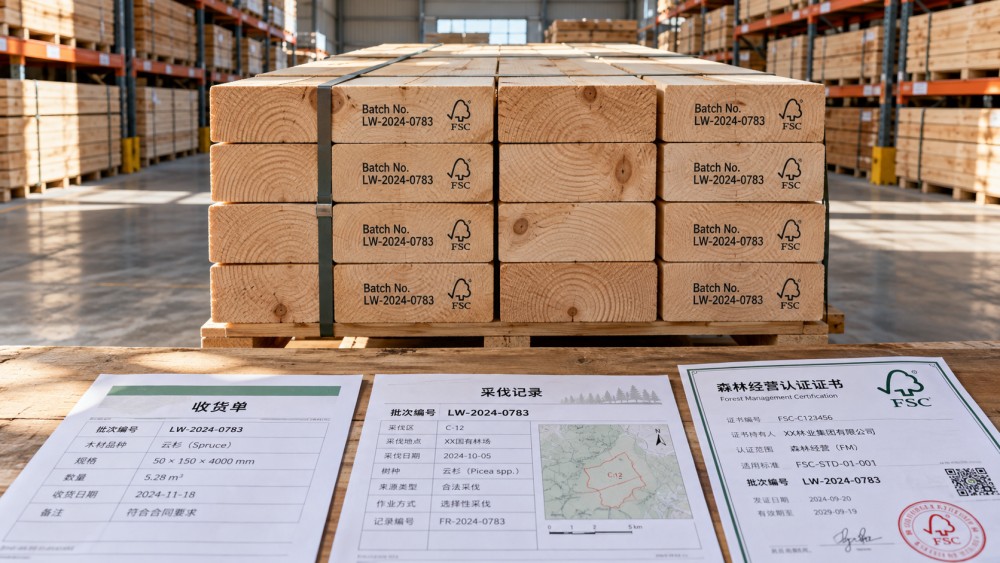
Processing records connect these locations to the finished goods. For sawn timber, that connection can involve harvest identifiers, log intake records, production batches, drying records, and dispatch documents. For plywood or other composite products, several species and production areas may contribute to one batch.
Consider a panel shipment manufactured from veneer supplied by several mills. A certificate held by the panel factory does not establish the origin of every veneer input. The evidence must cover the contributing wood sources, and the production records must explain how those inputs entered the shipment.
Where exact physical segregation is absent, traceability must still identify the relevant possible origins and support compliance for the material involved. An accounting claim under a certification scheme cannot, by itself, resolve the presence of wood from an unknown or non-compliant source.
Test land-use history and legality as separate questions
A legally issued harvesting permit does not establish that the timber is deforestation-free. Equally, evidence that an area remained forested does not establish that harvesting complied with applicable law. These questions require different evidence, even when some records overlap.
Assess the land against the regulatory definitions
The EUDR uses a cutoff date of 31 December 2020 for its deforestation-free conditions. For wood, the assessment must also address whether harvesting induced forest degradation after that date, using the regulation’s definitions. Certification dates and recent audit results do not replace this historical assessment.
Satellite imagery, forest inventories, management plans, harvest records, and reliable land-use datasets can help establish what happened on a plot. Their usefulness depends on resolution, timing, and interpretation. A single recent image rarely explains the land’s condition before harvesting or the type of forest involved.
Tree-cover loss requires interpretation. It can reflect harvesting, fire, storm damage, or conversion to agricultural use. These events do not have identical regulatory consequences. Likewise, continued tree cover does not settle every forest degradation question: changes in forest type can matter even where trees remain present.
Match legality evidence to the production location
Relevant legislation extends beyond permission to cut trees. Depending on the applicable legal framework, the assessment can involve land-use rights, environmental protection, forest management and biodiversity rules directly related to harvesting, third-party rights, labour rights, protected human rights, applicable consent requirements, and tax, anti-corruption, trade, and customs rules.
Documents need to relate to the correct entity, location, activity, and period. A concession document covering a neighbouring area does not support the harvested plot. A harvesting authorization issued after the recorded activity needs explanation. Conflicting names across permits and invoices require a documented connection between the entities.
Certification audits can provide relevant findings, but their scope should be examined. An audit summary that confirms general conformity may provide little evidence about a disputed land right or a specific harvest authorization.
Use certification to inform the risk assessment
Risk assessment evaluates the evidence as a whole. Relevant considerations include the production country and region, forest conditions, the reliability of documents, supply chain complexity, mixing risks, and substantiated concerns about the source. Certification contributes most when its controls directly address the risks identified.
Start by validating the certificate in the scheme’s official records. Confirm its status, covered sites, product groups, activities, and claim scope. Then compare those details with the seller and processing sites shown in the transaction records. A genuine certificate belonging to a related business does not automatically cover the entity issuing the invoice.
Review the precise claim attached to the material. Different claim categories can represent different sourcing and accounting arrangements. A certified percentage or credit-based claim should never be read as proof that every physical wood input has independently demonstrated EUDR compliance.
The assessment should also consider what the certification evidence leaves unresolved. An annual audit offers evidence about the controls assessed at that time; it does not establish the origin and compliance of every subsequent shipment. New sourcing areas, subcontracted processing, or changed input materials can create gaps after an audit.
Where simplified due diligence applies under the current rules, it does not turn certification into an exemption. The relevant information obligations remain, and evidence of circumvention, mixing, or non-compliance can trigger further assessment.
Resolve the gap before treating the shipment as ready
A useful review produces a specific finding rather than a general request for “more sustainability documents.” The next action should address the uncertainty that prevents a supported compliance conclusion.
- Missing production locations: obtain the relevant plot geolocation and its connection to harvesting and batch records. Another copy of the certificate adds no location evidence.
- Unclear land-use change: compare appropriately dated imagery with management and harvesting records. Specialist interpretation may be necessary where the forest classification or disturbance is disputed.
- Mixed inputs: establish the origins contributing to the batch and assess whether the production controls exclude unknown material. If they do not, changing the input or production arrangement may be necessary.
- Contradictory legality records: resolve the inconsistency through reliable supporting evidence, including independent verification where warranted.
Additional supplier assurances are useful only when they are supported. A signed declaration that repeats “legal and sustainable” does not explain conflicting plot boundaries or an unexplained volume increase.
Quantity reconciliation is particularly valuable. Compare harvested or purchased inputs with processing output, inventory movements, and dispatch quantities, allowing for credible conversion losses. An unexplained surplus can indicate missing sources, incorrect allocation, or unreliable records even when all certificates are valid.
If the assessment cannot establish no or only negligible risk where that standard applies, the product should not proceed under an unsupported compliance conclusion. Commercial urgency does not close an evidence gap.
Keep the compliance decision connected to the goods
Once the evidence supports compliance, complete the applicable due diligence statement or other required submission for the transaction and supply chain role. Certification paperwork does not replace a required regulatory submission, and submission itself does not validate inaccurate source data.
The retained file should connect the product and quantity to its species, production plots, supporting legality evidence, risk assessment, any mitigation, and the relevant regulatory references. A reviewer should be able to follow that connection without reconstructing it from disconnected emails.
Shipment changes require attention. Substituting a species, adding an unassessed source, or replacing part of a batch can invalidate assumptions behind an earlier decision. The release process should identify such changes before dispatch and route them back for assessment.
Certified timber becomes useful evidence when its claim is supported by records that match the goods and address the EUDR’s specific requirements. The release decision rests on that complete, traceable evidence—not on the certificate alone.
Got questions about this industry topic or seeking best practices for your business? Drop us a line below, and let the expert team at AgriTrade help you out.
We respect your privacy. Your information is strictly confidential.
Related News
- 00
0000-00
EU Issues Regulation Restricting Lead in Fishing Gear - 00
0000-00
Agriculture Ministry Calls for Strict Yellow River Fishing Bans and Greener Farming - 00
0000-00
Three Ministries Set Out University Admissions Plan for Rural Revitalization - 00
0000-00
Animal Health Policy News: Disease Reporting and Trade Updates - 00
0000-00
U.S. Food Manufacturing Safety Regulations: Key FDA Compliance Requirements
0000-00
Policy & Regulations Editorial Team
Weekly Insights
Stay ahead with our curated technology reports delivered every Monday.