Professional Agri-Forestry Industry Insights | Global Intelligence Leader

How to correct FDA prior notice when shipment details change





How to correct FDA prior notice when shipment details change
A delayed flight, a new carrier, or a revised shipment quantity can leave your FDA prior notice out of step with the food shipment heading to the United States. For operators handling agricultural products, seafood, or processed foods, the next step depends on which details changed—not every change requires the same response. This guide explains how to assess the discrepancy, determine whether a new submission is needed, and coordinate updated confirmation details with your broker or carrier.
The key distinction: a confirmed prior notice generally cannot simply be edited. Under 21 CFR 1.282, changes to required information generally call for a new prior notice, but the regulation provides exceptions for estimated quantity, anticipated arrival information, and planned shipment information. Knowing which category a change belongs to prevents both unnecessary refiling and reliance on an invalid submission.
Start with the confirmed record, not the latest invoice
Retrieve the actual submission and its FDA confirmation number. A commercial invoice, booking confirmation, or broker instruction sheet may show what someone intended to file, rather than what FDA received. Compare the confirmed record against the shipment now being dispatched.
Establish whether the notice is still a draft, was rejected, or has been confirmed. Draft information can be corrected before submission. A rejected transmission needs its errors resolved and must be successfully submitted. A confirmed notice requires the change assessment described below; sending an email with revised documents does not amend FDA’s record.
Also identify the filing route. The FDA Prior Notice System Interface (PNSI) and a broker’s Automated Commercial Environment (ACE) workflow have different screens and procedures. The regulatory obligation does not disappear because the change is handled inside customs software.
Which changes require a new submission?
Use the field definitions in 21 CFR Part 1, Subpart I, particularly sections 1.281 and 1.282. Operational descriptions such as “routing update” are too broad: one routing update might only change an arrival time, while another replaces the carrier or changes the transportation mode.
A flight-number change is not necessarily a carrier change. Conversely, a booking reference that stays the same does not prove the carrier stayed the same. Compare the specific submitted fields with the revised transport documents.
The quantity exception also has limits in practice. Fewer cartons of the same declared food is different from substituting a different product or adding food from another manufacturer. A mixed-food consignment may contain several prior notices; assess each affected article rather than treating the entire container as one record.
A workable correction sequence
Assign one person to coordinate the correction. Exporters, forwarders, importers, and brokers may all hold different versions of the shipment information. Parallel, uncoordinated submissions can leave the carrier carrying one confirmation while the broker references another.
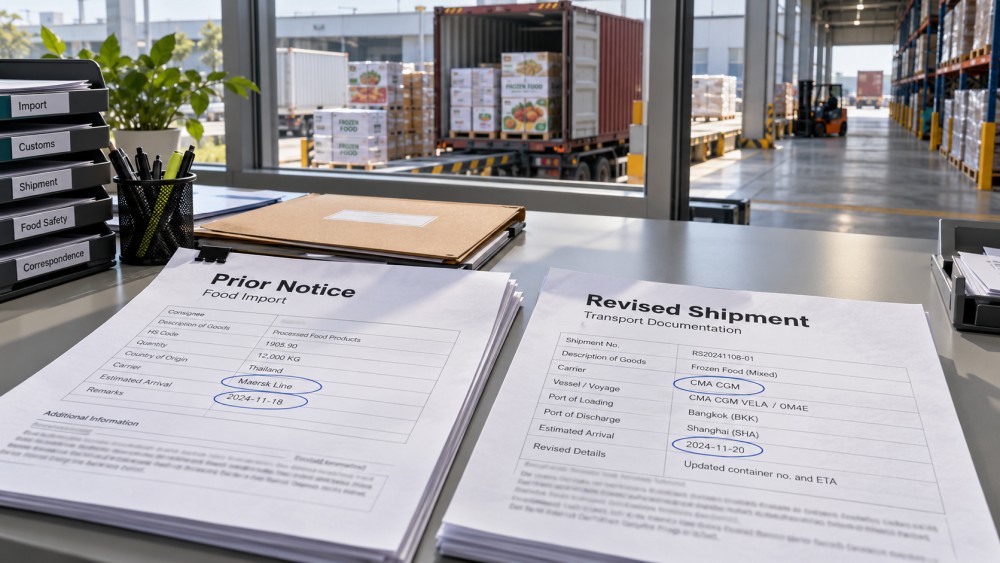
Document the exact difference
Record the original value, revised value, supporting document, affected food article, and expected U.S. arrival. This can be a short change log. “Shipment revised” is not enough; “carrier replaced, product and manufacturer unchanged” gives the filer something actionable.
If the discrepancy falls entirely within the regulatory exceptions, document why a replacement notice is unnecessary. That conclusion does not remove separate obligations to correct customs entries, manifests, or commercial records.
Prepare and submit the replacement where required
In PNSI, use the available copy or creation workflow to prepare a new notice, then review every required field before submitting. Copying saves time, but it can also reproduce an incorrect manufacturer address, product code, or consignee detail.
For ACE filings, ask the transmitting broker to apply the appropriate replacement and cancellation procedures in its system. Do not assume that amending an entry automatically produces a valid replacement FDA prior notice. Obtain the actual transmission result and the applicable FDA confirmation.
Under section 1.282, when a new notice is required, the earlier notice should be canceled. Coordinate that cancellation with the replacement submission and retain both records. Simply canceling the old notice leaves no valid replacement; simply creating another record without communicating the change leaves an avoidable identification problem.
Verify confirmation and distribute the current reference
A saved draft or successful software upload is not the same as FDA confirmation. Check the response, resolve errors, and record the new confirmation number and submission timing. Then send the current details to the broker, importer, forwarder, and carrier as applicable.
State clearly which confirmation has been superseded. For a multi-article shipment, map each food article to its valid confirmation rather than circulating an unexplained list of numbers.
Recalculate the arrival deadline before releasing cargo
A replacement notice must satisfy the applicable advance-notice requirement. The original submission time does not transfer to a new notice merely because both relate to the same purchase order.
Under 21 CFR 1.279, standard minimum submission periods before arrival at the U.S. port are:
- Two hours for arrival by road.
- Four hours for arrival by rail.
- Four hours for arrival by air.
- Eight hours for arrival by water.
International mail has a different rule: prior notice must be submitted before the food is sent. Other shipment circumstances may also require separate review, so do not apply the commercial air-freight timetable to every parcel movement.
Work backward from arrival at the relevant U.S. port, not delivery at the buyer’s warehouse. Check time zones and allow room to resolve submission errors. A notice sent just before the cutoff offers little protection if the transmission is rejected.
If a delayed flight is the only change and no replacement is required, there is no automatic new filing clock. However, an earlier arrival can still create a timing problem. If a carrier replacement requires a new notice, assess the deadline using that new submission.
When the shipment is already approaching—or has arrived
Escalate immediately if a required correction cannot meet the advance-notice window. Give the broker and relevant FDA contact the existing confirmation, discrepancy, revised transport details, and current cargo location. Follow their instructions rather than assuming a late replacement will clear the shipment automatically.
Food imported with inadequate prior notice can face refusal and holding requirements under section 1.283. A new confirmation is not an import release, and prior notice does not replace other FDA, CBP, or applicable agricultural admissibility requirements.
For chilled seafood, fresh produce, and other temperature-sensitive cargo, coordinate compliance handling with cold-chain operations. Confirm storage arrangements, temperature monitoring, and who can authorize additional handling. Do not move held cargo based solely on a commercial delivery instruction.
Keep a correction record that the next shift can use
Close the task with a compact record: what changed, which regulatory category applied, whether a replacement was submitted, the current confirmation, the cancellation status of the earlier notice, and who received the update. Include the revised arrival information and any unresolved agency instructions.
This is especially useful when export teams and U.S. brokers work across time zones. The next operator should not have to reconstruct the decision from scattered messages while a truck waits at the border.
AgriTrade, operated through www.zsiron.com, covers food-trade regulation, export developments, and supply-chain conditions across agriculture, livestock, fisheries, and food processing. That industry context can help teams anticipate disruption, but shipment-specific decisions should remain anchored in current FDA requirements and the actual filing record.
Before authorizing the next movement, confirm three things: the notice accurately represents the food, any required replacement meets the timing rules, and everyone handling the shipment has the correct confirmation. Those checks matter more than whether the latest invoice simply looks complete.
Got questions about this industry topic or seeking best practices for your business? Drop us a line below, and let the expert team at AgriTrade help you out.
We respect your privacy. Your information is strictly confidential.
Related News
- 00
0000-00
EU Issues Regulation Restricting Lead in Fishing Gear - 00
0000-00
Agriculture Ministry Calls for Strict Yellow River Fishing Bans and Greener Farming - 00
0000-00
Three Ministries Set Out University Admissions Plan for Rural Revitalization - 00
0000-00
Animal Health Policy News: Disease Reporting and Trade Updates - 00
0000-00
U.S. Food Manufacturing Safety Regulations: Key FDA Compliance Requirements
0000-00
Policy & Regulations Editorial Team
Weekly Insights
Stay ahead with our curated technology reports delivered every Monday.